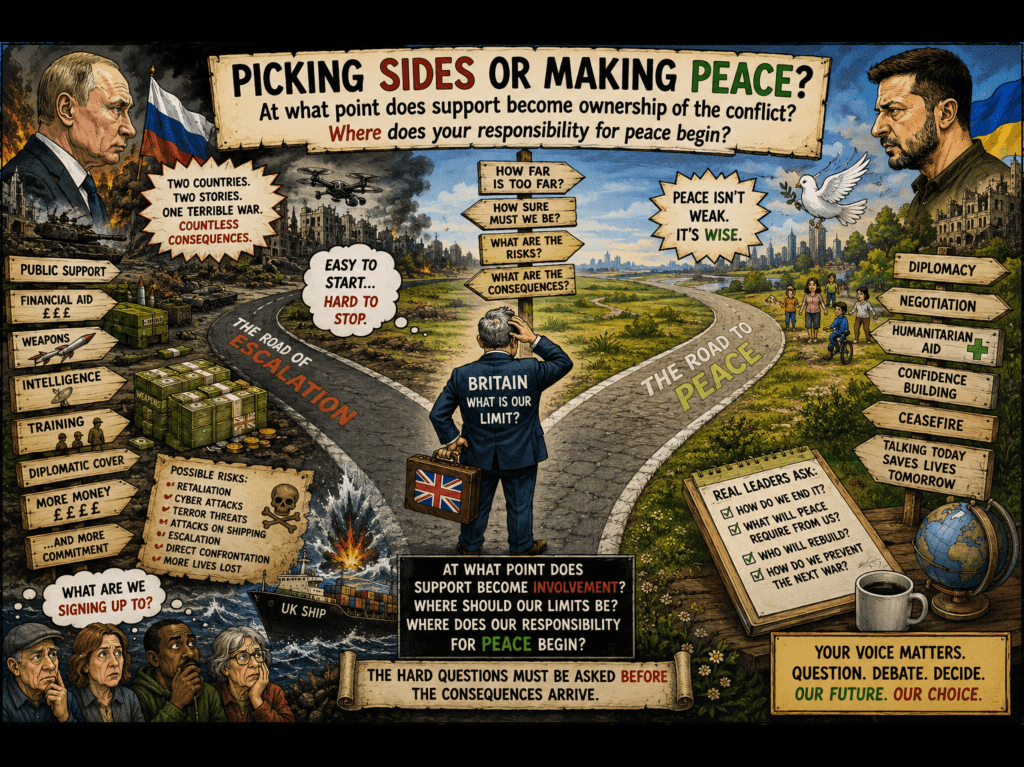
When two countries are locked in a bitter conflict, most people instinctively feel compelled to pick a side. One side tells its story. The other tells theirs.
Politicians, media outlets, commentators, and campaigners quickly divide into camps, each convinced they know who is right and who is wrong.
But here’s a question that deserves far more attention than it receives:
At what point does supporting one side stop being support and start becoming participation?
And equally important: Where does your responsibility for peace begin?
🎭 The World’s Most Expensive Team Sport
Imagine two neighbours involved in a vicious dispute. At first, you sympathise with one of them. Then you defend them publicly. Then you help them financially. Then you provide equipment. Then intelligence. Then training. Then diplomatic backing. Then even more money.
At what stage are you no longer simply observing events?
At what point do you become part of them?
The modern world often presents conflicts as morality plays with heroes and villains neatly assigned from the opening scene.
Pick a side. Wave a flag. Repeat the approved slogans. Ask no difficult questions. But foreign policy isn’t football. There are no trophies for backing the winning team.
There are only consequences.
🚨 How Far Does Support Go?
This is where uncomfortable questions begin. If you support a country politically, does that mean supporting it financially? If you support it financially, does that mean supplying weapons? If you supply weapons, does that mean supplying intelligence? If you provide intelligence, does that mean accepting retaliation?
If your ships are threatened, your businesses targeted, or your citizens placed at risk, what then?
Do you double down?
Do you step back?
Or do you discover that commitments made years earlier have consequences nobody properly explained at the time?
These aren’t questions about loyalty. They’re questions about responsibility.
Because every government has a duty to consider not only what happens if everything goes according to plan—but also what happens if it doesn’t.
🚢 The Question Nobody Wants to Ask
What happens if the conflict expands beyond the assumptions made by politicians?
What happens if commercial shipping becomes a target?
What happens if British-owned vessels operating in international waters find themselves harassed, seized, or threatened because Britain is no longer viewed as a neutral observer?
What happens if actions taken in support of one side create risks for people who never voted for those risks?
Nobody is saying such outcomes are inevitable. But responsible governments plan for possibilities, not certainties. Foreign policy is easy when everything works.
Leadership is measured by how prepared you are when it doesn’t. And the public has every right to ask where the limits are. Because if support continues indefinitely, shouldn’t voters know exactly what obligations come with it?
☮️ Where Does Your Responsibility for Peace Begin?
This may be the most important question of all.
If governments have a responsibility to support allies, do they also have a responsibility to pursue peace? If billions can be found for weapons, can equal effort be found for diplomacy. If leaders can explain how a conflict should continue, can they explain how it ends?
Because every war in history eventually arrives at the same destination.
A negotiating table. The only variable is how many lives are lost before everyone gets there. Peace is rarely popular during war. Compromise rarely earns headlines.nDiplomacy rarely trends on social media.
But history is filled with conflicts that continued long after sensible people should have been asking how to bring them to an end.
The responsibility of government isn’t simply to choose sides.
It is also to recognise the moment when supporting peace becomes just as important as supporting victory.
🔥 Challenges 🔥
So here’s the challenge.
At what point does support become involvement?
Where should a government’s limits be?
How much commitment is too much commitment?
Should there be a clear line between helping an ally and becoming part of the conflict?
And where does a nation’s responsibility for peace begin?
Is it enough to support one side?
Or should governments be working just as hard to create the conditions for peace as they are to sustain the conditions for war?


 Chameleon Magazine
Leave a comment