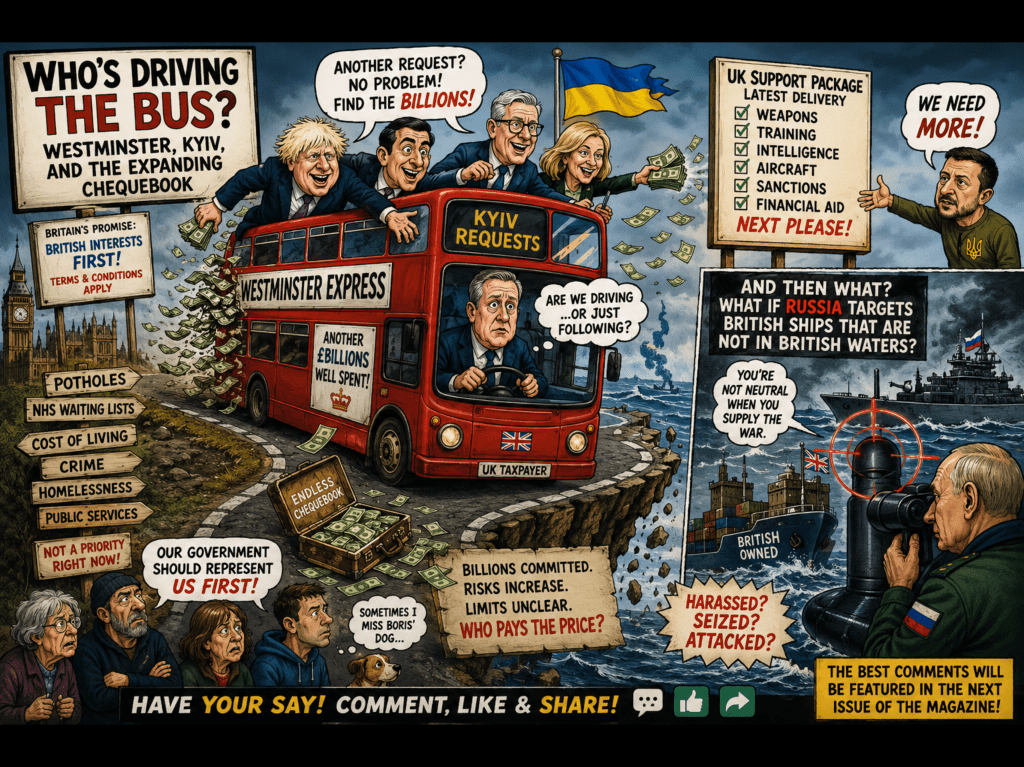
The debate isn’t whether Ukraine is ordering Britain around—it’s whether Britain’s political class has become so eager to answer every request from Kyiv that many voters are starting to wonder who sits behind the steering wheel.
Ukraine, understandably fighting for its survival, asks for weapons, money, training, intelligence, aircraft, sanctions, and more support. That’s exactly what any nation in its position would do. The real question is why British ministers seem to find fresh billions down the back of the Treasury sofa whenever the request arrives, while potholes multiply, public services strain, and taxpayers are told to manage expectations.
🎭 Westminster’s Favourite New Subscription Service
Remember when governments used to explain spending decisions by talking about the national interest? Those were simpler times.
Now it sometimes feels like British politicians are trapped in an endless free trial they forgot to cancel. Another request arrives from Kyiv. Another announcement follows from Westminster. Another minister appears on television explaining why this latest package is absolutely essential, while carefully avoiding questions about whether there might be a limit somewhere beyond the horizon.
To be clear, Ukraine isn’t issuing orders. Nobody is claiming British ministers receive daily instructions from Kyiv via carrier pigeon. But critics increasingly ask whether the relationship has drifted from support into something resembling political autopilot.
The concern isn’t that Ukraine asks for help. Of course it does.
The concern is whether Britain’s leaders have become better at explaining foreign commitments than they are at explaining domestic priorities. 🇬🇧🤔
Supporters argue that resisting Russian aggression protects European security and ultimately benefits Britain. Critics respond that voters keep hearing about strategic necessities abroad while being told to tighten their belts at home.
And that’s where the frustration lives.
Because every government promises to put its own citizens first—right up until another international emergency appears and the cheque book springs mysteriously back to life. 💸✨
But there is another question hovering in the background that rarely receives the attention it deserves.
What happens if Russia decides that countries supplying weapons, intelligence, training, and financial support are no longer merely spectators?
Imagine British-owned merchant ships being harassed, seized, or even attacked in international waters. Not in British territorial waters. Not off the coast of Dover. Somewhere far from home where the response becomes legally, politically, and militarily complicated. Suddenly, the comfortable distance between supporting a war and becoming entangled in one starts to shrink.
Nobody is saying such a scenario is certain. But if ministers are willing to commit billions, equipment, and resources overseas, shouldn’t the public be told where the red lines are? What happens if British commercial vessels become targets? What level of escalation is Britain prepared to accept? At what point does support become direct confrontation?
These aren’t questions asked by Kremlin sympathisers. They’re questions any responsible government should be capable of answering before events force the issue.
Because foreign policy isn’t measured by how many applause lines it generates at international summits. It’s measured by consequences. And consequences have a habit of arriving long after the press conference ends. ⚓🌍💥
Perhaps that’s what bothers many voters most. Not that Britain supports Ukraine. Not even the amount of support itself. It’s the feeling that major decisions with potentially enormous risks are being presented as if they’re self-evident, beyond debate, and immune from scrutiny.
In a democracy, they shouldn’t be.
🔥
Challenges
🔥
So here’s the challenge:
Where should Britain’s line be?
Should the UK continue providing extensive support for as long as necessary? Should there be limits? Should ministers be required to explain the risks of escalation as clearly as they explain the reasons for involvement?
And if British interests, assets, or citizens were directly threatened as a consequence of Britain’s role in the conflict, what response would you expect from the government?
Whatever your view, we want to hear it.
Is Britain acting in its own national interest? Is it helping to protect European security? Or has Westminster become too comfortable signing blank cheques while expecting taxpayers not to ask questions?
💬 Drop your thoughts in the blog comments.
👍 Like it.
🔄 Share it.
🔥 Challenge it.
The sharpest comments, strongest arguments, and best-written responses will be featured in the next issue of the magazine.


 Chameleon Magazine
Leave a comment