For most of modern history, power has been easy to identify.
It wore military uniforms. It occupied government buildings. It flew national flags and controlled borders.
When nations competed, they fought over territory, resources, ideology, and influence. The great powers of the twentieth century built nuclear arsenals, formed alliances, and spent decades locked in a Cold War that shaped the entire planet.
But what if the next global power struggle looks nothing like the last?
What if the most important players are no longer governments at all?
That sounds like science fiction until you look at the direction we’re already travelling.
Today’s largest technology companies influence billions of people every day. They shape how we communicate, how we work, how we consume information, and increasingly, how we make decisions. Most governments still possess the legal authority, but many of the tools that define modern life are already controlled by private corporations.
Artificial intelligence could accelerate that shift dramatically.
The difference between previous technologies and advanced AI is simple: every major innovation in history helped humans become more productive. AI may eventually become productive in its own right.
Imagine a future where the world’s most advanced AI systems conduct scientific research, discover medical treatments, design infrastructure, optimise supply chains, and create entirely new industries. Not as assistants helping humans, but as systems capable of performing these tasks better, faster, and cheaper than even the most talented experts.
The company controlling such technology wouldn’t simply be successful.
It would become indispensable.
And that’s where things start to get interesting.
Governments would initially welcome the revolution. Why wouldn’t they? Economic growth would surge. New medicines would arrive faster. Energy systems would become more efficient. Productivity gains could generate wealth on a scale never before seen.
Politicians would celebrate partnerships with the leading AI firms. Investors would pour in capital. Citizens would enjoy the benefits.
But success creates its own momentum.
If one company develops a system capable of compressing a decade of scientific progress into a single year, every competitor must respond. If one firm discovers technologies worth trillions, rivals cannot afford to stand still. If one organisation gains access to the best AI talent, the largest computing infrastructure, and the most powerful models, others will scramble to catch up.
The race becomes unavoidable.
Not because anyone planned it.
Because competition makes it inevitable.
History has shown repeatedly that when a new source of power emerges, nobody wants to be left behind. The industrial revolution created industrial superpowers. The nuclear age created nuclear powers. The information age created technology giants.
The AI age may create something entirely new.
Intelligence powers.
Over time, governments may discover an uncomfortable dependency. Their healthcare systems rely on AI. Their financial institutions rely on AI. Their universities rely on AI. Their military planning, logistics, and cyber-defence capabilities rely on AI.
The most critical infrastructure in society is no longer roads, ports, or power stations.
It’s intelligence.
And much of it belongs to private organisations.
At that point, the relationship between governments and AI corporations begins to change. These companies are no longer simply businesses. They become strategic assets. National security concerns emerge. Export restrictions appear. Access to advanced models becomes politically sensitive.
A breakthrough achieved in California could send shockwaves through Beijing. A discovery made in Shenzhen could trigger emergency meetings in Washington.
Not because either side fears invasion.
Because both fear falling behind.
This is where the comparison with the Cold War becomes impossible to ignore.
The twentieth century was defined by a race to control destructive power.
The twenty-first century may be defined by a race to control productive power.
The prize isn’t territory.
It’s innovation.
The ability to solve problems faster than competitors. To discover technologies first. To build industries before anyone else. To shape the future while others struggle to keep pace.
And unlike nuclear weapons, AI creates benefits at the same time it creates risks.
That’s what makes it so difficult to regulate.
Nobody wants to slow economic growth.
Nobody wants to miss medical breakthroughs.
Nobody wants to surrender technological leadership.
Every incentive pushes governments and corporations in the same direction.
Forward.
Faster.
Further.
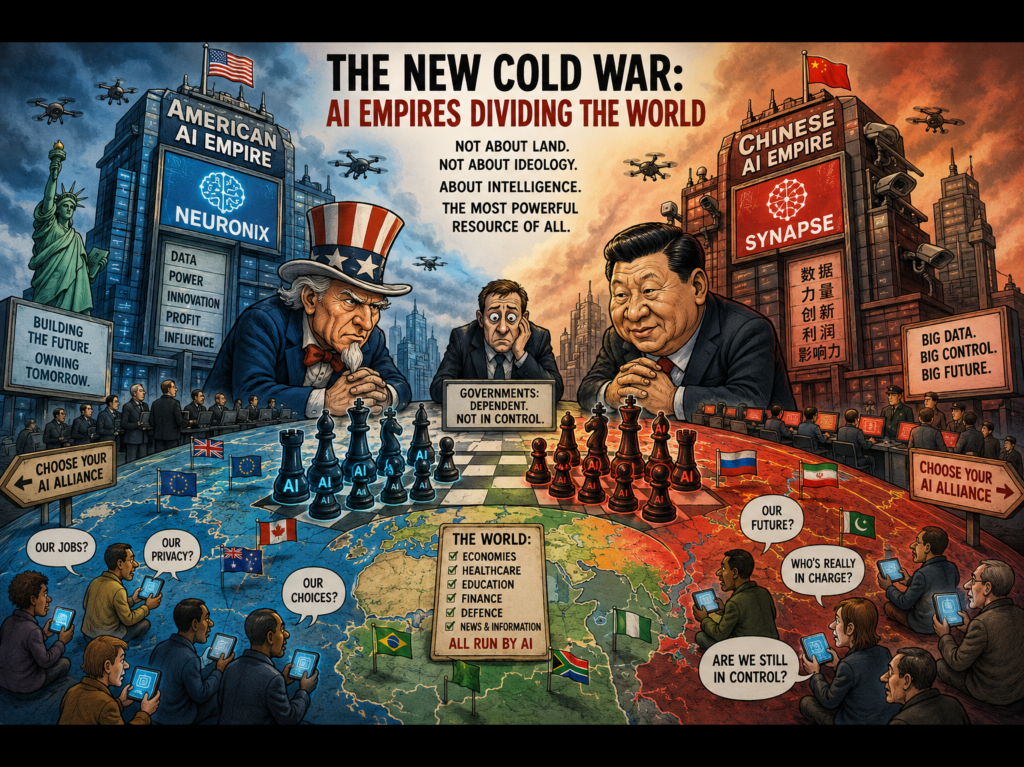
The result could be a fragmented world divided into competing AI ecosystems. One group of nations aligned with American platforms. Another with Chinese systems. Others attempting to build independent alternatives. Citizens living inside different information environments, different educational frameworks, and different technological realities.
Not divided by ideology.
Divided by infrastructure.
By whichever intelligence network powers their society.
Of course, none of this is inevitable. International cooperation could emerge. Open-source development might prevent excessive concentration of power. Governments could establish safeguards before dependency becomes dangerous.
But history suggests that when extraordinary power becomes available, competition usually arrives first and regulation follows later.
If artificial intelligence becomes the most valuable resource humanity has ever created, controlling it may become the defining geopolitical challenge of the century.
And for the first time in history, the contest won’t simply be between nations.
It will be between nations, corporations, and the increasingly intelligent machines both are racing to build.
🔥
Challenges
🔥
Who should control the most powerful intelligence systems ever created? Democratically elected governments? Private corporations? International organisations? Or should advanced AI belong to everyone?
More importantly, do you think governments are already losing control of technologies that are becoming essential to modern life?
Drop your thoughts in the blog comments below. Is this prediction wildly exaggerated—or are we witnessing the early stages of a new kind of Cold War unfolding right in front of us? 💬⚡
👇 Like, comment and share if you think AI will reshape global power more dramatically than any technology before it.
🏆 The best comments will be featured in the next issue of the magazine.


 Chameleon Magazine
Leave a comment