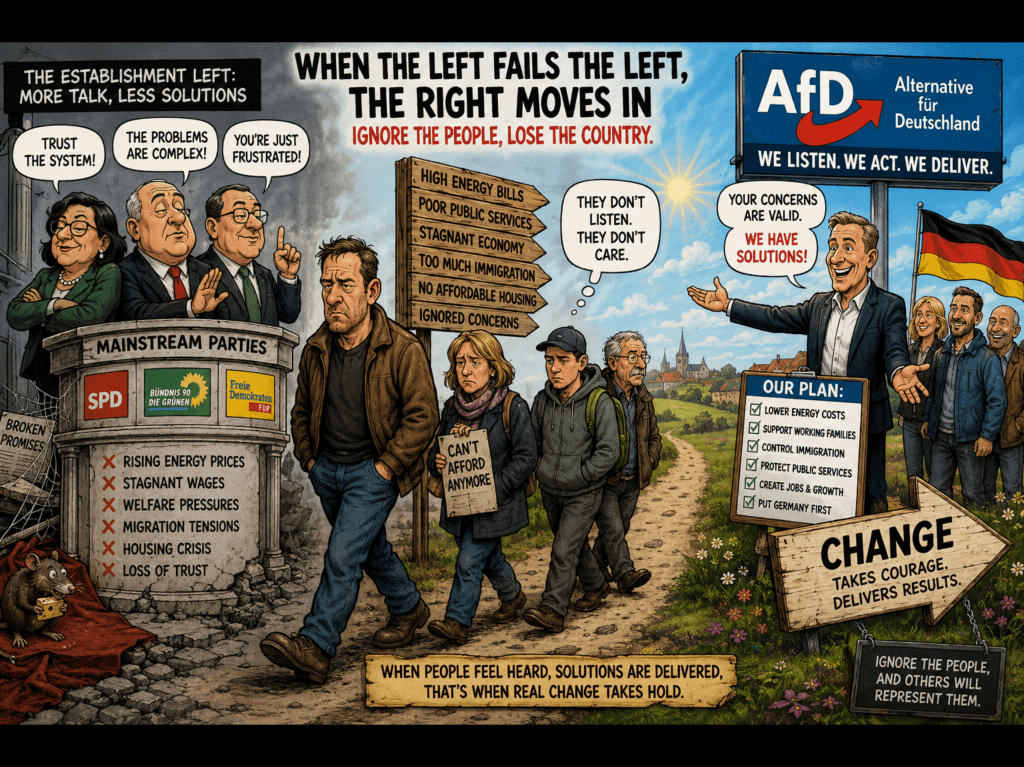
Germany is discovering a political lesson that much of the Western world has already learned the hard way.
When ordinary people feel ignored, someone else will listen.
For years, German voters have been told that rising energy bills, struggling public services, stagnant wages, housing pressures, and concerns over migration were either temporary problems or concerns they shouldn’t worry about too much.
Many weren’t convinced.
Now they’re voting accordingly.
🏛️ The Vacuum Nobody Wanted to Fill
The rise of Alternative for Deutschland (AfD) didn’t happen in a vacuum.
Political vacuums never stay empty for long.
Across large parts of Germany—particularly in the former East—many voters increasingly feel that the parties traditionally claiming to represent workers and ordinary families have become more interested in managing narratives than solving problems.
When people raise concerns about jobs, living costs, crime, housing shortages, or migration pressures, they don’t necessarily want lectures.
They want solutions.
And when those solutions fail to arrive, voters start looking elsewhere.
That’s the uncomfortable truth many establishment politicians refuse to acknowledge.
The far Right doesn’t grow because everything is working.
It grows because large numbers of people believe nothing is working.
📉 High energy costs.
📉 Sluggish economic growth.
📉 Rising welfare pressures.
📉 Growing migration tensions.
The more these issues linger unresolved, the more credibility drains away from those in power.
Nature abhors a vacuum.
Politics does too.
🔥 Ignore Problems, Create Opportunities
For decades, mainstream parties across Europe assumed voters had nowhere else to go.
That assumption is now being tested.
In Germany, AfD’s surge isn’t simply a story about ideology.
It’s a story about trust.
Millions of voters aren’t necessarily embracing every aspect of the party’s platform.
Many are simply voting against a political establishment they believe has stopped listening.
And here’s the part that should worry every mainstream party:
If alternative parties eventually succeed in delivering solutions that voters can actually see and feel, that’s when political change becomes permanent.
Protest votes can come and go.
Results are what reshape history.
If voters believe a new political movement has succeeded where traditional parties failed, the old order doesn’t just lose an election.
It loses its legitimacy.
⚡ That’s when temporary frustration becomes lasting realignment.
⚡ That’s when political earthquakes happen.
⚡ That’s when entire countries change direction.
💥 The Warning Germany Can’t Ignore
The lesson isn’t really about Germany.
It’s about every democracy facing the same pressures.
When governments fail to address the concerns of working people, those concerns don’t disappear.
When mainstream parties stop representing the people they were created to serve, someone else steps forward.
The question isn’t whether voters will demand change.
The question is who will deliver it.
Because history repeatedly shows that when the Left abandons its traditional voters, the Right doesn’t need to win them over.
It simply needs to be the only side still listening.
🔥 Challenges 🔥
Are voters abandoning traditional parties—or have traditional parties abandoned their voters first?
Can Germany’s political establishment rebuild trust before the next election, or has the shift already become unstoppable?
Drop your views in the blog comments below. 💬👇
Like, share, and join the debate.
The best comments will be featured in the next issue of the magazine. 🏆📝


 Chameleon Magazine
Leave a comment