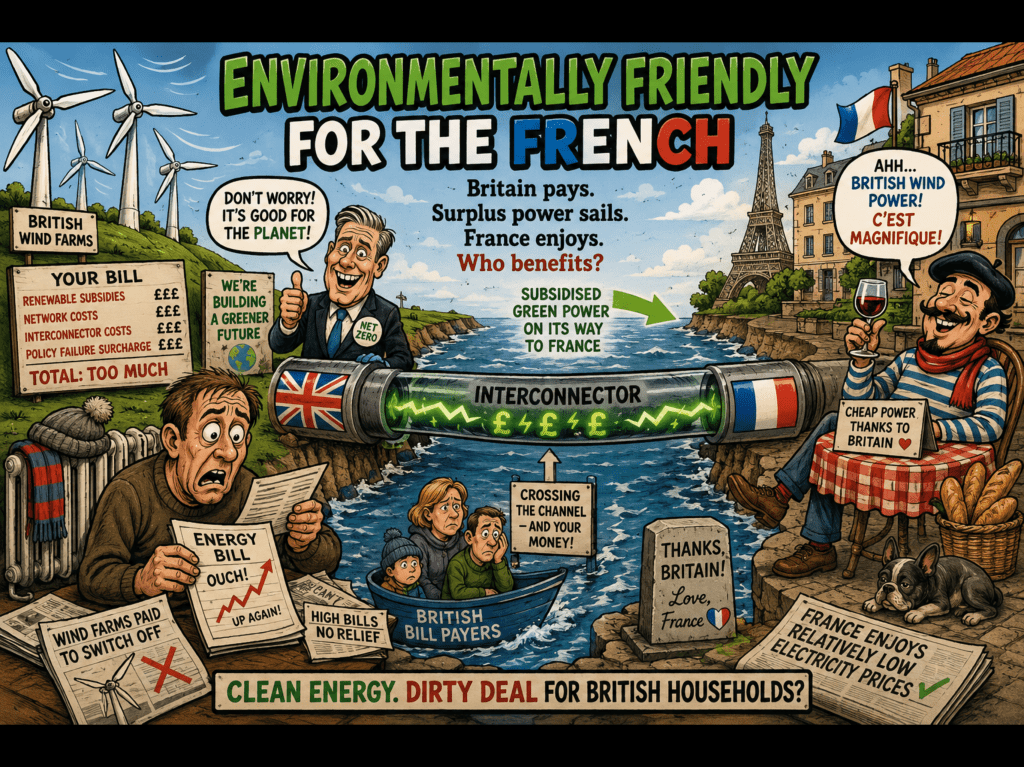
British households are being told to tighten their belts, embrace net zero, and pay ever-rising energy costs for the good of the planet. Meanwhile, critics say some of that heavily subsidised green electricity is flowing across the Channel, helping keep French homes powered while UK families wonder whether boiling a kettle now counts as a luxury purchase. 🌍💸
What was sold as an environmental revolution is increasingly being portrayed as an international generosity programme—funded by British bill payers and enjoyed by whoever happens to be plugged into the nearest European socket.
🥐 “Merci Beaucoup, Britain!” – The Great Green Giveaway
Imagine buying your neighbour a solar panel, paying their electricity bill, and then being thanked with a shrug and a croissant. That’s roughly how opponents describe the current situation.
Britain spends billions supporting renewable energy generation. Wind farms receive subsidies, consumers absorb the costs, and when the grid can’t efficiently use all the electricity being produced, some of it heads abroad through interconnectors. 🚢⚡
Supporters insist this is perfectly sensible. Electricity markets are interconnected. Surplus power should be exported rather than wasted. Energy security improves when countries can help each other during shortages.
Fair enough.
But critics are asking a rather awkward question: if Britain is paying wind farms to generate electricity and sometimes paying them to stop generating electricity because the grid can’t cope, why are ordinary households still facing eye-watering energy bills while subsidised power heads overseas? 🤔📈
To many people, it feels like being charged for a takeaway that gets delivered to someone else’s house.
And nowhere captures the frustration better than France—a country famous for nuclear power, cheap electricity, and now, according to critics, occasionally benefiting from Britain’s expensive green energy experiment. 🇫🇷💡
While British consumers are lectured about sacrifice for the climate, some wonder whether they’ve accidentally become Europe’s energy charity.
🔥Challenges🔥
If Britain is producing more renewable electricity than it can use, should the priority be exporting it—or fixing the grid and building storage so British consumers see the benefit first? ⚡🏗️
Are interconnectors a smart part of a modern energy system, or are taxpayers being asked to bankroll a green giveaway while their own bills remain painfully high?
We want your verdict. Is this sensible energy policy or another example of ordinary households picking up the tab while politicians celebrate targets and foreign consumers enjoy the rewards? 💬🔥
👇 Comment on the blog, like, and share this post. Tell us whether Britain’s green revolution is powering the future—or just powering France.
🏆 The best comments, hottest takes, and sharpest observations will be featured in the next issue of the magazine.


 Chameleon Magazine
Leave a comment