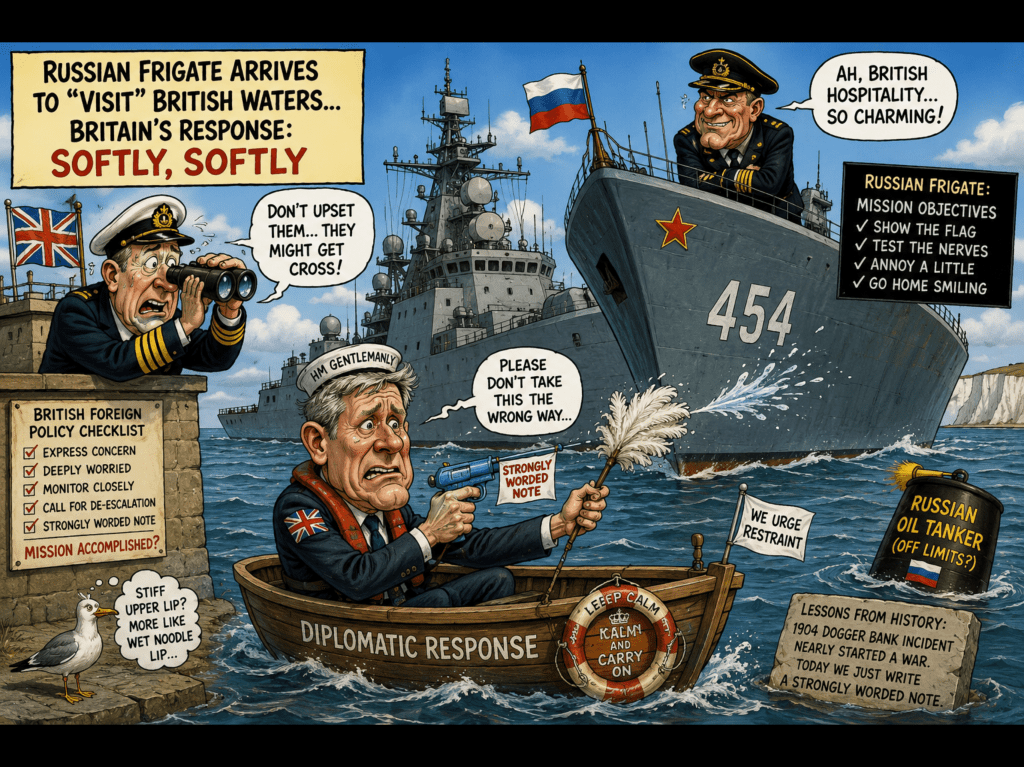
🇬🇧🇷🇺When a Russian frigate appears on the horizon and tensions start bubbling in British waters, you might imagine a firm response from a nation that once ruled the waves. Instead, Britain often seems to reach for its favourite weapon: a strongly worded statement, a diplomatic frown, and perhaps an emergency shipment of feather dusters. 🪶
The apparent logic goes something like this: if Britain acts too firmly against Russian-linked shipping, Moscow might become annoyed. If Moscow becomes annoyed, things could escalate. Therefore, the safest option is to spend several weeks looking concerned while explaining why looking concerned is actually a sophisticated strategic doctrine. 🤔
⚓ The Royal Navy’s New Motto: “Careful Now, We Might Upset Someone”
Critics argue that Britain has become trapped in a cycle of caution. Every incident is treated like a priceless antique vase that must not be touched.
Russian vessel enters the picture? Observe.
Provocative manoeuvre? Monitor.
Aggressive posturing? Assess.
National frustration? Commission a report.
By the time the paperwork is complete, everyone involved has retired, written memoirs, and appeared on a panel discussion explaining why nothing happened. 📚☕
The argument from government circles is that restraint prevents escalation with a nuclear power. Fair enough. Nobody sensible wants a military confrontation.
But there is a growing public perception that “restraint” sometimes looks suspiciously like “waiting for someone else to deal with it.”
If the theory is that seizing or disrupting an oil tanker would somehow trigger the apocalypse, then surely the arrival of every Russian naval vessel cannot be treated like the appearance of a mythical dragon that must never be disturbed. 🐉
At some point, deterrence has to involve something more convincing than another press conference featuring the phrase “we are monitoring the situation closely.”
🔥Challenges🔥
Has Britain mastered the art of strategic patience—or simply perfected the performance of looking busy while doing very little?
When does restraint become hesitation?
When does caution become weakness?
And if every provocation is met with another carefully crafted statement, what incentive is there for provocations to stop?
💬 Drop your thoughts in the blog comments and tell us where you think the balance should be between avoiding escalation and showing strength.
👍 Like it, 🔄 share it, and 💥 challenge the argument if you disagree.
The best comments will be featured in the next issue of the magazine.


 Chameleon Magazine
Leave a comment