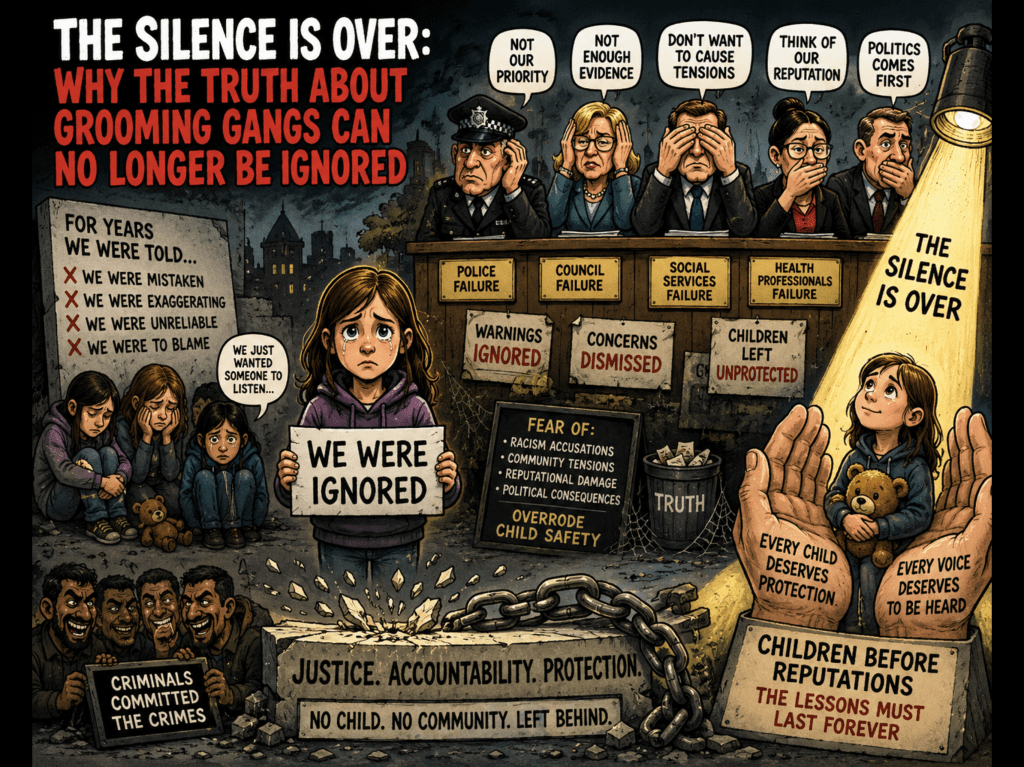
🚨For years, victims were treated like the problem rather than the evidence.
They were told they were confused. Misremembering. Exaggerating. Seeking attention.
Meanwhile, the adults whose job descriptions literally included the words protect children appeared to be competing in an Olympic event called Extreme Looking the Other Way. 🏅🙈
Today, after inquiries, investigations, criminal convictions, and mountains of official reports, the stories victims spent years desperately trying to tell have been confirmed.
Not because politicians discovered courage.
Not because institutions suddenly developed functioning ears.
But because the evidence became impossible to ignore.
🚪 The Great Institutional Escape Act 🎭
Imagine a building filled with police officers, social workers, managers, councillors, safeguarding teams, and public officials.
Now imagine warning lights flashing everywhere. 🚨
Children reporting abuse.
Parents raising concerns.
Frontline workers sounding alarms.
Evidence accumulating.
And yet somehow, instead of rushing to protect vulnerable children, parts of the system appeared to become trapped in an endless committee meeting about optics, reputations, paperwork, and public relations.
The result?
Children remained in danger while professionals debated how uncomfortable the truth might be.
Some feared accusations of prejudice.
Some feared political fallout.
Some feared community tensions.
Others simply failed to do their jobs properly.
Whatever the reason, the outcome was devastatingly simple:
The people who needed protection most often received the least.
And when victims spoke up, many were met not with support but suspicion.
Because apparently, in some corners of bureaucracy, protecting a department’s reputation ranked higher than protecting a child. 🤦♂️📉
The lesson isn’t that entire communities should be blamed for the crimes of individuals.
That lazy shortcut helps nobody.
Criminals are responsible for their crimes.
Institutions are responsible for their failures.
And both truths can exist at the same time.
What these scandals exposed wasn’t simply criminal behaviour.
They exposed what happens when fear, incompetence, denial, and career preservation become more important than safeguarding vulnerable children.
That’s not a political failure.
That’s a moral one.
🔥Challenges🔥
Here’s the uncomfortable question:
How many warning signs does a system need before it finally acts?
What should accountability actually look like when institutions fail children for years?
And have the lessons truly been learned—or are we simply hoping history won’t repeat itself?
💬 Tell us what you think in the blog comments. Not on social media. Not in somebody else’s thread. Join the discussion where the conversation matters.
👇 Like, comment, and share if you believe protecting children should always come before protecting reputations.
🏆 The strongest, sharpest, and most thought-provoking comments will be featured in the next issue of the magazine.


 Chameleon Magazine
Leave a comment