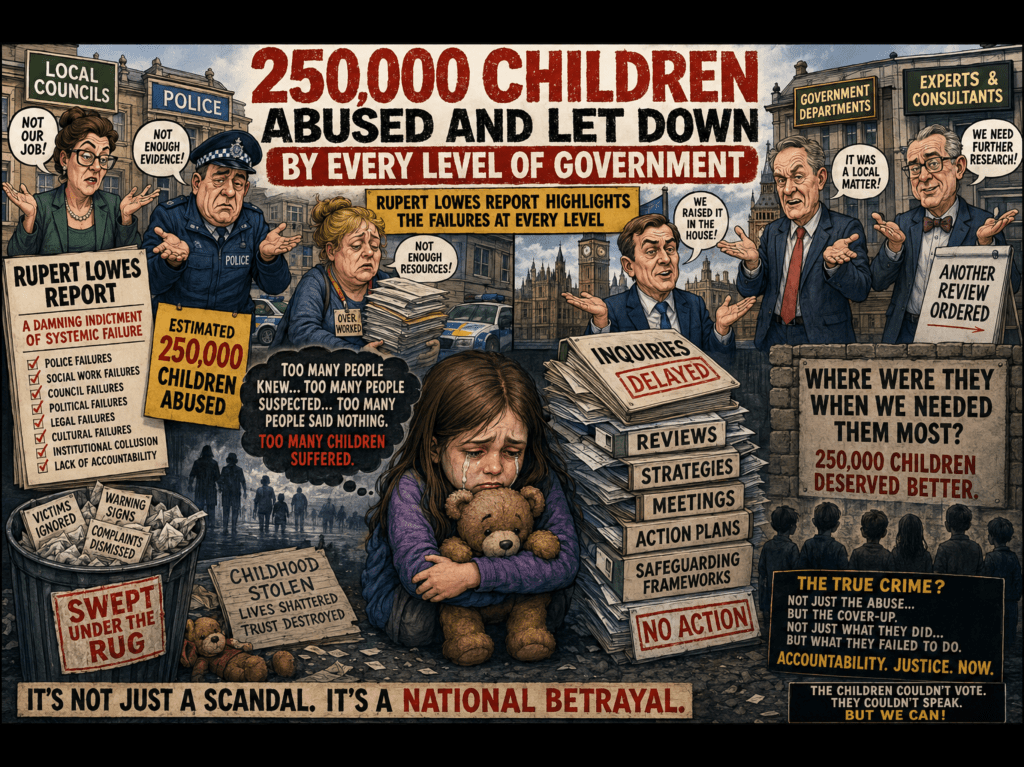
🚨💔A report highlighted by politician Rupert Lowe has reignited outrage over child sexual exploitation in Britain, alleging that as many as 250,000 children were abused while institutions repeatedly failed to act. If true, the scale is almost impossible to comprehend. Yet what makes the allegations even more disturbing is not simply the abuse itself—it is the claim that failures occurred across government, policing, social services, local authorities, and the political establishment. 🏛️⚠️
For decades, vulnerable children were supposedly protected by layer upon layer of safeguarding systems. The uncomfortable question now being asked is simple: if all those systems existed, where exactly were they when they were needed most? 🤔
🏛️ The Great British Passing-The-Buck Olympics🏅🙈
Every institution appears to have its own explanation.
The politicians commissioned reviews. 📑
The councils held meetings. ☕
The police opened investigations. 🚔
The social workers completed paperwork. 📋
The experts wrote reports. 🖊️
The committees launched inquiries. 🔍
And somehow, amid all the bureaucracy, the children themselves seemed to disappear from the conversation.
Britain may have accidentally invented a new Olympic sport: Competitive Responsibility Avoidance. Gold medals all round. 🥇🥇🥇
Whenever questions emerged, somebody else was apparently responsible. The council blamed the police. The police blamed resources. Politicians blamed previous administrations. Agencies blamed communication failures. Before long, accountability had become the hottest game of pass-the-parcel in the country.
Meanwhile, victims were left waiting for answers that often never came.
What makes the allegations so explosive is that they challenge the very institutions that citizens are told to trust. If safeguarding systems can fail repeatedly, over many years, and across multiple organisations, then the public is entitled to ask whether those systems are fit for purpose at all. ⚖️🔥
Because safeguarding isn’t measured by the number of meetings held. It’s measured by the number of children protected.
And that is where the real questions begin.
🔥 Challenges 🔥
If the allegations are correct, how did so many warning signs go unheeded for so long?
Why were institutions seemingly better at protecting themselves than protecting vulnerable children?
Should there be a full national reckoning, with genuine accountability for those who failed in their duties, regardless of rank, title, or position?
💬 We want to hear your views in the blog comments.
👇 Comment, like, and share this article. Join the debate and tell us whether Britain has learned the lessons of the past—or whether the same failures are still being repeated today.
🏆 The strongest comments and most thought-provoking contributions will be featured in the next issue of the magazine.


 Chameleon Magazine
Leave a comment