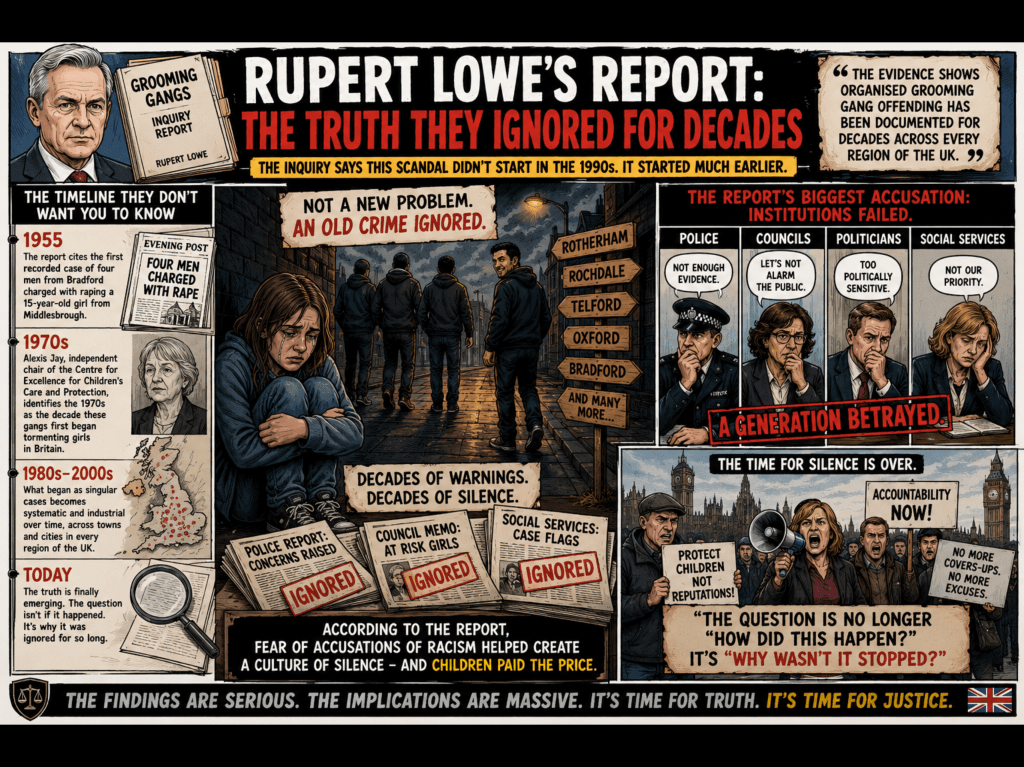
⚠️📖Most people believe Britain’s grooming gang scandal began in places like Rotherham, Rochdale and Telford.
According to Rupert Lowe’s grooming gangs inquiry, they’re wrong.
Very wrong.
The report argues that organised rape gangs involving Pakistani men were not a phenomenon discovered in the 1990s, 2000s or even the 1970s.
Instead, the inquiry claims evidence can be traced back to 1955, when four Bradford-based Pakistani men were reportedly charged with raping a 15-year-old girl from Middlesbrough.
If the report is correct, Britain hasn’t spent decades failing to solve the problem.
Britain has spent decades failing to acknowledge how long the problem has existed.
⏳ Not A New Scandal—An Old One Ignored
One of the report’s most striking conclusions is that what began as isolated incidents evolved into something systematic over time.
The inquiry argues that the issue was not confined to one town, one city or one region.
Instead, it claims exploitation networks emerged across multiple parts of the country over several generations.
The implication is explosive.
If the evidence presented in the report is accurate, then this is not simply a story of criminal gangs.
It is a story of repeated institutional failure stretching back decades.
🤐 The Question Nobody Wanted To Ask
The report argues that one of the reasons the problem was not confronted earlier was a reluctance to discuss the ethnic and cultural background of offenders.
Supporters of the report argue that avoiding uncomfortable facts prevented effective intervention.
Critics argue that broad conclusions about communities require particularly strong evidence.
Either way, the report is asking a question that many politicians, police forces and public bodies have spent years trying to avoid:
What happens when institutions become more concerned about accusations than outcomes?
According to Rupert Lowe’s inquiry, the answer was devastating.
🏛️ The Bigger Allegation
The report’s most serious accusation is not aimed at the perpetrators.
It is aimed at the institutions.
Police.
Councils.
Social services.
Politicians.
Regulators.
The inquiry argues that warning signs existed for decades and that opportunities to act were repeatedly missed.
That is the allegation that should make every taxpayer sit up and pay attention.
Because criminals committing crimes is tragic.
Institutions failing to stop them is unforgivable.
💥 The Report’s Real Challenge
Whether readers agree with every conclusion or not, Rupert Lowe’s inquiry presents a direct challenge to Britain’s political establishment.
It argues that the country did not stumble blindly into this scandal.
It argues that warning signs were visible for years.
And if that is true, then the biggest question is no longer:
“How did this happen?”
It’s:
“Why wasn’t it stopped?”
🔥 Challenges 🔥
Rupert Lowe’s report claims the roots of Britain’s grooming gang scandal stretch back far further than most people realise.
Do you think Britain has had an honest conversation about these failures?
Were difficult questions avoided for too long?
And if institutions knew more than they admitted, who should be held accountable?
💬 Drop your thoughts in the blog comments below.
👇 Like, comment and share.
🏆 The best comments will be featured in the next issue of the magazine.


 Chameleon Magazine
Leave a comment