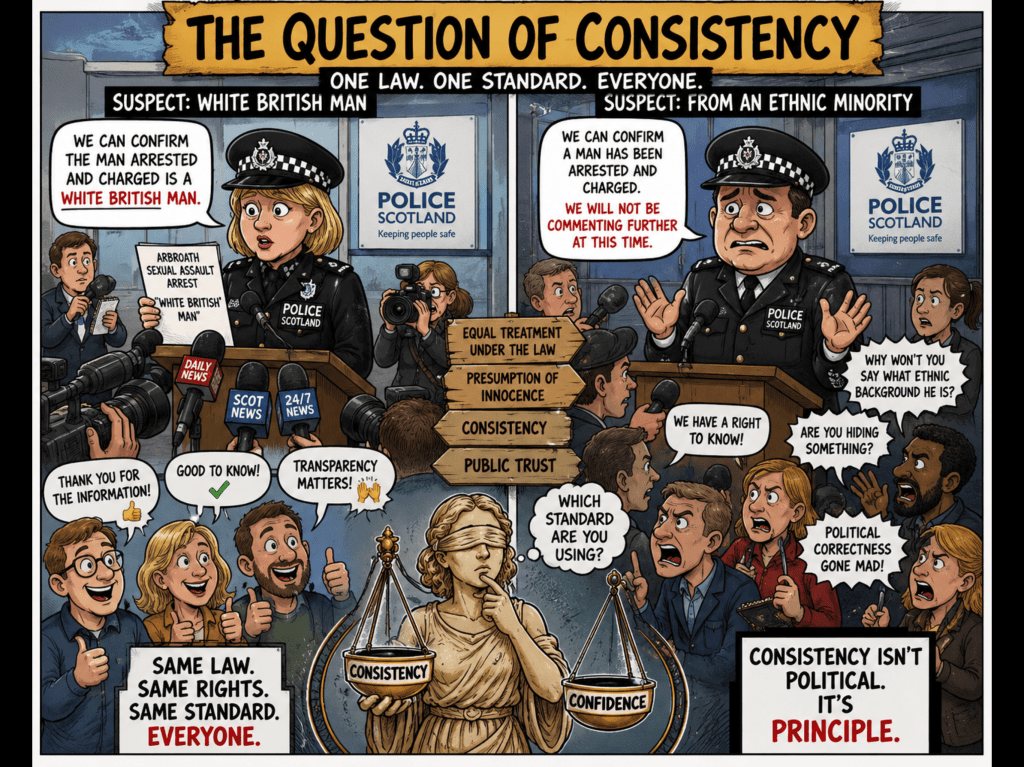
🎭⚖️A Police Scotland statement concerning a serious sexual assault in Arbroath identified the accused as a “white British man.” That simple description has sparked a much larger question—one that goes far beyond a single case.
Why is race or ethnicity sometimes treated as essential information, while at other times it appears to vanish from official reporting altogether? 🤔
Most people aren’t asking for special treatment. They’re asking for equal treatment. The law doesn’t change depending on someone’s skin colour, background, or heritage. A person is either charged or they are not. Convicted or they are not. Innocent until proven guilty remains the foundation upon which British justice stands. 🏛️
Yet many members of the public increasingly feel they’re watching two different rulebooks being applied depending on who’s involved.
🚦 One Rulebook or Two? The Great Reporting Lottery
Here’s where things get awkward.
When a suspect is described as white and British, those details often appear in headlines and police statements without attracting much discussion. But when suspects come from other ethnic backgrounds, suddenly the conversation shifts. Questions emerge. Debates begin. Editors hesitate. Officials tread carefully. Eggs are walked on. Entire chicken farms are tiptoed through. 🥚🚶
The result?
A growing perception that information is being filtered through a political sensitivity detector before reaching the public.
Now, perception isn’t always reality. But institutions ignore public perception at their peril. Trust doesn’t collapse overnight—it erodes one unanswered question at a time. 📉
If race genuinely helps identify a suspect, locate a missing person, assist witnesses, or protect public safety, then the principle should apply equally to everyone. If it isn’t relevant, then perhaps it shouldn’t be highlighted at all.
What becomes difficult to defend is a system that appears to decide relevance based on who the suspect happens to be.
It’s a bit like a referee who insists the rules are identical for both teams while blowing the whistle for only one side. Eventually, the crowd notices. And once the crowd starts questioning the referee, confidence in the entire game begins to suffer. ⚽🎯
The bigger issue isn’t race. It’s consistency.
Because if authorities cannot clearly explain why certain details are reported in some cases but omitted in others, they shouldn’t be surprised when people start drawing their own conclusions.
And history suggests that public trust is rarely strengthened by unanswered questions.
🔥Challenges🔥
Here’s the challenge:
Can institutions clearly explain when race is relevant and when it isn’t? Can they apply that standard consistently regardless of the suspect’s background? And if they already have such a policy, why do so many people believe they’re seeing something different?
💬 We want to hear your view.
Should race always be reported? Never reported? Or only reported under specific circumstances that apply equally to everyone?
👇 Drop your thoughts in the blog comments. Like, share, and join the debate.
🏆 The sharpest comments, strongest arguments, and most thought-provoking responses will be featured in the next issue of the magazine.


 Chameleon Magazine
Leave a comment