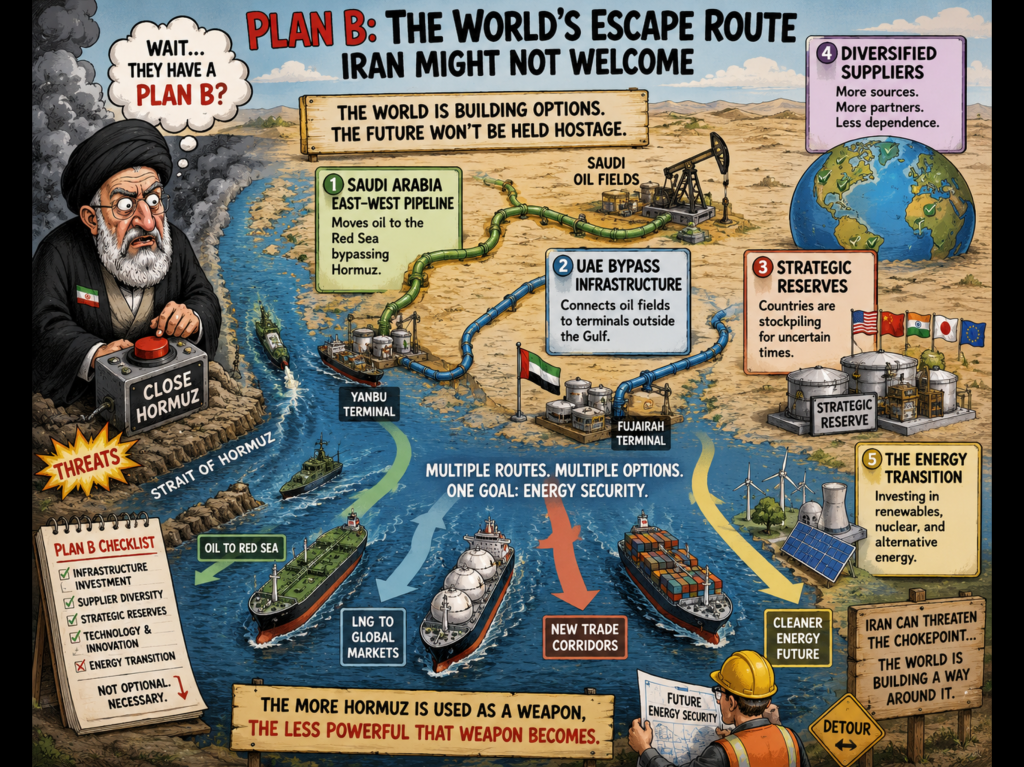
The latest Hormuz showdown isn’t just rattling oil markets—it’s forcing governments, investors, and energy giants to confront an uncomfortable reality: maybe betting the global economy on a narrow strip of water repeatedly featured in geopolitical crisis bingo wasn’t the masterstroke everyone thought it was. 🎯🌍
For decades, the Strait of Hormuz has been the world’s energy superhighway. Tankers glide through, economies hum along, and politicians periodically threaten to set fire to the instruction manual. But while markets can tolerate risk, they absolutely detest uncertainty. And uncertainty is now being served in industrial quantities. 📈😬
🛢️ The World’s Most Expensive Game of “What If?” 🤔💰
Every time Hormuz dominates the headlines, boardrooms from London to Singapore start asking awkward questions.
What if the route closes for a week?
What if it closes for a month?
What if insurance costs explode?
What if our entire business model is balanced on a geopolitical tightrope suspended over a barrel of crude oil? 🎪🛢️
The irony is that the response is already underway.
Saudi Arabia is expanding alternative routes to the Red Sea. The UAE has invested heavily in infrastructure that bypasses the strait. Strategic reserves are growing. Importers are diversifying suppliers. Renewable energy, nuclear power, and alternative technologies suddenly look a little more attractive every time another Hormuz crisis erupts. ⚡☢️🌞
Nobody is abandoning Hormuz tomorrow.
The problem for Tehran is that nobody needs to.
Infrastructure shifts happen slowly—until suddenly they don’t.
The Strait remains one of the cheapest and most efficient energy corridors on Earth. Replacing it entirely would require colossal investment, political will, and years of construction. But every threat nudges another investor, another government, and another energy executive toward the same conclusion:
“Maybe we should have a backup plan.” 📋🚨
And history suggests that once enough people start making backup plans, the future starts arriving faster than expected.
It’s a bit like owning the only bridge into town and charging tolls for decades—then repeatedly threatening to blow the bridge up yourself. Eventually, someone builds a second bridge. 🌉😂
That is the strategic gamble at the heart of the current crisis.
Using Hormuz as leverage may create pressure today. But every time that card is played, the rest of the world gains another reason to reduce its dependence on it tomorrow.
The ultimate irony could be brutal.
The more frequently Hormuz is used as a geopolitical weapon, the less valuable that weapon eventually becomes. 📉🚢
Because once businesses spend billions preparing for a world without Hormuz, they’re unlikely to forget the lesson.
And that’s the billion-dollar question echoing through energy markets right now:
🛢️ What happens to our business if Hormuz is unavailable for thirty days?
The companies that can answer that question today may dominate the next decade.
The ones that can’t may discover that building an empire around a geopolitical chokepoint is rather like constructing a luxury mansion on the side of an active volcano because the sunsets are spectacular. 🌋🏠
Looks fantastic.
Right up until it doesn’t. 🔥😳
🔥Challenges🔥
Here’s the challenge: has the world become too dependent on a handful of strategic chokepoints controlled by unstable politics and unpredictable actors? Or is the threat of disruption being exaggerated for headlines and market panic?
Drop your thoughts in the blog comments. Tell us whether Hormuz remains indispensable—or whether the world’s energy future is already quietly moving around it. 💬🌍
👇 Like, comment, and share if you think the biggest threat to global energy isn’t oil shortages—it’s complacency.
🏆 The best comments, hottest takes, and sharpest observations will be featured in the next issue of the magazine.


 Chameleon Magazine
Leave a comment