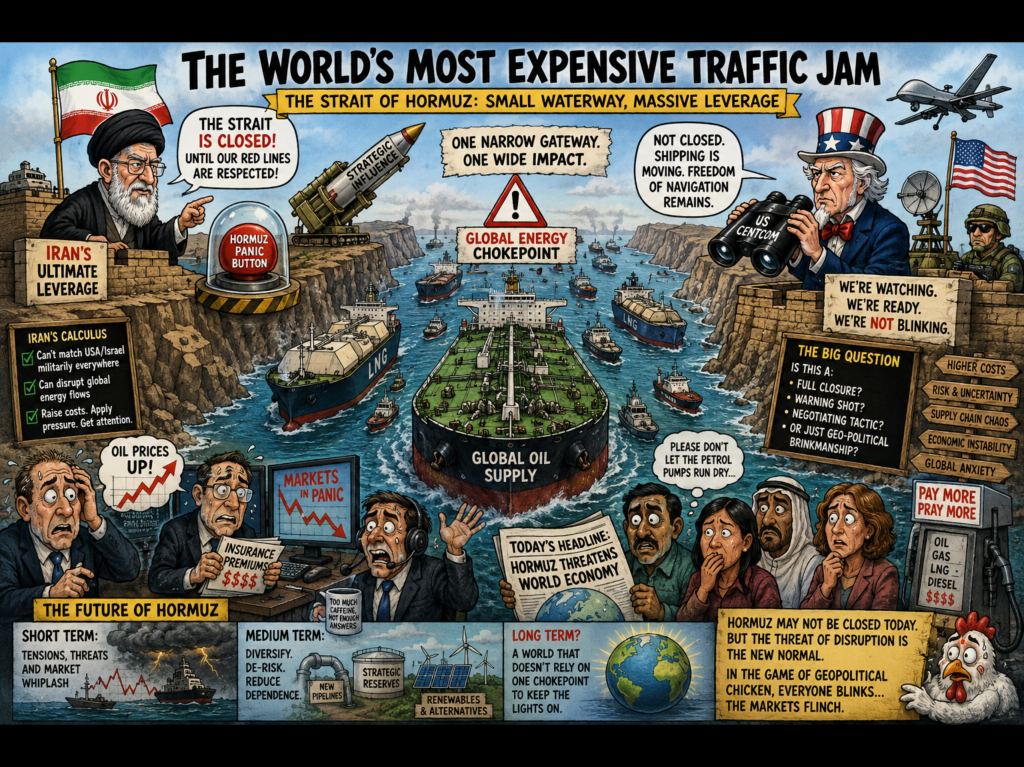
Iran says the Strait of Hormuz is closing. The United States says shipping is still moving. Oil traders are clutching spreadsheets, insurers are reaching for aspirin, and the rest of the world is trying to figure out whether this is a blockade, a warning shot, or the geopolitical equivalent of someone dramatically announcing they’re leaving a WhatsApp group while continuing to post messages. 📱💥
One thing everyone agrees on: when tensions rise in the Middle East, the Strait of Hormuz suddenly becomes the most valuable stretch of water on Earth.
🌍 Welcome to the Global Economy’s Panic Button 🎯💰
Imagine if the entire world’s fuel supply had to squeeze through a motorway service station exit at rush hour. That’s Hormuz.
Iran knows it can’t always compete tank-for-tank or jet-for-jet with larger military powers. What it does possess is a strategic location capable of sending shockwaves through energy markets faster than a politician can deny yesterday’s statement. 📈😬
The message from Tehran appears simple: if military pressure continues, economic pressure can follow.
Iranian officials have linked recent threats and restrictions to ongoing regional hostilities and what they describe as continued violations of ceasefire arrangements. Meanwhile, Washington insists commercial shipping is still flowing and that freedom of navigation remains intact.
In other words, one side is shouting “The road is closed!” while the other is waving traffic through and insisting everything is perfectly normal. 🚦🤷
The truth, as usual, sits somewhere between the press releases.
Every threat to Hormuz pushes up risk calculations, insurance premiums, shipping costs, and market anxiety. Even if tankers continue moving, the mere possibility of disruption is enough to make traders sweat through expensive suits. 💸🥵
And that’s the genius—and danger—of the strategy.
You don’t necessarily have to close the world’s most important energy chokepoint.
Sometimes you just have to remind everyone that you could.
For Iran, Hormuz remains the ultimate leverage point. When conventional military options are limited, the ability to threaten a route carrying a significant share of the world’s oil and liquefied natural gas exports becomes a remarkably powerful bargaining chip. Every government, investor, shipping company, and energy importer pays attention the moment the strait enters the headlines.
The challenge for Tehran is that leverage cuts both ways. A prolonged closure would not only impact Western economies but would also affect major energy customers across Asia and potentially invite a far broader international response than Iran may wish to provoke.
Which raises a fascinating question:
Is this about shutting the strait, or simply reminding the world who controls one of its most important gateways?
🔮 The Future of Hormuz: The Chokepoint That Refuses to Lose Relevance 🚢⚠️
The bigger question isn’t whether the Strait of Hormuz is fully closed today.
It’s whether the world is entering an era where the threat of closure becomes the new normal.
For decades, Hormuz has been the geopolitical equivalent of a giant red emergency button covered by a glass case marked “Do Not Press.” Every regional crisis seems to bring another hand hovering over it. 🖐️🔴
What we’re witnessing may be less about a single confrontation and more about a long-term shift. As tensions between Iran, Israel, the United States, and regional powers continue to simmer, the strait is increasingly becoming a weapon of economic influence rather than simply a shipping route.
The irony is that every threat against Hormuz encourages the very thing that could eventually weaken its importance. Countries dependent on Gulf energy are investing billions into alternative pipelines, strategic reserves, diversified supply chains, and renewable energy infrastructure designed to reduce reliance on vulnerable chokepoints. 🌍⚡
Yet despite years of predictions that its importance would decline, Hormuz remains stubbornly essential. The world talks endlessly about energy diversification, then quietly continues sending enormous volumes of oil and gas through the same narrow corridor because there is still no alternative capable of matching its scale and efficiency.
That leaves us with a future that looks increasingly unstable.
Not necessarily because the strait will be permanently closed, but because the threat of disruption may become a recurring feature of international politics.
The real danger may not be a dramatic blockade involving warships and headlines. It may be the gradual normalisation of uncertainty itself—a world where every regional flare-up sends markets into panic, insurers into overdrive, and governments scrambling to reassure nervous consumers that the petrol pumps aren’t about to run dry. ⛽📉
And perhaps that’s the most unsettling possibility of all.
The future of Hormuz may not be defined by closure.
It may be defined by permanent brinkmanship.
A place where threats become routine, markets become hypersensitive, and global stability hinges on how many warships, tankers, and politicians happen to be having a bad week.
In that sense, Hormuz isn’t just a waterway anymore.
It’s becoming a barometer of global stability.
And right now, the needle is flickering. 📉🌍⚠️
🔥
Challenges
🔥
If a threat can move markets without a single ship being stopped, who really holds the power—the navy, the oil producer, or the traders pressing panic buttons in financial centres thousands of miles away? 🤔💭
Has the Strait of Hormuz become the ultimate geopolitical bargaining chip, or is the world becoming dangerously dependent on a route that can trigger global anxiety every few months?
And here’s the challenge for our readers:
If you were advising world leaders today, would you be investing billions to protect Hormuz—or billions to make sure we no longer need it?
Drop your thoughts, predictions, outrage, sarcasm, or solutions in the blog comments. 💬🔥
👇 Like, comment, and share if you think global energy security shouldn’t depend on a maritime game of geopolitical chicken.
🏆 The sharpest comments, hottest takes, and most savage observations will be featured in the next issue of the magazine.


 Chameleon Magazine
Leave a comment