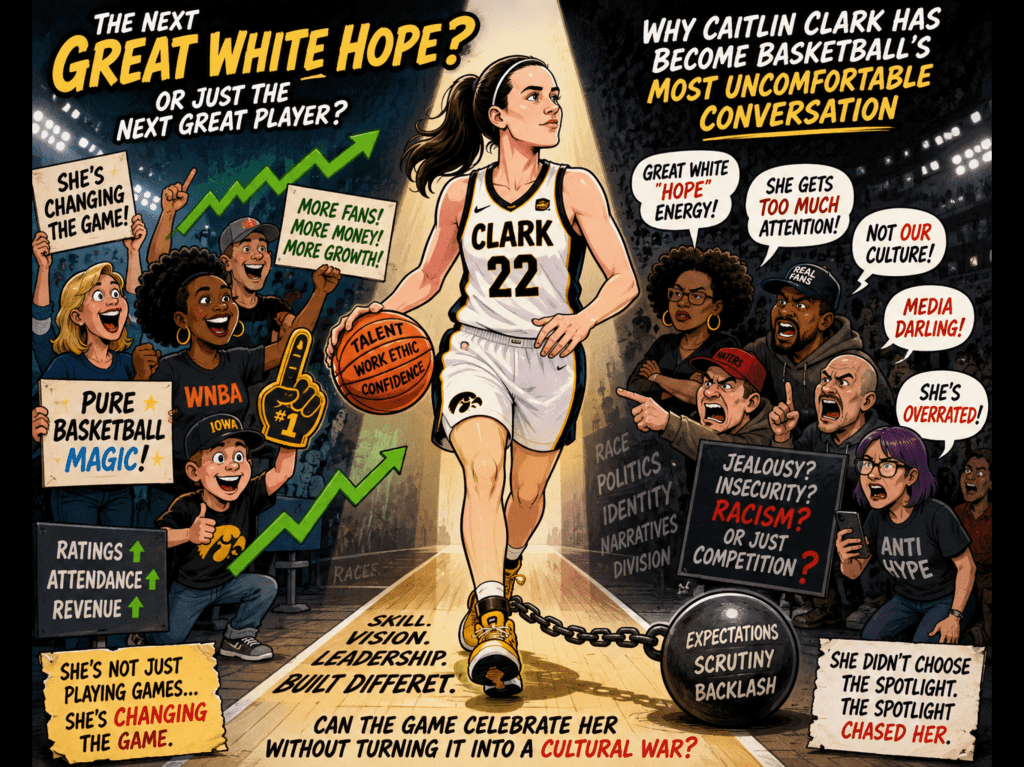
⚡🏆Caitlin Clark didn’t just arrive in women’s basketball—she detonated into it. Ratings exploded. Arenas sold out. Merchandise flew off the shelves. Suddenly, millions of people who couldn’t name three WNBA players were glued to their screens.
And with that came a question nobody seems comfortable answering out loud:
Has Clark become a threat—not to the sport itself—but to the established pecking order within it? 🤔🔥
🎭 When a Superstar Changes the Script
For years, women’s basketball fought for attention. Then Clark arrived and brought a tidal wave of eyeballs, sponsorships, media coverage, and revenue.
Normally, that would be cause for celebration.
Instead, every hard foul, every criticism, every media controversy seems to ignite another cultural wildfire.
Why?
Some argue it’s simple jealousy. Superstars in every sport get targeted. Michael Jordan did. LeBron James did. Tom Brady did. Success attracts enemies.
Others think there’s something deeper at work.
Basketball in America has long been a sport heavily influenced and shaped by Black athletes. The WNBA’s stars, history, culture, and identity have largely been built by Black women who carried the league through years when mainstream media barely paid attention.
Then along comes a white player who becomes the face of the league almost overnight.
That’s where the phrase “Great White Hope” enters the conversation. 🏀⚡
Not because Clark created it. Not because she asked for it. But because some fans and commentators project it onto her.
To her supporters, she’s simply the most exciting player in the game.
To her critics, some of her popularity appears connected to factors beyond basketball.
And that’s where things get messy.
🔥 Is It About Race, Popularity, or Power?
Here’s the uncomfortable reality:
If some people dislike Clark because she’s white, that’s discrimination.
If some people elevate Clark primarily because she’s white, that’s also a racial issue.
If some people resent her because she’s changing the economics and attention structure of the league, that’s something different entirely.
The truth may be a mixture of all three.
Sports are never just sports. They’re status, culture, money, identity, and power wrapped inside a jersey.
Clark didn’t create those tensions.
She exposed them.
Every discussion about her quickly turns into a discussion about race, media, politics, gender, popularity, and who gets to be the face of a movement.
That’s an enormous burden to place on a 23-year-old basketball player who mostly seems interested in hitting logo threes and winning games. 🎯🏀
🔥 Challenges 🔥
So here’s the question nobody can dodge:
Would Caitlin Clark receive the same treatment if she were Black?
Or is she experiencing the backlash that comes with becoming the most famous player in a sport undergoing a historic transformation?
Where does legitimate criticism end and identity politics begin?
Drop your thoughts in the blog comments. No scripts. No talking points. No media-approved answers. Just your honest view. 💬🔥
👇 Like, comment, and share if you’re willing to tackle one of the most controversial debates in modern sport.
🏆 The best comments and strongest arguments will be featured in the next issue of the magazine.


 Chameleon Magazine
Leave a comment