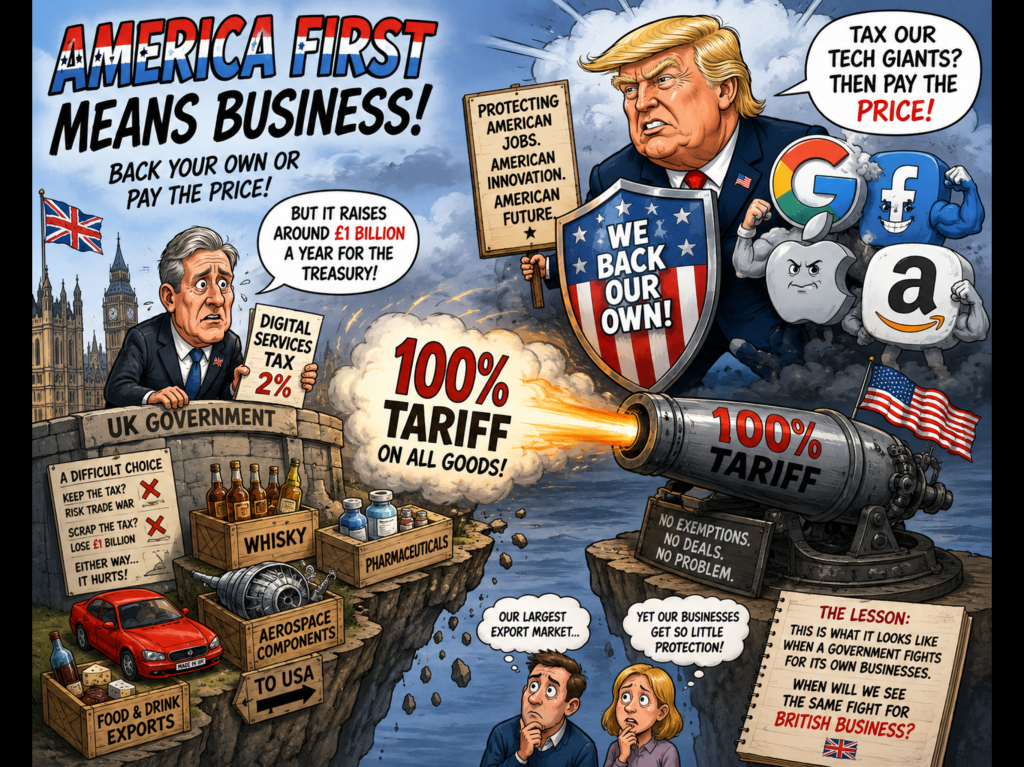
What’s Really Going On? 🇬🇧🇺🇸
This latest dispute centres on the UK’s Digital Services Tax (DST), introduced in 2020. Unlike corporation tax, the DST applies a 2% levy to certain UK revenues earned by the world’s largest digital companies. Because many of the businesses affected are American giants such as Google, Meta, Apple and Amazon, successive US administrations have argued that the tax disproportionately targets US firms.
That’s How You Back Your Own! 💼🔥
Donald Trump has now warned that if Britain—or any other country—continues to impose taxes like the DST on American companies, the United States could respond with a 100% tariff on imports from those countries. While this remains a political threat rather than an implemented policy, it highlights a much broader debate about whether governments should actively defend the interests of their own businesses when they face overseas taxation.
Whether you like Donald Trump or not, there’s one thing that’s hard to argue with—he’s making it crystal clear that American companies won’t be left to fight their own battles.
When foreign governments tax America’s biggest businesses, his response isn’t to issue a strongly worded letter or appoint another committee. He reaches for America’s biggest bargaining chip: access to its market.
That’s called backing your own.
Critics will call it aggressive. Supporters will call it leadership. Either way, it’s a government putting the interests of businesses built in its own country at the top of the agenda.
Meanwhile, Britain often seems to take the opposite approach. Our businesses are expected to shoulder ever-growing taxes, rising costs, endless regulation and fierce international competition while politicians deliver speeches about “growth” without always matching the words with decisive action.
From America’s point of view, this strategy is difficult to fault. Either other countries back down and remove taxes aimed at US tech giants, or America gains leverage to negotiate better trade terms. From Washington’s perspective, that’s a win-win.
Britain, on the other hand, faces an uncomfortable choice. Keep the Digital Services Tax and risk damaging trade with our largest single-country export market, or scrap the tax and lose around £1 billion in annual revenue.
Whatever happens next, there’s a lesson here. Governments should be fighting just as hard for the companies that create jobs, generate investment and keep their economies growing.
The question isn’t whether you agree with Trump’s politics.
The question is this: when was the last time you saw the British Government fight this hard for British business? 🇬🇧🤔
🔥 Challenge Time! 🔥
Should governments always put the interests of businesses built in their own country first? Is America simply playing the game better than everyone else, or is this a dangerous path towards a trade war?
💬 We want to hear your views! Head over to the blog comments and tell us whether Britain should be standing up for its own businesses with the same determination.
👍 Like it. 🔁 Share it. 💥 Start the debate.
🏆 The best comments will be featured in the next issue of the magazine.


 Chameleon Magazine
Leave a comment