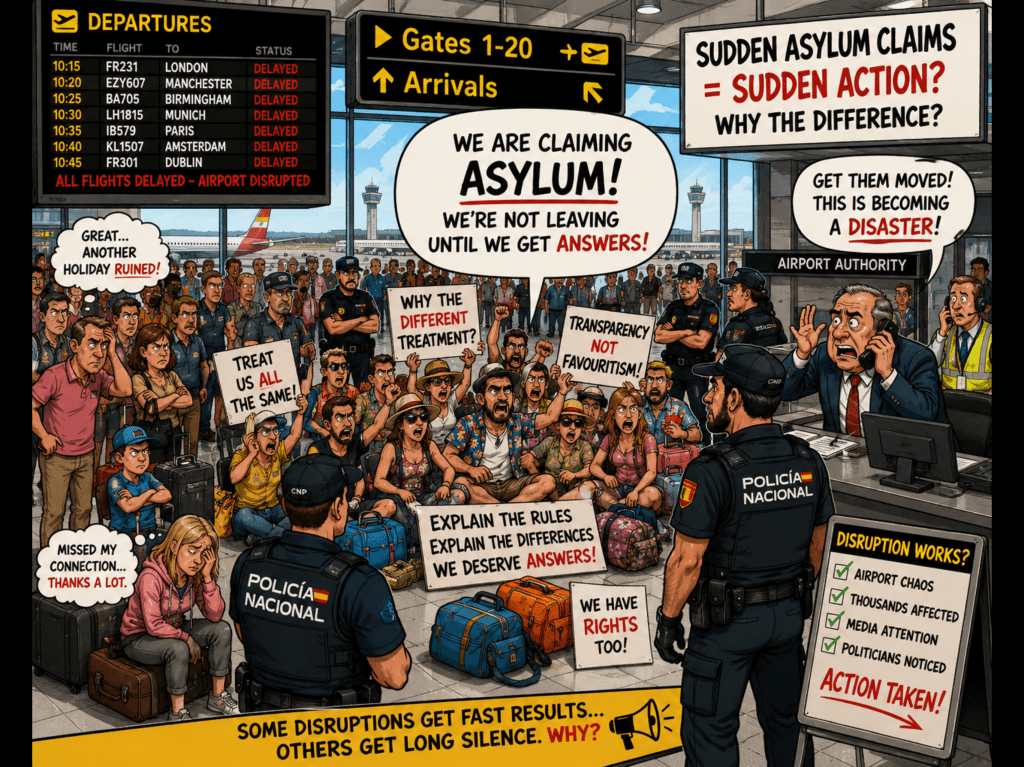
Some people argue that the only way to get politicians to notice anything is to cause maximum disruption. After all, history is full of protests that grabbed headlines only after bringing everyday life to a standstill. But where’s the line between making a point and making everyone else miserable?
🛬 If Everyone Played the Same Game… What Then?
Imagine this for a moment. A packed Airbus touches down at a sweltering Spanish airport just after midday. As passengers shuffle off the plane, dragging wheeled suitcases over the tiled floor, a group suddenly sits down in the arrivals hall, blocking the exit gates. One person raises their voice, declaring they are claiming asylum and urging others to do the same. Confusion spreads. Security staff hesitate, unsure how to respond. Within minutes, the queue behind them stretches back toward the jet bridge.
Because the exit is blocked, incoming passengers can’t clear the terminal. Ground crews delay unloading the next flight. Departure gates begin to fill with stranded travelers who can’t board because their aircraft hasn’t been cleared. Screens flicker from “On Time” to “Delayed.” Parents try to calm restless children. Business travelers pace, checking watches and phones. Airline staff scramble to reroute passengers, but options vanish as the backlog grows.
Soon, the ripple effect spreads across the airport. Flights are held on the tarmac. Connections are missed. Tempers rise. News crews arrive, cameras capturing the chaos. Within hours, politicians are asked to respond, pressed for answers they hadn’t planned to give that day.
It’s a thought experiment—not a proposal—but it exposes an uncomfortable question.
Why do some forms of disruption appear to generate an immediate response while others seem to be ignored for months or even years? Why do governments react with urgency in some situations, yet ask for patience in others?
Whether you support current immigration policies, oppose them, or sit somewhere in the middle, it’s reasonable to expect clear, consistent explanations. Transparency should not be reactive or selective—it should be the standard.
When governments fail to communicate openly, they don’t just delay answers—they erode trust. And once that trust is lost, restoring it becomes far harder than preventing the damage in the first place.
💬 Challenges 🔥
Here’s the bottom line.
Disruption should not be the price of being heard. Governments must lead with clarity, consistency, and accountability—before frustration boils over.
If you believe transparency should be the rule, not the exception, make your voice count. Demand answers. Expect consistency. Hold leaders to account.
👇 Share your perspective in the comments and help push the conversation forward.


 Chameleon Magazine
Leave a comment