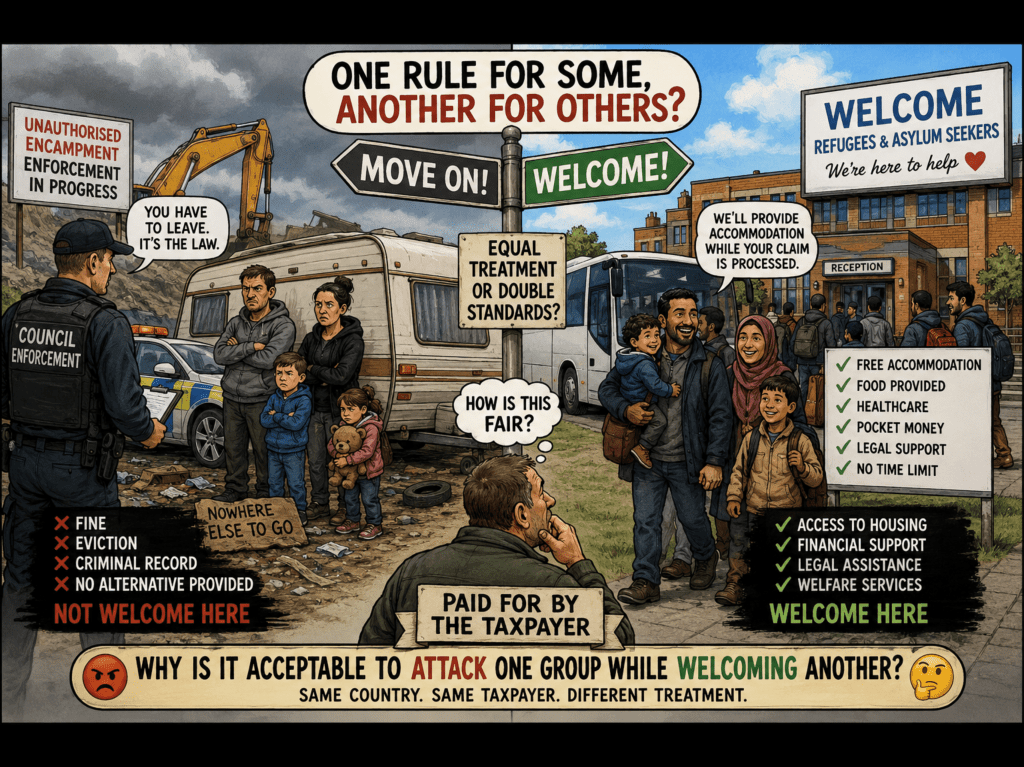
Travelling communities can face enforcement action from local councils when they set up unauthorised encampments, while asylum seekers arriving by small boats may be provided with publicly funded accommodation as their claims are processed. To many people, those two approaches appear difficult to reconcile.
🤔When Does Compassion Become Contradiction?
This isn’t about blaming individuals for the circumstances they find themselves in. It’s about asking whether government policy applies consistent principles—or whether different groups are treated under entirely different rules.
Councils often argue that unauthorised encampments can create legal, environmental, or community issues, leading to enforcement action. At the same time, the Government says it has legal obligations to provide accommodation to many asylum seekers while their applications are considered.
Both explanations exist. But for many taxpayers, the contrast still raises uncomfortable questions.
It’s also worth asking why public attitudes can seem so different. Criticism of travelling communities is often expressed openly and can attract little objection, while criticism of asylum policy is frequently viewed through a very different lens. Why do we appear to find it more acceptable to condemn one group while extending sympathy and support to another? Is that distinction based on consistent principles, or has the debate become shaped by different social and political expectations?
These are difficult questions, but asking them shouldn’t be off limits. A healthy democracy should be able to examine whether similar situations are being treated differently, and whether those differences are justified.
Whether you support stricter immigration controls, greater protections for travellers, both, or neither, transparency matters. Policies that appear inconsistent inevitably fuel public frustration and mistrust. Governments shouldn’t expect people simply to accept obvious differences in treatment without offering a clear, evidence-based explanation.
Good policy isn’t just about making decisions—it’s about explaining them in a way that the public can understand and scrutinise. When that doesn’t happen, speculation quickly fills the vacuum. 🏛️⚖️
💬 Challenges
Do these two policies make sense together, or do they expose an inconsistency that deserves greater public debate? Why do you think society often reacts so differently to these two groups?
Share your thoughts in the blog comments. Keep it respectful, challenge the ideas, and tell us whether you think the Government has adequately explained the difference—or whether more transparency is needed. 👇
👍 Like it. 📢 Share it. 💬 Join the conversation.
The best comments will be featured in the next issue of the magazine. 📰


 Chameleon Magazine
Leave a comment