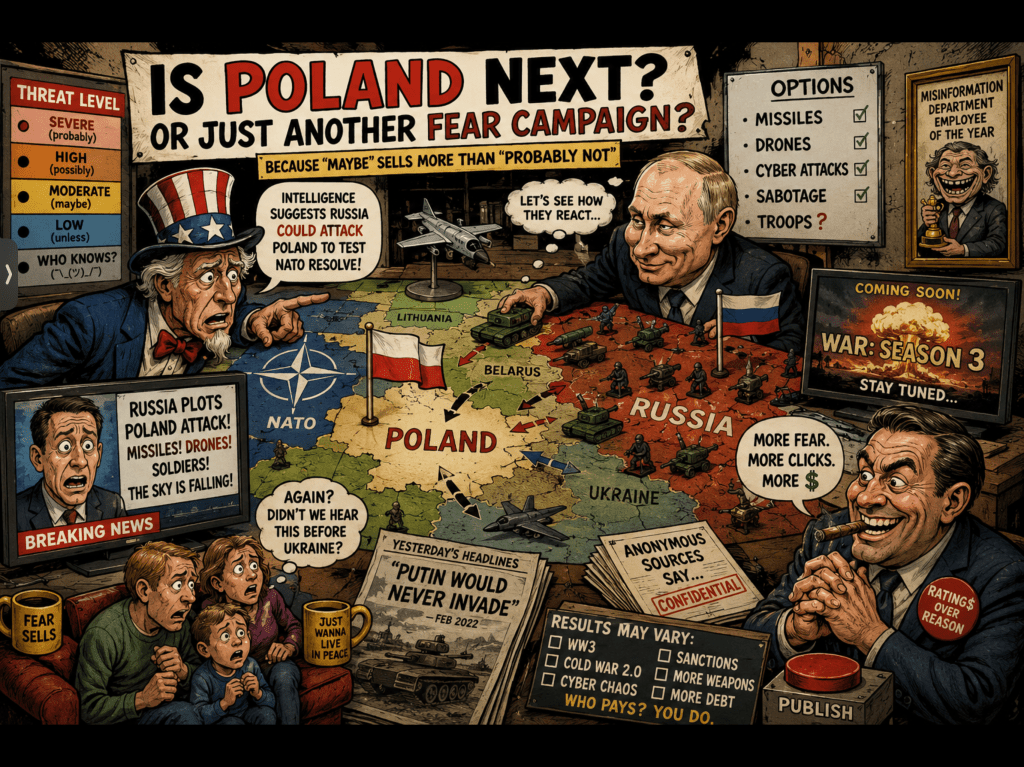
The headlines are flying faster than the missiles they predict. “Russia planning attack on Poland to test NATO resolve,” they scream. According to US warnings, critical infrastructure could be hit, drones could swarm the skies, and troops might pour across borders from Kaliningrad or Belarus.
It’s enough to make anyone reach for the emergency supplies—or perhaps just the remote to switch off the 24-hour news cycle.
📰 From ‘Impossible’ to ‘Inevitable’… Haven’t We Seen This Movie Before? 🎭
Here’s the uncomfortable truth.
When intelligence agencies warned that Russia was about to invade Ukraine, plenty of people laughed it off. “Putin would never do that,” they said. “It’s just Western scaremongering.”
Then February 2022 arrived.
So today, when another warning appears, people are split down the middle. One side believes we’re witnessing responsible intelligence sharing. The other sees another chapter in the endless business of fear, headlines and geopolitical theatre.
The real question isn’t whether every warning is true.
It’s whether governments should ignore threats simply because they sound unbelievable.
At the same time, healthy scepticism isn’t the enemy. Democracies depend on questioning claims, demanding evidence and refusing to swallow every dramatic headline without chewing first.
The problem is that modern news thrives on panic. Fear generates clicks. Clicks generate revenue. Before long, every intelligence assessment becomes tomorrow’s apocalypse.
Is Russia preparing to test NATO? Is this genuine intelligence? Or is it another reminder that uncertainty sells better than certainty?
Whatever the answer, one thing is clear: if history has taught us anything, it’s that dismissing every warning can be just as dangerous as believing every prediction.
Somewhere between blind trust and outright cynicism is where common sense ought to live.
🔥 Challenges 🔥
What do you think? Are these warnings a responsible attempt to keep the public informed—or another round of fear-driven headlines designed to keep everyone on edge? Has the media learned lessons from Ukraine, or has it learned that anxiety attracts attention?
💬 Join the debate in the blog comments. We want to hear your views, whether you’re convinced, sceptical, or somewhere in between.
👇 Like it. Share it. Challenge it. But don’t just scroll past—add your voice to the conversation.
🏆 The sharpest comments, funniest observations and strongest arguments will be featured in the next issue of the magazine.


 Chameleon Magazine
Leave a comment