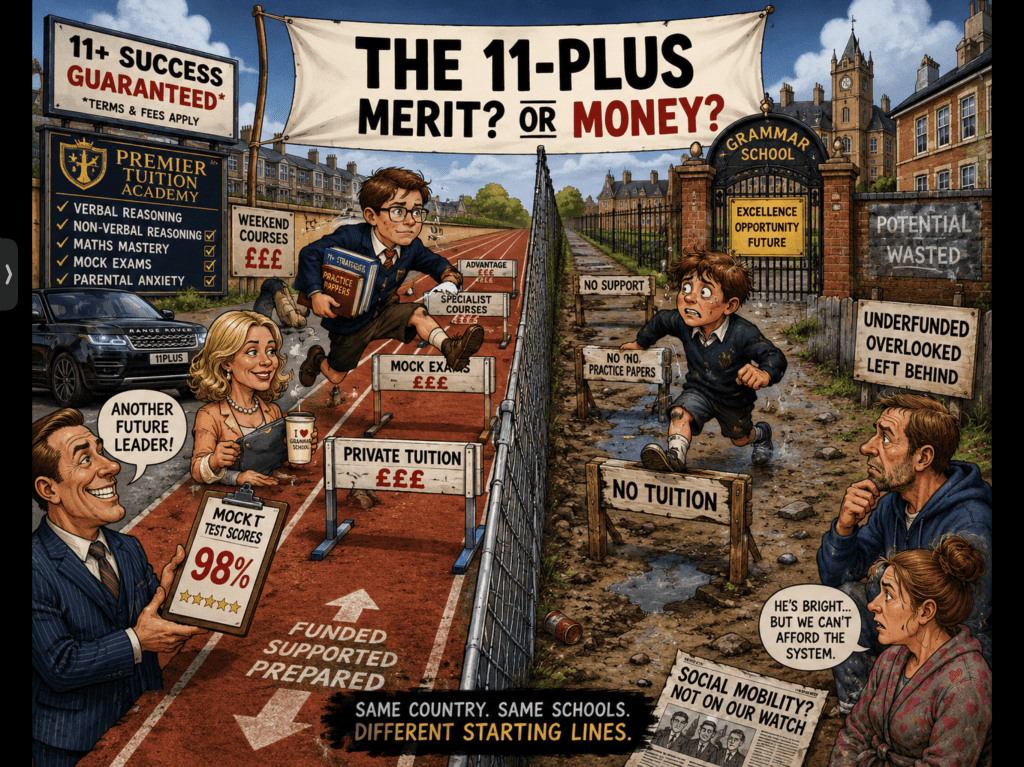
For generations, grammar schools were sold as Britain’s great social elevator—a chance for bright children, regardless of background, to climb the ladder through talent alone. But somewhere along the way, that ladder acquired a hefty price tag. Today, an entire tutoring industry has transformed the 11-plus into an arms race where success often depends less on natural ability and more on how many practice papers Mum and Dad can afford. And once again, it’s the white working class left watching the bus disappear down the road.
📚 Welcome to the Exam Factory: Where Childhood Becomes a Subscription Service 🤯
The idea was simple enough: identify academic potential and give children the opportunity to thrive. Noble. Fair. Almost inspirational.
Then the tutoring companies arrived.
Now, children as young as eight spend evenings and weekends drilling verbal reasoning until they can spot patterns in their sleep. Parents empty savings accounts chasing ever more expensive coaching sessions, while those already struggling to pay the electricity bill are expected to somehow compete against families investing thousands before exam day even arrives.
It’s no longer an entrance exam—it’s an auction.
Schools find themselves teaching two classes of pupils: those preparing for the real curriculum and those quietly rehearsing for an exam that increasingly rewards preparation over potential. The result? Children with genuine academic ability but limited financial backing can be edged out by those whose biggest qualification is having access to a professional tutor.
The cruel irony is impossible to ignore. A system originally designed to create social mobility now risks reinforcing exactly the inequalities it claimed to solve.
Meanwhile, politicians continue to praise “opportunity” while conveniently ignoring that opportunity now comes with an hourly rate.
Of course, not every family paying for tuition is wealthy. Many parents sacrifice holidays, overtime and family time simply hoping to give their child the best chance. They aren’t the villains. They’re responding rationally to a system that has quietly turned education into a competitive marketplace.
The real question is why we’ve allowed the rules of the game to become so distorted in the first place.
Because when educational success depends on disposable income, we shouldn’t be surprised when social mobility starts running in reverse.
🔥 Challenges 🔥
Should access to Britain’s best state schools depend on talent—or on who can afford the most tutoring? Has the 11-plus become a genuine test of ability, or simply another advantage for families with deeper pockets? We’d love to hear your experiences, opinions and stories.
👇 Leave your thoughts in the blog comments, give the article a like, and share it with friends and family. Let’s get the conversation going.
🏆 The sharpest, funniest and most thought-provoking comments will be featured in the next issue of the magazine.


 Chameleon Magazine
Leave a comment