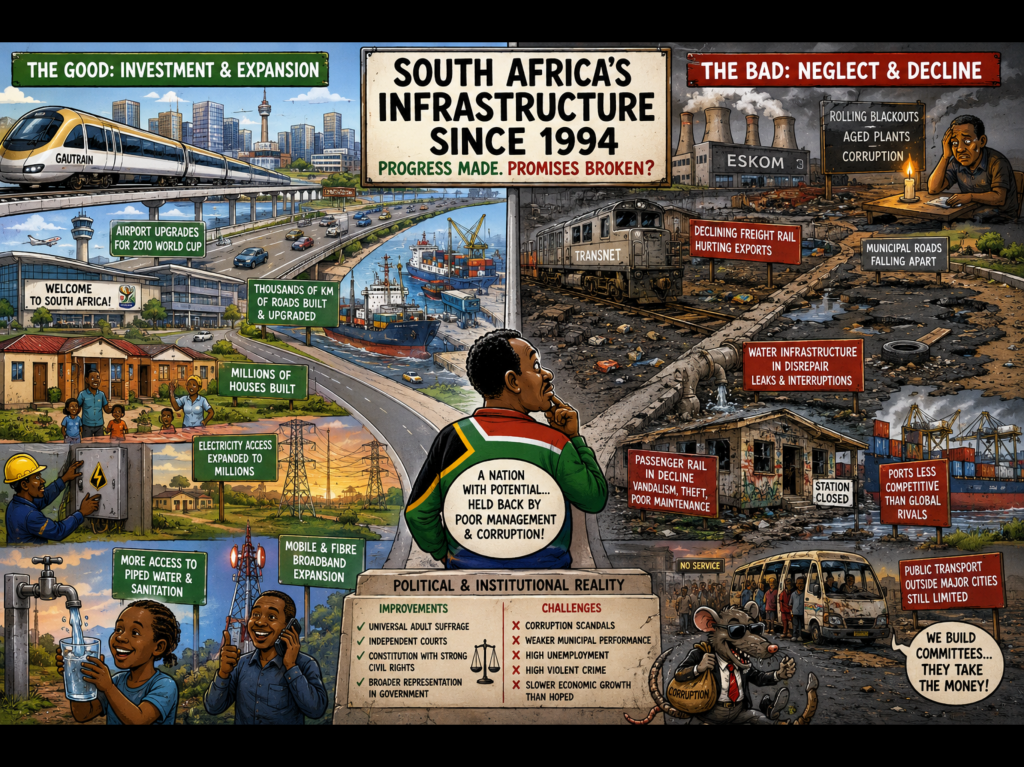
Since 1994, South Africa has undeniably changed. Millions of people gained access to electricity, clean water, sanitation, housing and telecommunications for the first time. The Gautrain glides between Johannesburg and Pretoria, airports received a World Cup makeover, and major roads and ports have seen investment. 🚆🌍
But alongside those achievements lies an uncomfortable reality: many of the country’s once-proud public assets have struggled under poor maintenance, corruption, and institutional decline. The result? A nation that has expanded access to services while watching parts of its existing infrastructure slowly crumble. ⚡🚰🚧
🚦 Ribbon-Cutting Champions… Maintenance Amateurs?
Building something shiny makes for a fantastic photo opportunity. Keeping it running twenty years later? That’s apparently where the enthusiasm runs out. 📸
Yes, the Gautrain is world-class. Yes, millions of homes have been built. Yes, rural electrification transformed countless communities. These are genuine achievements that deserve recognition.
Then reality clocks in.
Eskom became synonymous with candles instead of power. 💡🕯️ Passenger rail disappeared from many communities faster than politicians disappear after election promises. Municipal roads have evolved into obstacle courses worthy of an off-road championship, while leaking water pipes perform daily fountains that nobody ordered. 🚜💦
Ports expanded—only to become slower than many of their international competitors. Freight rail stumbled. Municipal infrastructure aged with little maintenance. Somewhere along the line, “asset management” became shorthand for “we’ll fix it next budget… probably.”
It’s a curious national strategy: build enough to celebrate today while quietly forgetting that infrastructure requires care tomorrow.
South Africa’s greatest success since 1994 may not have been constructing vast amounts of brand-new infrastructure—it was extending essential services to millions previously excluded. That achievement changed lives.
Its greatest challenge? Ensuring those services still work when the ribbon-cutting ceremony is a distant memory.
Because roads don’t maintain themselves. Power stations don’t repair themselves. Water pipes don’t magically stop leaking because another committee has been formed. 🔧
Infrastructure isn’t glamorous. It’s the plumbing of a nation. Ignore it long enough, and eventually everyone notices the smell.
🔥 Challenges 🔥
What do you think has been South Africa’s biggest infrastructure success since 1994—and what’s been its biggest failure? 🤔
Should the focus now be on ambitious new megaprojects, or should government concentrate on repairing and maintaining what already exists?
💬 Drop your thoughts in the blog comments, not just on social media. 👍 Like, share, and keep the conversation going.
🏆 The best comments will be featured in the next issue of the magazine!


 Chameleon Magazine
Leave a comment