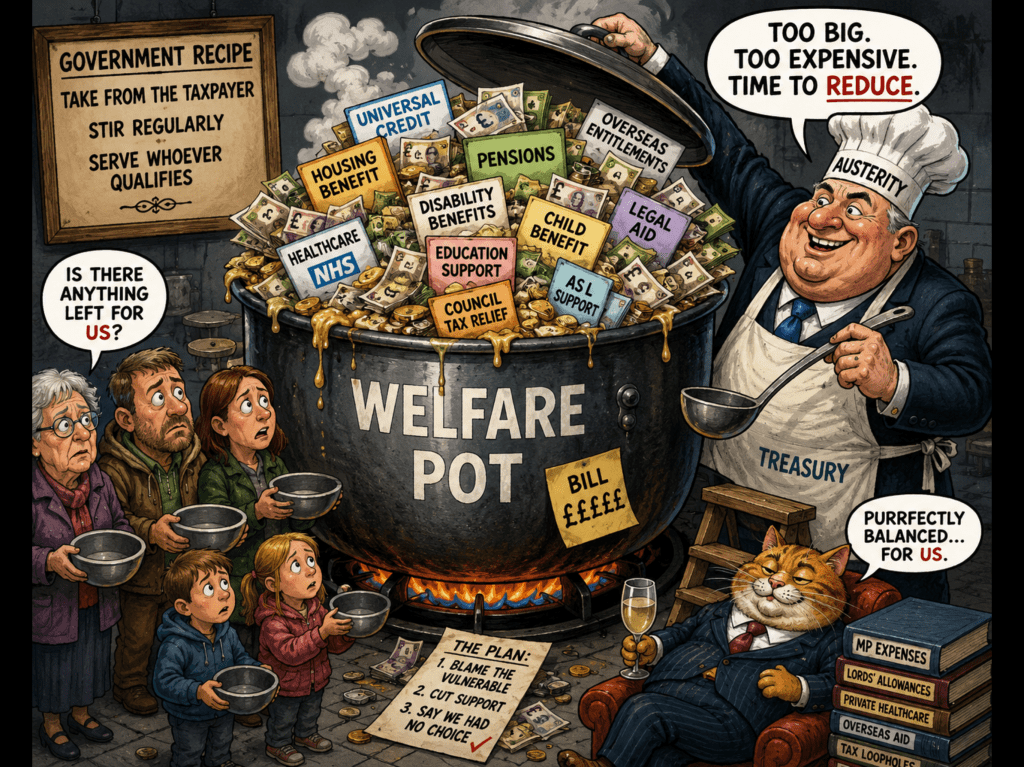
Britain’s finances are creaking under the strain, and the Government is running out of easy options. Taxes are already at levels many households can barely stomach, borrowing is becoming increasingly expensive, and interest payments on the national debt are swallowing billions that could have been spent elsewhere. 📉💰
The uncomfortable truth? When ministers start hunting for savings measured in billions instead of millions, one budget towers above the rest.
Welfare.
🎯 The Biggest Target in the Room
This isn’t about claiming everyone receiving benefits is doing anything wrong. Most aren’t. Many rely on support through circumstances entirely beyond their control.
But politics isn’t always about fairness—it’s about arithmetic.
And welfare is one of the biggest numbers on the Government’s balance sheet.
That makes it the easiest place for politicians to point when they need to convince voters they’re making “tough decisions.” Expect familiar phrases to make a comeback:
“The system must be fair.”
“Support should go only to those who need it most.”
“Hard choices are unavoidable.”
Sound familiar? They usually arrive just before the rulebook changes. 📋⚖️
Questions that once seemed politically untouchable could soon become everyday headlines.
Should people with substantial savings continue receiving the same support?
Should those with sizeable private pensions still qualify for certain benefits?
Should eligibility become significantly stricter?
These aren’t fringe debates anymore—they’re edging ever closer to the mainstream.
Then comes the issue guaranteed to ignite arguments across Britain. 🔥
Successive governments have chosen to extend elements of the welfare system to some people arriving from overseas, depending on immigration status, residency rules and the benefit involved. That’s a political decision made by Parliament—but it’s also a financial commitment funded by taxpayers.
When the economy is booming, many people accept those commitments as part of Britain’s responsibilities.
When the country’s finances are under pressure, a different question starts echoing around kitchen tables.
Can we still afford everything we’ve promised?
And the bill stretches far beyond benefit payments.
Accommodation.
Healthcare.
Education.
Administration.
Legal processes.
Legal aid where applicable.
Every one of those services draws from the same public purse. Every pound spent in one direction is a pound that can’t be spent somewhere else. 🏥🏫⚖️
Meanwhile, borrowing becomes more expensive, and debt interest quietly eats away at public spending like a financial termite infestation. Money that could have repaired hospitals, funded policing, strengthened defence or reduced taxes simply vanishes into paying yesterday’s bills.
That’s hardly a recipe for long-term stability.
History also suggests governments rarely choose the most politically painful route.
Will they wage war on multinational corporations that can shift profits around the globe?
Will Westminster slash its own perks before asking everyone else to tighten their belts?
Experience suggests those battles are far less appealing.
Instead, the pressure often lands where resistance is weakest.
The welfare budget.
The disability budget.
The people who depend on them.
Perhaps economic growth will arrive just in time and make these warnings unnecessary.
Let’s hope it does.
But if Britain’s finances continue travelling in the same direction, don’t be shocked when ministers begin explaining why “difficult decisions” have become unavoidable.
Because when the Treasury starts searching for billions instead of millions, the welfare pot isn’t just another budget.
It’s the biggest target in sight. 🎯💷
💬 Challenges
Is welfare really the next place the Government will come looking for savings—or are politicians avoiding the real waste elsewhere? 🤔
Who should shoulder the burden when the country’s finances tighten? Should benefits be protected at all costs, or is reform inevitable?
Join the debate in the blog comments below. We want your views, your arguments and your solutions—not just soundbites. 👇
👍 Like it. 🔄 Share it. 💬 Comment on the blog and tell us where you think the axe will really fall.
The best comments will be featured in the next issue of the magazine. 📰🏆


 Chameleon Magazine
Leave a comment