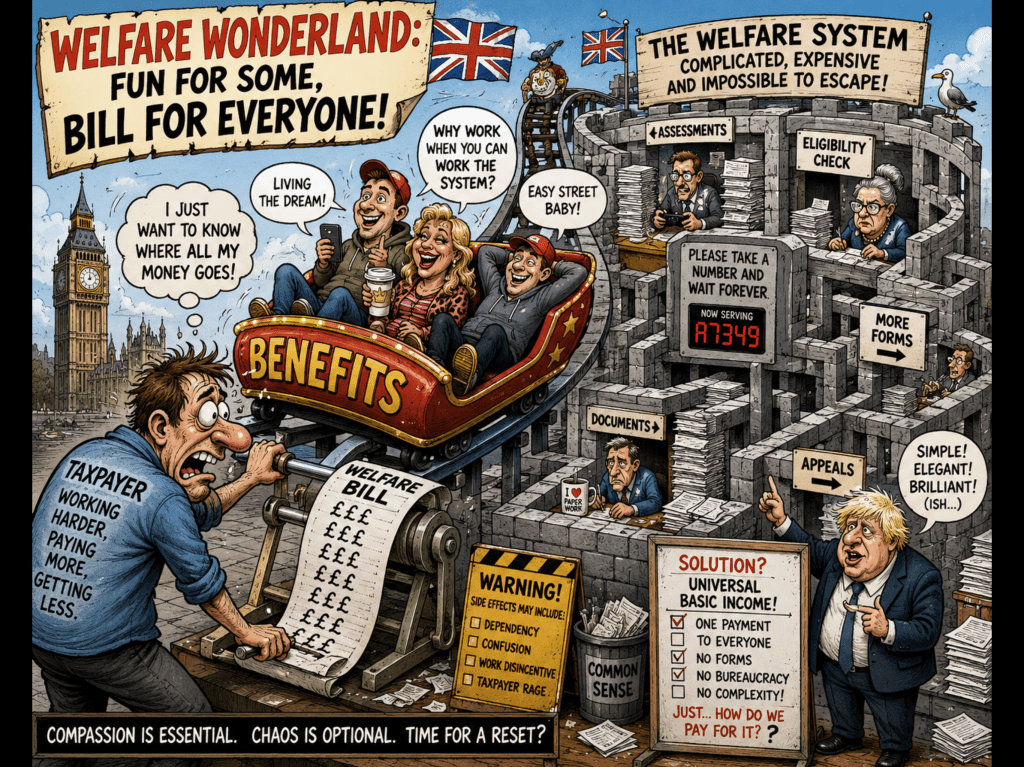
Britain’s welfare system started life as a safety net. Somewhere along the way, it evolved into a labyrinth where even the people running it need a sat-nav, three consultants, and a 400-page guidance manual just to find the front door.
It’s become the national version of DIY. Every government promises to “fix it,” then simply slaps on another layer of wallpaper over the cracks and declares the job done. Fifty years later, we’ve got a benefits system so complicated it could probably qualify for benefits itself.
🤹 The Great British Circus of Forms, Rules and Excuses 🎪📋
Need help? Fill in Form A38, submit three utility bills, a passport photo, your grandmother’s birth certificate, and wait twelve weeks while someone loses your paperwork.
Unless, of course, you’re trying to catch fraudsters. Then apparently they’re wearing invisibility cloaks.
Supporters insist the welfare state is a mark of a compassionate society—and they’re right. A wealthy nation should look after people when illness, disability, redundancy, or simple bad luck strikes.
But compassion and chaos aren’t the same thing.
We’ve somehow built a system that manages the impossible: frustrating people who genuinely need help while simultaneously convincing millions of taxpayers that someone, somewhere, is gaming the system.
That’s almost impressive.
Then comes the awkward question nobody can mention without social media exploding…
Should benefits come with tougher obligations?
If you’re able to work, should job hunting actually mean… well… job hunting? Training? Learning new skills? Giving something back to the community?
Or is asking that considered an act of medieval cruelty in 2026?
Then there’s Universal Basic Income—the political equivalent of saying, “You know what? Let’s just start over.”
One payment. Everyone gets it. No endless forms. No alphabet soup of departments. No bureaucrats measuring how many teaspoons of optimism you possess before approving a claim.
It sounds beautifully simple…
…right up until someone asks where the hundreds of billions of pounds are coming from.
At which point Westminster performs its favourite magic trick: looking very serious while quietly changing the subject.
Meanwhile, taxpayers are discovering that “cost of living” apparently means everyone else’s cost of living too.
The welfare bill climbs.
Taxes climb.
National debt climbs.
The only thing that doesn’t seem to climb is confidence that the system is actually doing what it was designed to do.
Perhaps Britain’s biggest benefit isn’t Universal Credit.
It’s universal confusion.
🔥 Challenges 🔥
So here’s the question politicians keep kicking further down the road…
Does Britain need to reform the welfare state…
…or bulldoze it and start again?
Should support be simpler? Tougher? More generous? More conditional? Or have we built a machine that’s become so expensive and complicated that nobody—claimants, taxpayers, or governments—actually knows how it works anymore?
💬 Jump into the debate in the blog comments. Don’t just shout—bring your best argument. Agree, disagree, dismantle the article, or rebuild the welfare state from scratch.
👇 Like it. Share it. Tag someone who’ll completely disagree with you.
🏆 The smartest, funniest, and fiercest comments will be featured in the next issue of the magazine.


 Chameleon Magazine
Leave a comment