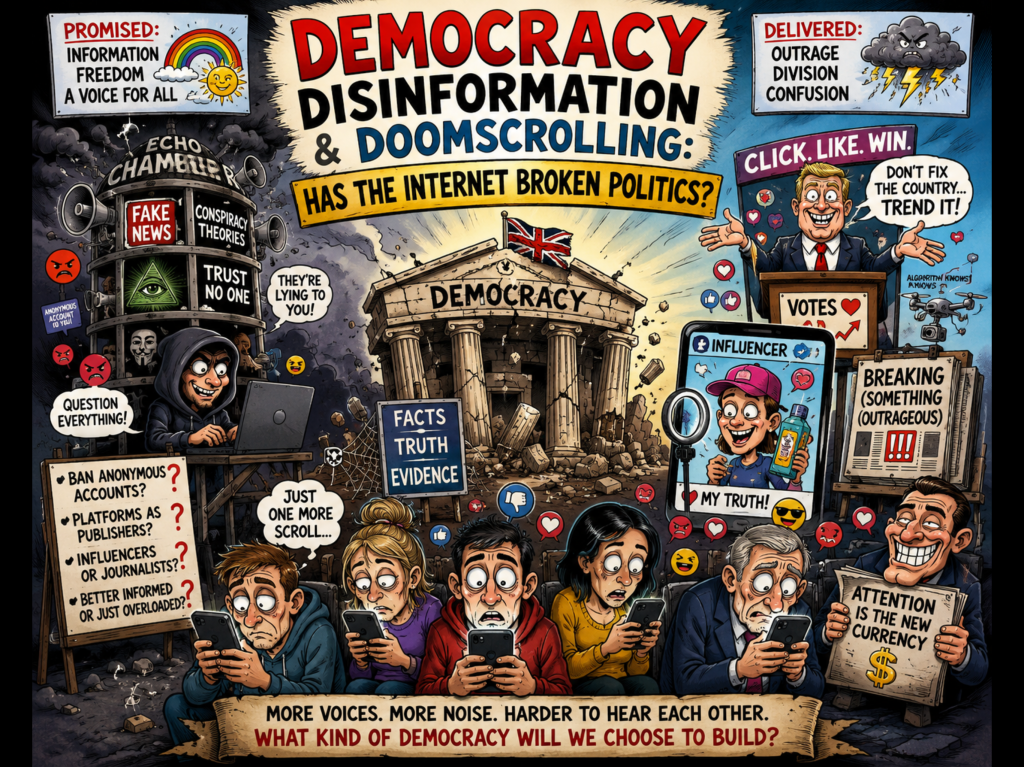
The internet was supposed to democratise information. Everyone would have a voice. Gatekeepers would disappear. Politicians would become more accountable. Citizens would be better informed than ever before.
Instead, many people feel we’ve ended up trapped in an endless cycle of outrage, conspiracy theories, clickbait headlines, viral misinformation, and politicians competing for likes instead of solving problems. 📲🔥
So, has the internet strengthened democracy—or quietly undermined it?
🌐 From the Information Age to the Opinion Age
Twenty years ago, most people received their news from newspapers, television, or radio. Editors decided what deserved attention, journalists were expected to verify facts, and breaking news arrived at a slower pace.
Today, anyone with a smartphone can reach millions.
That’s undeniably powerful. Hidden stories can emerge, whistleblowers can be heard, and ordinary people can challenge powerful institutions.
But there’s another side.
False claims can spread faster than corrections. Algorithms often reward outrage over accuracy. Influencers can command audiences larger than many news organisations, even without the editorial standards expected of traditional journalism. 🤳
The result is an information landscape where separating fact from opinion can feel like a full-time job.
🤔 The Questions Nobody Agrees On
Should anonymous accounts be banned to improve accountability—or would that silence whistleblowers and vulnerable people?
Should social media platforms be treated like publishers and held legally responsible for what appears on their sites—or would that encourage excessive censorship?
Has traditional journalism been replaced by influencers—or are both simply competing in the same crowded marketplace?
Are we genuinely better informed than we were twenty years ago, or are we simply drowning in an ocean of opinions?
Reasonable people answer these questions differently, which is exactly why they matter.
⚖️ Democracy Needs More Than Wi-Fi
Democracy depends on informed citizens, open debate, and trust in public institutions.
The internet has undoubtedly expanded access to information and made it easier for people to participate in public discussion. At the same time, it has made misinformation easier to spread, intensified political polarisation in some communities, and encouraged communication styles that often prioritise attention over careful debate.
Perhaps the real challenge isn’t that the internet has destroyed democracy.
Perhaps it’s that democracy is still learning how to survive in an age where everyone has a microphone, every opinion competes for attention, and every scroll brings another argument.
The technology itself isn’t the whole story. How we use it—and how we respond to its incentives—may matter just as much.
💬 Challenges
Has social media strengthened democracy by giving ordinary people a voice, or weakened it by rewarding outrage and misinformation?
Should governments regulate online platforms more aggressively—or would that create new risks for free expression?
Drop your thoughts in the blog comments. We want arguments, evidence, and respectful disagreement—not just slogans. The best discussions are often the ones where people challenge each other’s ideas without dismissing each other. 👇
👍 Like it. 💬 Comment on the blog. 🔄 Share it with someone who’ll argue the opposite view.
The best comments will be featured in the next issue of the magazine. 📝


 Chameleon Magazine
Leave a comment