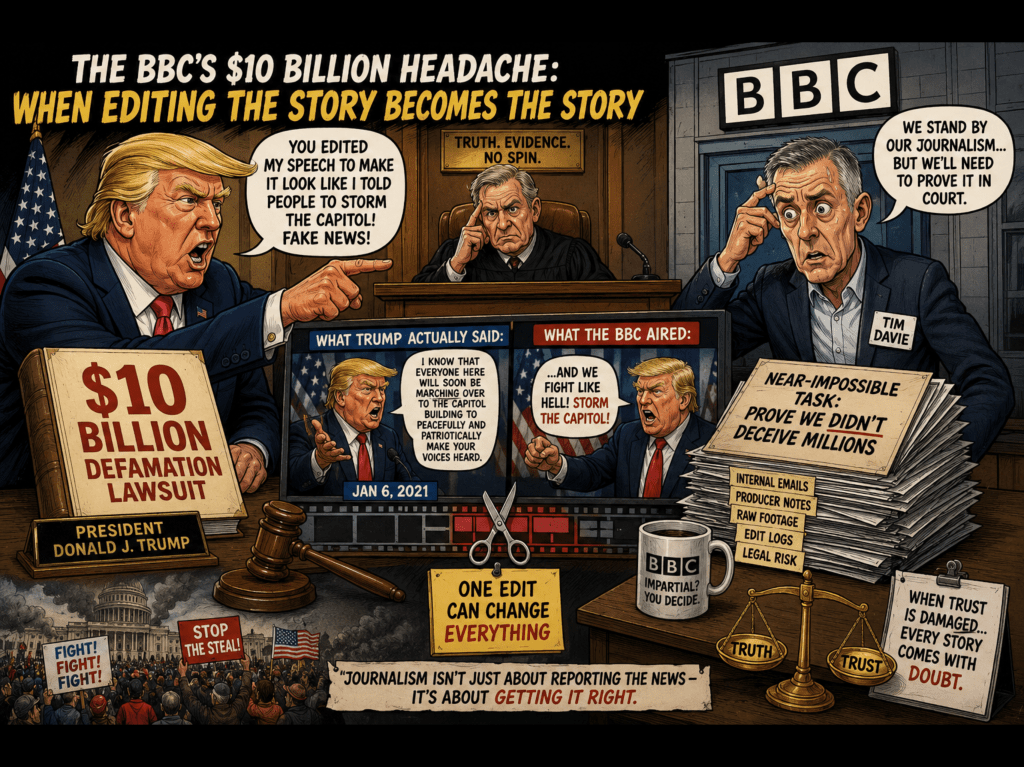
📺💥For years, the BBC has proudly branded itself as the gold standard of impartial journalism. But what happens if the broadcaster itself ends up in the dock, accused of editing reality rather than reporting it?
Donald Trump is suing the BBC for a staggering $10 billion, claiming a Panorama programme deceptively edited his January 6 speech to make it appear he encouraged supporters to storm the US Capitol. If the allegations hold up in court, the broadcaster won’t just be defending its journalism—it will be defending its credibility.
And suddenly, the organisation that has spent decades interrogating politicians could find itself answering questions under oath instead. 🎭⚖️
🎬 Lights… Camera… Selective Editing?
The BBC has built an empire on asking awkward questions.
Now it’s time for someone else to ask them.
If a broadcaster edits footage in a way that materially changes its meaning, is that journalism—or political storytelling?
Millions of people trust news organisations to show events as they happened, not as producers wished they’d happened. Once that trust is damaged, every headline, every interview and every “exclusive” starts coming with an invisible disclaimer:
“Viewer discretion advised… editing may contain surprises.” 🎞️
Supporters of the BBC argue that it remains one of the world’s most respected broadcasters and that complex legal cases deserve to play out in court before conclusions are drawn.
Fair point.
But if any media organisation expects politicians to be transparent, accountable and truthful, shouldn’t the same standard apply to journalists?
Because trust works both ways.
If politicians are expected to answer for every word they say, broadcasters should also answer for every frame they broadcast.
Otherwise, impartiality becomes less of a principle and more of a marketing slogan. 📺🤔
🔥 Challenges🔥
Should broadcasters face the same level of scrutiny they demand from politicians?
If a news organisation edits material in a misleading way, should it face serious legal consequences—or is that simply part of modern journalism?
Drop your verdict in the blog comments. Is this a vital test of press accountability—or an attempt to silence the media through the courts? 💬🔥
👇 Comment, like and share this post. The biggest stories shouldn’t be immune from the biggest questions.
The sharpest comments, strongest arguments and best debates will be featured in the next issue of the magazine. 🎯📝


 Chameleon Magazine
Leave a comment