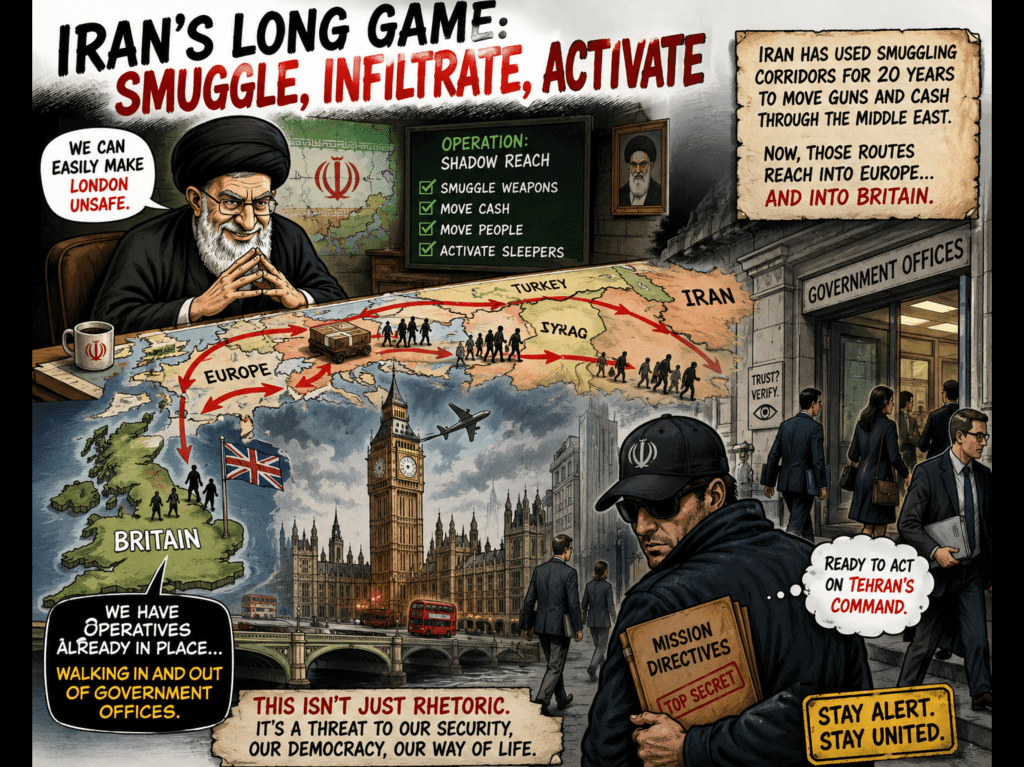
🇬🇧⚠️A new investigation by The Telegraph claims that Iran has repurposed long-established smuggling networks—originally used to move weapons and money across the Middle East—to transport people into Europe, including Britain. According to the report, Iranian officials allegedly boasted they could “easily make London unsafe” and claimed to have operatives already embedded in the UK, even suggesting some were “walking in and out of government offices.” If true, it’s the sort of statement designed to send shivers through Whitehall and beyond. 🕵️♂️🌍
🎭 When Geopolitics Starts Sounding Like a Spy Thriller
There’s nothing quite like a government official casually implying they’ve got people lurking in the corridors of power to spice up the evening news. 🍿
If these claims are genuine, they paint a picture of a regime that’s less interested in diplomacy and more interested in reminding everyone it can reach far beyond its own borders. Whether the boasts are entirely accurate, partly exaggerated, or pure psychological warfare, the objective is obvious: create uncertainty and make adversaries wonder who’s watching.
History tells us authoritarian regimes often inflate their capabilities because fear is cheaper than deploying an army. A whispered threat can sometimes achieve more than a battalion. But equally, dismissing such claims outright would be reckless. British intelligence has repeatedly warned of hostile-state activity on UK soil, and several alleged Iranian-linked plots have been disrupted in recent years.
The uncomfortable truth is that modern conflicts aren’t fought solely with missiles and tanks. They’re fought through cyber-attacks, espionage, criminal networks, influence campaigns, and, if allegations prove correct, individuals quietly blending into everyday society.
That doesn’t mean every migrant, visitor, or foreign national should become the subject of suspicion—that would be both unfair and counterproductive. It does mean governments face the difficult task of identifying genuine security threats without undermining the freedoms they’re trying to protect.
🔥Challenges🔥
If a foreign government is openly claiming it has operatives inside Britain, should ministers treat it as credible intelligence, political bluff, or both? 🤔
How should Britain respond while avoiding panic or unfairly targeting innocent communities? Share your thoughts in the blog comments and join the debate. 💬
👇 If this made you think, comment, like, and share. Your opinion could spark the next big discussion.
🏆 The best comments will be featured in the next issue of the magazine!


 Chameleon Magazine
Leave a comment