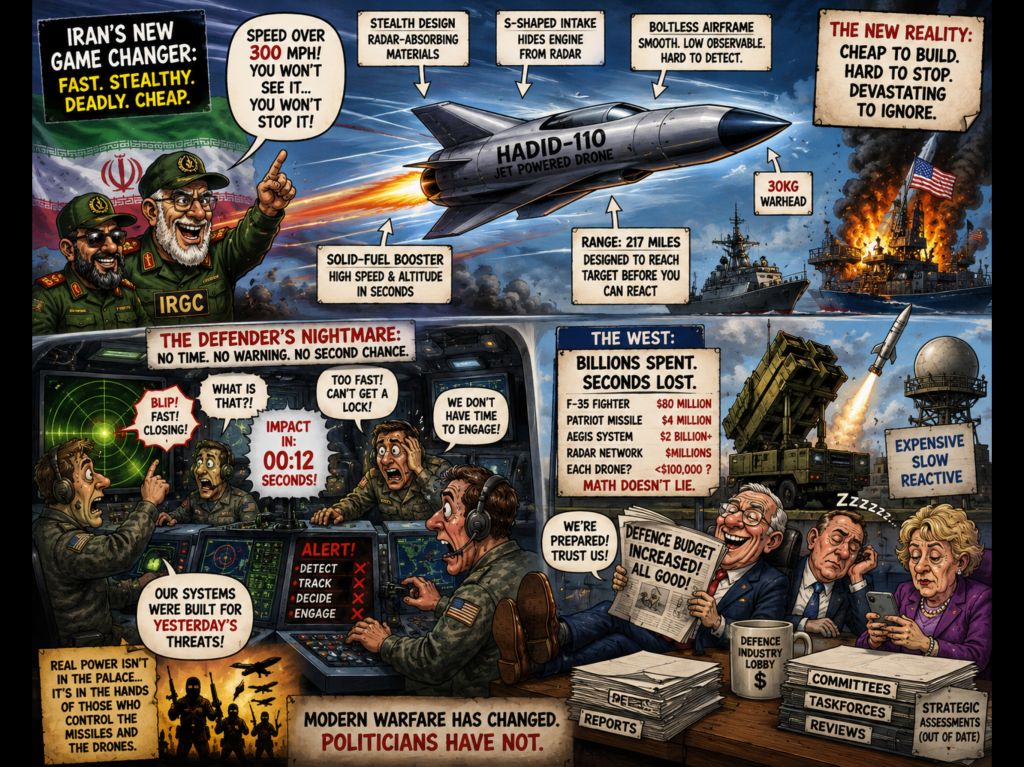
🤖💥For years, the world’s military superpowers have spent billions building sophisticated air defence systems designed to stop missiles, aircraft and conventional drones. Now Iran claims it has found a cheaper way to make those defences sweat.
The Islamic Revolutionary Guard Corps says it has deployed a new jet-powered version of its Hadid-110 suicide drone, capable of speeds exceeding 300mph, carrying a 30kg warhead and designed to reach its target before defenders have time to react.
Whether every claim proves true or not, one thing is undeniable: modern warfare is changing faster than politicians seem capable of understanding it.
🎯 Expensive Defences… Meet Cheap Innovation
For decades, military thinking has followed a simple formula: build bigger, build faster and spend more than your opponent.
Now along comes a weapon that reportedly costs a fraction of the systems designed to destroy it.
Smooth airframes. Radar-absorbing materials. Hidden engine intakes. Jet propulsion. It’s not science fiction—it’s the next stage of a battlefield where technology is making yesterday’s billion-pound defences look increasingly vulnerable.
Imagine buying the world’s most expensive lock, only for someone to discover they can climb through the window instead. 🔐🪟
That’s the problem facing every military relying on traditional air defence.
It’s no longer just about stopping aircraft.
It’s about detecting something small, fast, difficult to see and cheap enough to launch in swarms.
The defender spends millions.
The attacker spends thousands.
Guess who eventually runs out of money?
Meanwhile, politicians continue announcing defence spending as though simply throwing more cash at yesterday’s problems magically prepares you for tomorrow’s battlefield.
History suggests otherwise.
⚔️ The Men With the Drones Hold the Power
Perhaps the most revealing part of this story isn’t the drone at all.
It’s what it says about Iran.
With the country’s leadership in transition, power appears to be shifting towards those who command the missiles, drones and military hardware rather than those making speeches from behind podiums.
Throughout history, when uncertainty grips a nation, influence rarely belongs to the loudest politician.
It belongs to whoever controls the weapons.
And while governments around the world argue over budgets, diversity targets and climate pledges, military technology continues evolving at breakneck speed.
Wars are no longer won simply by having the biggest army.
They’re increasingly won by whoever adapts the fastest.
That should concern every nation watching from the sidelines.
🔥 Challenges 🔥
Have governments become obsessed with preparing for the last war instead of the next one? Are cheap, intelligent weapons making billion-pound defence systems obsolete? And are politicians always one technological revolution behind reality?
💬 Join the debate in the blog comments. Is modern warfare entering a completely new era, or is this just another military headline designed to grab attention?
👇 Comment, like and share this post. The sharpest opinions, strongest arguments and best observations could feature in the next issue of the magazine. 📰🔥


 Chameleon Magazine
Leave a comment