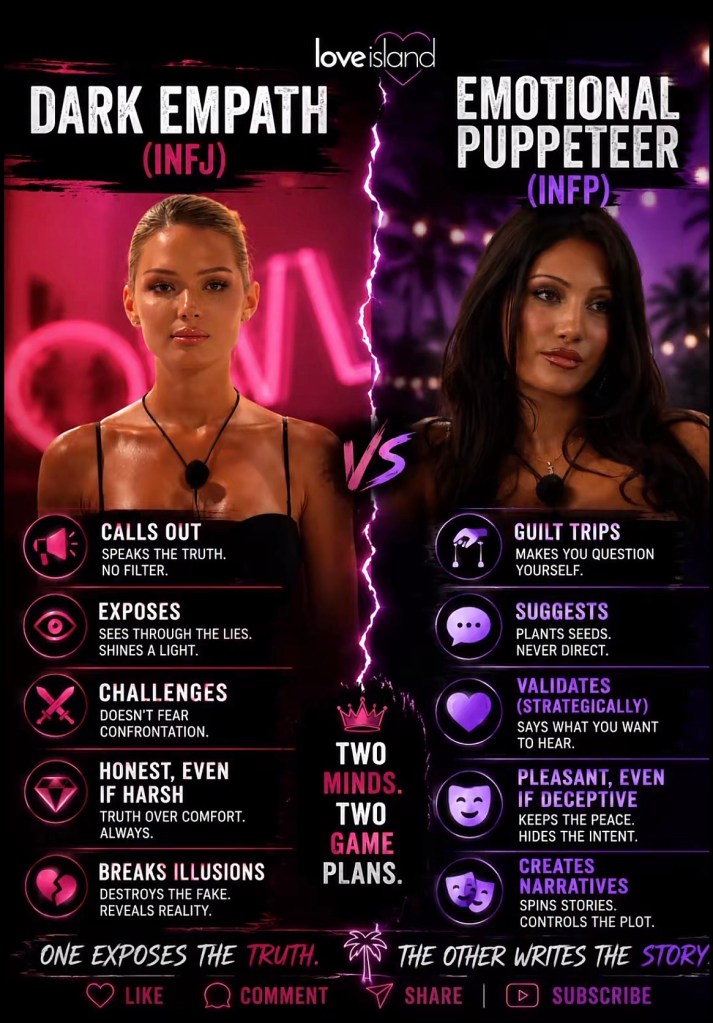
💔🧠Reality television has become less about finding love and more about exposing human psychology in its rawest form. Strip away the designer swimwear, luxury villas and endless slow-motion entrances, and what you’re left with is a fascinating social experiment where personalities collide, alliances form, reputations are destroyed, and perception becomes more valuable than truth.
The image above captures something that many viewers have noticed but few can properly explain. It isn’t simply comparing two contestants. It’s comparing two completely different ways of influencing people.
One confronts.
The other convinces.
One exposes.
The other edits.
One risks becoming unpopular by saying exactly what everyone else is thinking but is too afraid to admit. The other quietly shapes the conversation until everyone believes they reached the conclusion themselves.
And that’s where things become interesting.
The person who calls out bad behaviour is almost always labelled aggressive, dramatic or confrontational. They make people uncomfortable because truth usually does. Nobody enjoys having contradictions pointed out or uncomfortable realities thrown into the open.
Yet the emotional puppeteer rarely attracts the same criticism.
Instead, they listen carefully. They comfort. They sympathise. They ask innocent-looking questions that slowly plant seeds of doubt.
“Do you really think they meant that?”
“I’m only looking out for you…”
“I just thought you should know what was said…”
Nothing appears malicious on the surface. No shouting. No accusations. No obvious lies.
But slowly the narrative changes.
Friendships fracture.
Opinions shift.
People begin doubting themselves rather than questioning the person steering the conversation.
That’s what makes emotional manipulation so powerful. It rarely announces itself. It doesn’t need to.
The most effective manipulators don’t force people to think differently.
They simply create the conditions where people persuade themselves.
Reality television rewards this skill because audiences often judge behaviour by appearance rather than outcome. The blunt person looks like the problem because conflict follows them everywhere. The manipulator looks calm, supportive and caring because they rarely get caught holding the knife—they simply hand it to someone else.
Sound familiar?
It should.
This doesn’t only happen on Love Island.
It happens in workplaces where office politics outweigh competence.
It happens in families where one person quietly controls everyone through guilt rather than authority.
It happens in friendships where one individual always seems to be at the centre of the drama while somehow remaining blameless.
It even happens in politics, where public opinion is often shaped less by facts than by whoever tells the most convincing story.
Perhaps that’s why this comparison resonates with so many people.
In today’s world, perception has become more valuable than reality.
The person exposing uncomfortable truths is often treated as the villain because honesty creates friction.
The person quietly manipulating emotions is praised for being empathetic because manipulation wrapped in kindness is much harder to recognise.
Maybe the biggest lesson isn’t about personality types at all.
It’s about learning the difference between someone who makes you uncomfortable because they’re telling the truth… and someone who makes you comfortable because they’re telling you exactly what you want to hear.
Those are two very different people.
And confusing one for the other has consequences far beyond a reality TV villa.
🔥 Challenges 🔥
Who do you think poses the greater danger—the person who risks upsetting everyone by speaking uncomfortable truths, or the one who quietly controls the room without ever raising their voice? Have you ever encountered an emotional puppeteer in your own life, or do you think blunt honesty causes more harm than careful persuasion?
💬 Join the conversation in the blog comments. We want to hear your experiences, your opinions and your own observations. Sometimes the most revealing stories don’t come from television—they come from real life.
👇 Like, comment and share if you’ve ever watched someone control an entire room without anyone noticing.
The best comments and most thought-provoking responses will be featured in the next issue of the magazine. 📰🔥


 Chameleon Magazine
Leave a comment