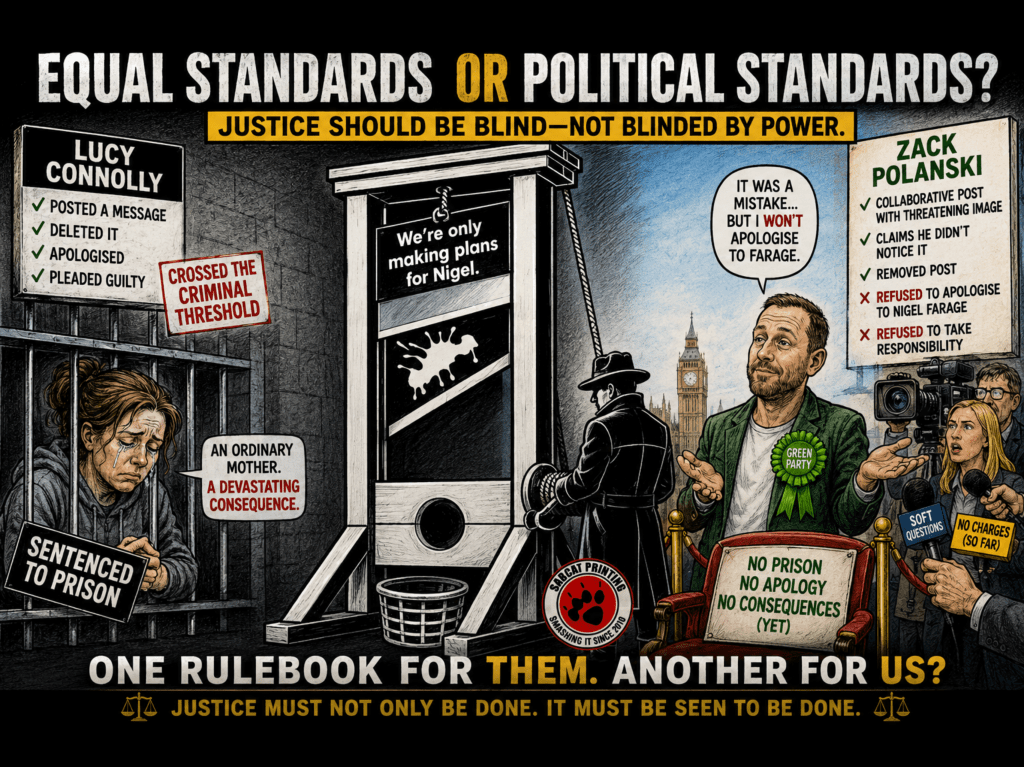
🚨Justice is supposed to wear a blindfold—not a party rosette. Yet millions are asking an uncomfortable question: are the same rules applied to everyone, or do political figures enjoy a softer landing when controversy strikes? The comparison between the imprisonment of Lucy Connolly and the scrutiny surrounding Green Party leader Zack Polanski has reignited one of the biggest debates in British politics: is justice truly equal, or does status change the standard?
🎭 One Law for the Public… Another for the Political Class?
Nobody is claiming these are identical legal cases. They’re not.
Lucy Connolly admitted the offence she was charged with after posting a message during a period of national tension. She deleted it, apologised, pleaded guilty, and the court decided her words crossed the criminal threshold. The result was prison.
Meanwhile, Zack Polanski became the subject of police inquiries after a collaborative social media post featured imagery many interpreted as threatening Nigel Farage. Polanski said he hadn’t noticed the image and described sharing it as a mistake. He removed the post once it was brought to his attention. However, despite being asked repeatedly in interviews, he declined to apologise directly to Nigel Farage, maintaining that he had not intended to share the image. At the time of writing, no criminal charges have been brought. (The Guardian)
The facts differ. The law will always examine different evidence.
But here’s the question nobody can dodge.
Should politicians—people whose voices reach millions—be held to the same standard as the public they govern… or to a higher one?
Leadership isn’t just about collecting a title and posing for photographs. It’s about responsibility. Every post, every repost and every public statement carries influence far beyond that of the average citizen.
If the courts can conclude that an ordinary person’s online words were capable of encouraging unlawful behaviour, shouldn’t those with far greater influence face at least the same level of scrutiny?
This isn’t about demanding prosecutions because someone belongs to a political party.
It’s about demanding consistency.
If an ordinary citizen is expected to think carefully before posting online, surely those entrusted with public office should be expected to exercise even greater care. And when a mistake is made, accountability should include the willingness to offer a straightforward apology to anyone reasonably affected.
Justice loses credibility the moment people begin believing there are two rulebooks: one for ordinary citizens and another for those occupying positions of power.
Equal justice doesn’t require identical outcomes.
Different evidence can—and should—produce different legal decisions.
What it does require is that the same legal principles, the same level of scrutiny, and the same expectation of accountability apply regardless of political colour, status or influence.
Because if those making the rules appear to play by different ones… public trust becomes the first casualty. ⚖️
🔥 Challenge 🔥
Should politicians be held to a higher standard because of the influence they wield?
And if an ordinary citizen can lose their liberty over a social media post, should political leaders be expected not only to exercise greater care—but also to apologise when they get it wrong?
Join the debate in the blog comments. Tell us whether you think Britain still has one standard of justice—or two.
👇 Like, share and comment if you believe accountability should never depend on who’s holding the microphone.
🏆 The best comments will be featured in the next issue of the magazine.


 Chameleon Magazine
Leave a comment