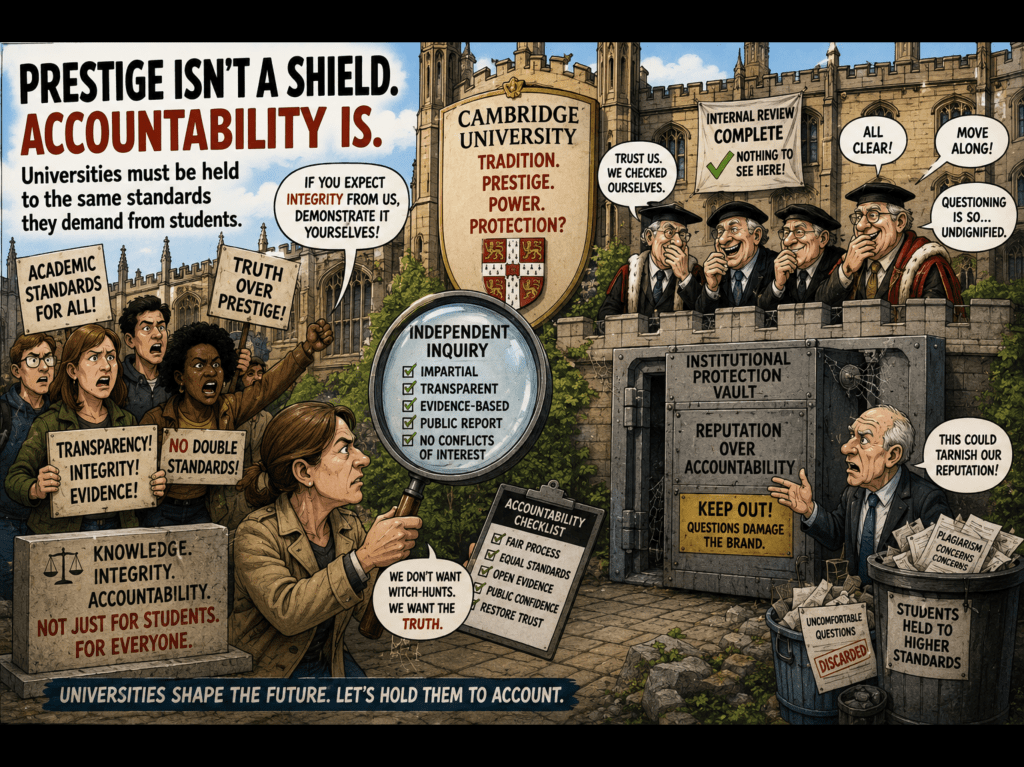
Pressure is mounting for the University of Cambridge to address plagiarism allegations involving Professor Jason Arday with something more convincing than institutional reassurance and a firmly closed door.
Reports have highlighted textual similarities between passages in Arday’s 2015 PhD thesis and an earlier thesis by another researcher. Arday cited that researcher repeatedly, but critics allege that some wording was reproduced too closely and without sufficiently clear attribution. Cambridge says the allegations have already been investigated by the relevant bodies and that Arday was cleared of wrongdoing. (The Times)
That distinction matters: these remain allegations, not proven misconduct. But so does transparency.
🔍 Nothing to See Here—Please Stop Looking at the Footnotes
Cambridge is one of the world’s most prestigious universities: an institution where students are warned that sloppy referencing can destroy grades, reputations and academic careers.
Apparently, however, when serious questions surround a prominent professor, the public is expected to accept the scholarly equivalent of:
“We checked ourselves and everything is absolutely fine.”
Case closed. Pack away the magnifying glasses. Return all suspicious quotation marks to storage. 📚🕵️
Cambridge has described the accusations as part of a “vile campaign” intended to undermine Arday’s credibility, while Liverpool John Moores University—where the doctorate was awarded—has also said that an earlier investigation found no wrongdoing. (The Times)
Those conclusions deserve to be reported fairly. But an independent inquiry would not automatically presume guilt. It could establish what was examined, which standards were applied and why the contested passages were judged acceptable.
That would protect everyone involved.
It would protect Professor Arday from allegations endlessly circulating without a definitive, publicly credible resolution. It would protect the original author whose work is said to resemble parts of the thesis. And it would protect Cambridge from the suspicion that prestige comes with a complimentary institutional force field.
Universities demand evidence, scrutiny and intellectual honesty from their students. They cannot suddenly become allergic to those principles when scrutiny reaches the senior common room.
This controversy must also be handled without turning one academic dispute into a racial or ideological circus. Arday is a prominent scholar whose work concerns race, inequality and education, and Cambridge appointed him Professor of Sociology of Education in 2023. (Education News)
His background, public profile and research interests neither prove nor disprove the allegations. The work should be assessed by clear academic standards—the same standards applied consistently to everyone.
No trial by social media. No institutional whitewash. No culture-war carnival with footnotes.
Just evidence.
🔥 Challenges 🔥
Why should students trust academic-integrity procedures when universities refuse to show clearly how controversial conclusions were reached?
Would an independent inquiry unfairly prolong allegations against someone already cleared—or is genuine independence the only way to settle the matter and restore confidence? 🎓⚖️
Put your verdict in the blog comments. Should Cambridge publish a detailed explanation, commission an independent review, or consider the case closed?
👇 Comment, like and share the post. Academic reputations should be defended by evidence—not merely embossed letterheads.
🏆 The strongest comments will be included in the next issue of the magazine.


 Chameleon Magazine
Leave a comment