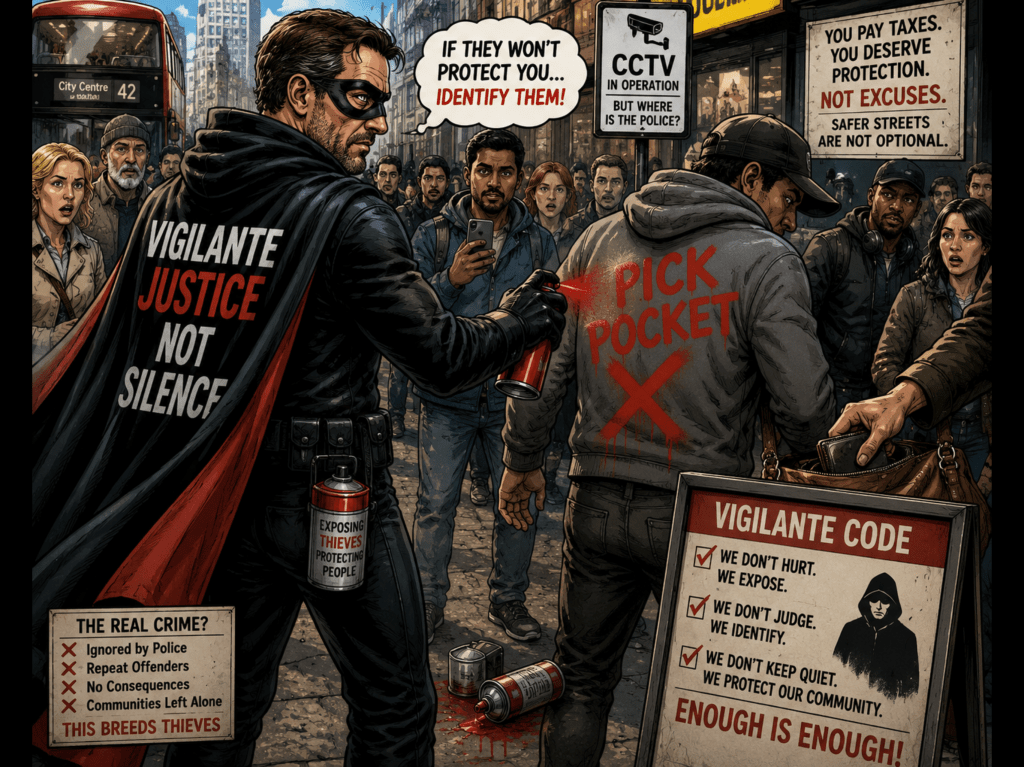
There was a time when seeing a police officer walking the streets was an everyday occurrence. That visible presence wasn’t just about catching criminals—it was about preventing crime before it happened. Today, many people feel that presence has all but disappeared.
Speak to victims of burglary, shoplifting or pickpocketing and a common story emerges. A crime is reported, a reference number is issued, and often that’s the end of it. Many understand that police resources are stretched, but understanding the reason doesn’t remove the feeling of being left to fend for yourself.
That is where a dangerous question begins to emerge:
If the state no longer appears capable of policing low-level crime, who fills the gap?
History gives us the answer.
Before modern policing existed, communities protected themselves. Town watches, local patrols and community justice were common because there was no professional police force to rely upon.
The creation of modern policing changed that social contract. Citizens gave the state the authority to enforce the law fairly and impartially. In return, the public funded that protection through taxation.
But social contracts only work when both sides uphold their responsibilities.
Today, many people believe that contract is beginning to fray.
Videos regularly appear online showing members of the public confronting pickpockets, exposing shoplifters or chasing thieves. Some praise these individuals as heroes. Others condemn them as vigilantes.
The truth is more complicated.
Very few people actively want vigilante justice. Most understand the dangers of people acting as judge, jury and executioner. Mistakes can be made. Innocent people can be harmed. Personal revenge is no substitute for justice.
Yet when people repeatedly see crime going unchallenged, they naturally begin asking a simple question:
“If nobody else is going to protect us, what are we supposed to do?”
That question should concern every politician.
Technology has never been more advanced. CCTV, facial recognition, ANPR cameras, artificial intelligence and smartphones provide policing tools previous generations could only dream of.
Yet despite these advances, many people feel less protected than they did decades ago.
Perception matters.
If criminals believe there is little chance of being caught for everyday offences, confidence grows. If ordinary people believe nobody is coming to help, confidence in the justice system falls.
That combination is toxic.
The answer is not to encourage vigilante groups.
Nor is it to dismiss public concerns by telling people to simply report crimes and wait.
The answer is to rebuild visible, effective neighbourhood policing that reassures communities and deters offenders before crimes occur.
Because history teaches us a simple lesson:
When the state creates a vacuum, society will fill it.
The question is not whether people will step in.
The question is whether governments will act before they do.
A society where citizens feel compelled to police their own streets is not a sign of stronger communities.
It is a warning that confidence in the institutions designed to protect them is beginning to fade.
Governments should treat that warning seriously.
Because once people stop believing the state can protect them, rebuilding that trust becomes far harder than preventing its loss in the first place.


 Chameleon Magazine
Leave a comment