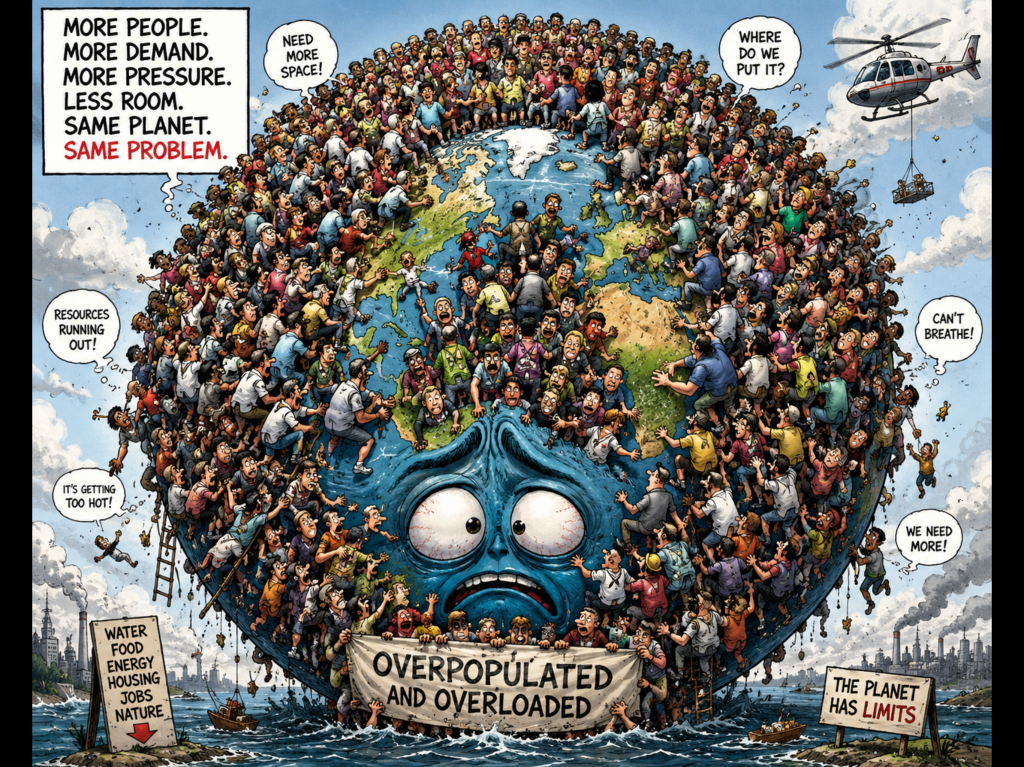
Every climate debate seems to circle back to fossil fuels, electric cars, plastic straws, or who forgot to recycle their yoghurt pot. But there’s one uncomfortable question that rarely gets invited to the party: what happens when there are simply more and more of us needing everything?
Every new person needs food, water, electricity, transport, housing, healthcare, clothing, and eventually a mountain of products that all require energy and resources to produce. Even with cleaner technology, adding billions more consumers places increasing pressure on a planet with finite land, water, and natural resources.
Ignoring population as part of the environmental conversation doesn’t make the maths disappear. It simply leaves one of the biggest variables off the whiteboard.
🚦 The Elephant in the Eco-Room Nobody Wants to Mention
Modern society behaves as though endless population growth and environmental sustainability can happily skip hand in hand forever. That’s a lovely bedtime story—but reality has a habit of sending the bill. 💸🌎
Every government cheers rising populations because they mean bigger economies, larger workforces and expanding tax bases. Businesses celebrate because more people mean more customers. Property developers see more houses to build. Retailers see more shoppers. Everyone applauds growth… until they’re stuck in traffic, paying soaring energy bills, watching forests disappear and wondering why water shortages are becoming normal.
This isn’t about blaming individuals for having children, nor is it about telling families what they should do. It’s about asking whether endless growth on a finite planet is really a sensible long-term strategy.
If every additional person increases demand—even by a small amount—that demand adds up. More homes. More roads. More farmland. More electricity. More factories. More mining. More emissions.
Technology can certainly reduce the environmental footprint of each person. Renewable energy, cleaner transport and better efficiency all matter enormously. But cleaner systems don’t magically erase the reality that billions more people still require billions more resources.
Perhaps the most ironic part of the whole debate is that we’re willing to discuss almost every climate solution imaginable—taxes, bans, carbon capture, electric vehicles and dietary changes—yet one of the most obvious contributors often remains politically untouchable.
Maybe it’s time we stopped pretending population doesn’t belong in the conversation.
💬 Challenges
Here’s the question many people avoid:
Can a planet with finite resources really support infinite human growth without consequences?
Agree? Disagree? Think this is the climate conversation everyone is too nervous to have—or completely the wrong direction?
Head over to the blog and tell us what you think. Challenge the argument. Defend it. Tear it apart if you must—but bring facts, not just fury. 🔥🗣️
👇 Like, comment and share if you believe no subject should be off limits when discussing the future of our planet.
🏆 The best comments will be featured in the next issue of the magazine.


 Chameleon Magazine
Leave a comment