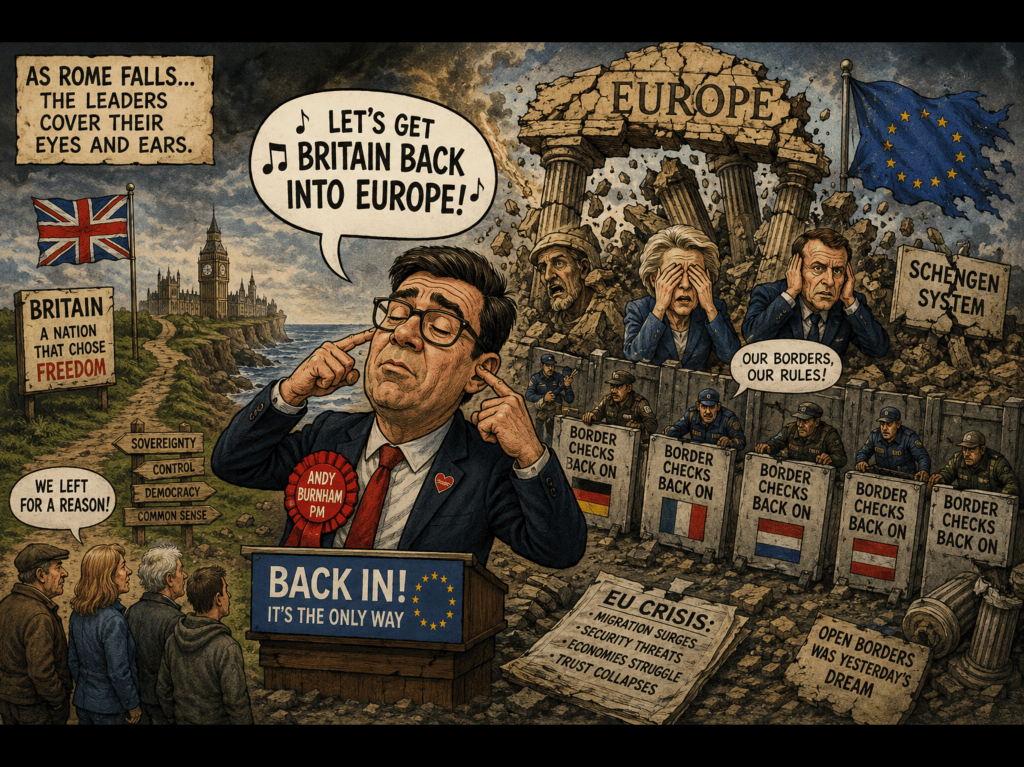
For years we’ve been told Brexit was the greatest act of self-harm in British history.
That Britain’s future lay firmly inside a borderless Europe.
That freedom of movement was the model to admire.
Yet look around Europe today, and a different picture is emerging.
🏛️ As Rome Stumbles, Some Still Dream of Going Back
Across Europe, governments are increasingly reintroducing border checks, tightening immigration controls and putting national security ahead of political ideals.
The Schengen system was sold as the jewel in the European crown—a continent where internal borders had become little more than lines on a map.
Today, more and more member states are making use of provisions that allow temporary border controls when they judge it necessary.
That’s prompted a simple question.
If countries keep deciding they need stronger borders, what does that say about the original vision?
Yet here in Britain, some politicians still speak as though rejoining the European Union is the obvious answer to every problem.
It’s a curious sight.
While cracks appear across the continent, Westminster’s most enthusiastic Europhiles seem determined to keep polishing the brochure.
As the old saying goes…
As Rome burns, some prefer to close their eyes and ears.
Supporters of closer ties with the EU argue cooperation remains essential and that temporary border controls don’t mean the European project is failing.
Critics counter that national governments increasingly appear to be putting domestic concerns first, raising questions about whether the original vision has changed.
Either way, the debate has moved on.
It’s no longer simply about whether Brexit was right or wrong.
It’s about whether Europe itself is evolving into something very different from what many people imagined a decade ago.
🔥 Challenges 🔥
If European countries are increasingly strengthening border controls, should Britain really be trying to move closer to that model?
Or does this simply show that every country—inside or outside the EU—sometimes decides it needs tighter controls?
💬 Join the debate in the blog comments—not just on Facebook. Has the European dream changed, or is it simply adapting to new realities?
👍 Like it. 🔄 Share it. 💥 Keep the conversation going.
🏆 The best comments will be featured in the next issue of the magazine.


Leave a comment