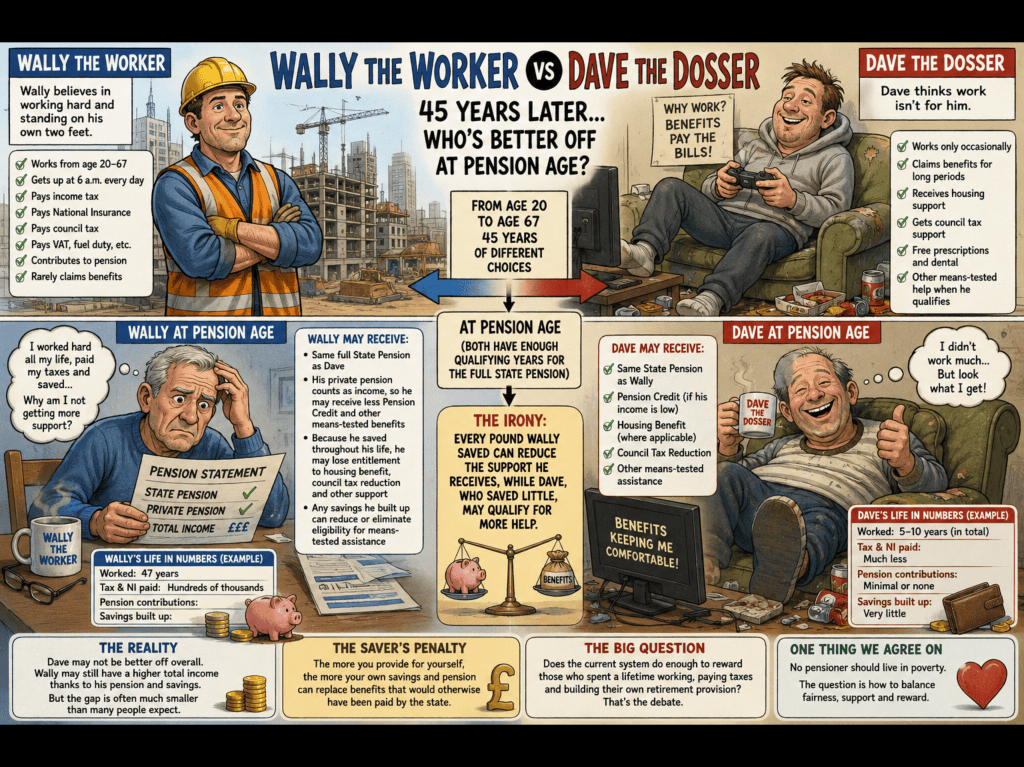
For nearly half a century, Wally the Worker did absolutely everything society told him to do. He got up before dawn, worked hard, paid his taxes, paid National Insurance, saved into a pension and put money aside for retirement. He genuinely believed the deal was simple: work hard, do the right thing, and you’ll be rewarded later in life.
Dave the Dosser took a very different path. Work was something he dipped in and out of whenever it suited him. For long stretches he relied on benefits, received housing support, council tax support, free prescriptions and a whole range of means-tested help whenever he qualified. He played the system as it was designed to be played.
Then comes retirement… and that’s where things start to feel deeply unfair. 🤔
💰 The Reward for Doing the Right Thing… Or Is It?
Wally reaches State Pension age expecting that decades of graft have earned him a secure, comfortable retirement.
Instead, he discovers something that leaves many taxpayers genuinely frustrated.
Both Wally and Dave can receive exactly the same full State Pension if they have enough qualifying National Insurance years, whether earned through relentless decades of work or simply credited through the system.
But that’s only the starting point.
Because Wally did the “responsible” thing and saved into a private pension, that very prudence now works against him. His pension counts as income. It reduces or wipes out entitlement to Pension Credit. His savings can drag down eligibility for Council Tax Reduction and other support. In effect, every pound he saved through discipline and sacrifice is treated as a reason to give him less help.
Dave, on the other hand, with little or no private income and minimal savings, can still qualify for Pension Credit, Council Tax Reduction, Housing Benefit (where it still exists), and a range of other means-tested support.
And this is where it starts to feel upside down.
Wally did everything “right” and is told to stand on his own two feet.
Dave did far less to prepare for retirement and is cushioned by the very system Wally spent his life funding.
It’s no wonder many people look at this and feel a growing sense of anger. 😠
It can leave Wally wondering, not entirely jokingly, whether he should have spent forty-seven years building a pension… or just taken life a bit easier and let the state pick up the slack. 📺
Now, to be absolutely clear, this doesn’t automatically mean Dave is living a life of luxury while Wally struggles. That would be an exaggeration. But the uncomfortable truth is that the gap between them is often far smaller than most people would expect given the massive difference in effort, discipline and lifetime contribution.
That’s why critics don’t just call it a “saver’s penalty” — they call it fundamentally perverse.
The more responsible you are, the more the system quietly takes away.
The less you prepare, the more support you may receive.
Supporters of the system argue that means-tested benefits exist to prevent poverty in old age, and that nobody should be left without basic support. That principle is widely accepted.
But critics ask a blunt question that is getting harder to ignore:
How long can a system survive where the person who worked, saved and contributed more ends up feeling like the mug?
Because at some point, responsibility stops feeling rewarded and starts feeling punished.
And that is exactly the message many younger workers are starting to notice.
After all, if the “right” choices lead to barely any better outcome, while the “wrong” choices are quietly cushioned, what exactly is the incentive to do the hard thing?
Perhaps Britain’s retirement advice should be rewritten in plain English:
“Work hard, save responsibly… and hope you didn’t do it too well, or you’ll lose the help you’re funding.” 🤷♂️💷
🔥 Challenges 🔥
Here’s the uncomfortable question.
Has Britain created a system that quietly penalises responsibility while rewarding dependency?
Should people like Wally receive clearer recognition and protection for doing everything right?
Or is it still fair that the system prioritises equal minimum living standards over rewarding lifetime contribution?
💬 We want to hear what you think.
Leave your views in the blog comments—not just on Facebook. Tell us whether Wally is right to feel cheated, whether Dave is simply acting rationally within the rules, or whether the entire structure needs serious reform.
👍 Like it. 🔄 Share it. 💥 Get the debate started.
🏆 The best comments will be featured in the next issue of the magazine.


Leave a comment