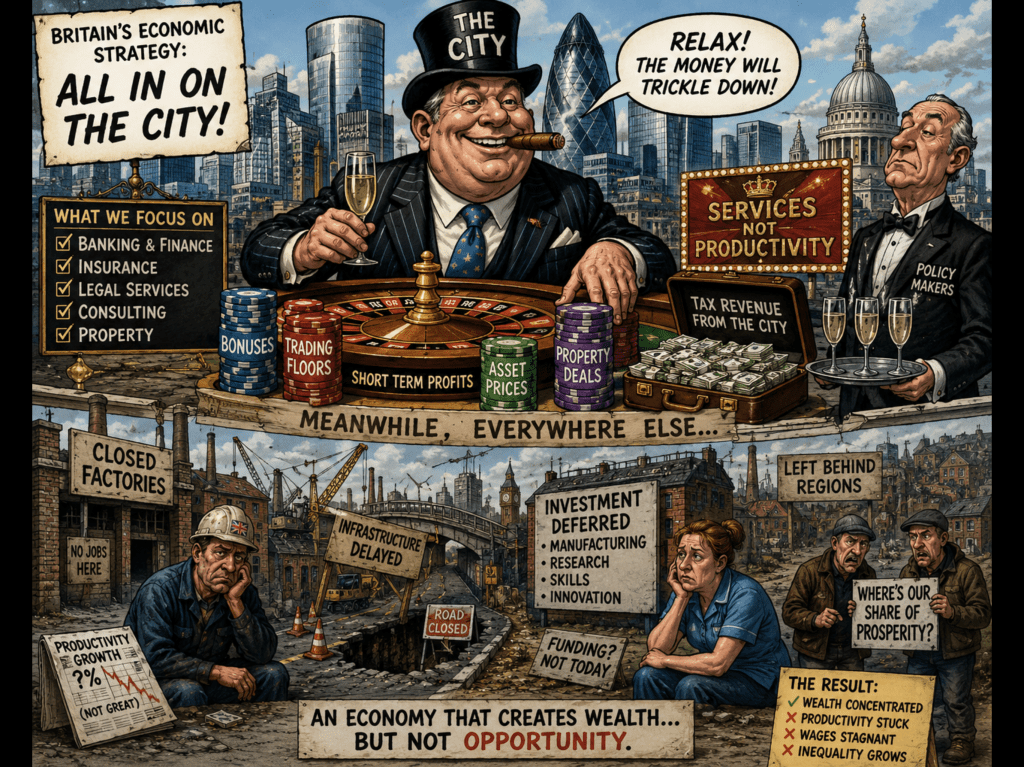
🎰🏦For years, Britain doubled down on a glittering belief: that the Square Mile could keep the entire nation afloat. While factories fell silent, apprenticeships dwindled, and infrastructure gathered dust, policymakers seemed convinced that if enough bankers shuffled enough money around Canary Wharf, prosperity would somehow trickle down to everyone else. Spoiler alert—it didn’t quite work out that way.
The UK didn’t stop making money. It simply became astonishingly good at making money from… money. Meanwhile, the industries that actually build things, invent things, and manufacture things were quietly shown the exit door like an unwanted guest at an exclusive cocktail party.
🏗️ Built on Sand? The Economy That Forgot How to Build
⚠️When the financial crash of 2008 exposed just how fragile the system had become, many hoped it would spark a national rethink. Perhaps Britain would invest in modern factories, cutting-edge technology, world-class transport, scientific research and the skilled workforce needed to compete with industrial powerhouses like Germany or South Korea.
Instead? We got years of cautious investment, delayed infrastructure projects, and an economy that continued putting most of its chips on finance, property and consultancy.
It’s a bit like owning a beautiful house but deciding the only room worth decorating is the living room. Sure, it impresses the neighbours—until the roof starts leaking, the wiring fails, and the kitchen falls apart.
The City of London remains one of the world’s financial giants, and that’s undeniably something Britain should celebrate. Banking, insurance, legal services and consultancy generate billions in exports and tax revenue.
But here’s the awkward question…
What happens when the wealth created inside gleaming skyscrapers never quite reaches the towns where factories closed decades ago?
Instead of flowing into new industries, cutting-edge manufacturing or ambitious start-ups, much of the available capital found its way into property. Houses became investment portfolios. Commercial buildings became financial assets. Prices climbed. Productivity… not so much. 📈🏠
The result is an economy that’s incredibly good at inflating asset values while often struggling to deliver the broad productivity growth and rising wages that ordinary workers were promised.
Britain didn’t become poor—it became uneven.
London surged ahead. Large parts of the Midlands, the North and coastal communities continued waiting for the “levelling up” train… which was frequently delayed due to “signal failures.” 🚆🙄
Meanwhile, countries investing heavily in manufacturing, automation and industrial innovation steadily improved productivity while Britain debated whether another luxury apartment block counted as economic growth.
Finance was never the villain. It was never supposed to be the entire plot.
The real criticism is that successive governments appeared content to let one incredibly successful sector shoulder responsibilities that should have been shared across a far broader economy.
Because an economy isn’t strongest when one engine is running flat out.
It’s strongest when every cylinder is firing. 🔧🇬🇧
🔥 Challenges 🔥
Is Britain still betting too heavily on finance while neglecting the industries that create long-term prosperity? Has investment been directed at the wrong places for too long? Or is the service-led economy simply the reality of the modern world?
We want to hear your verdict.
💬 Leave your thoughts in the blog comments—not just on social media. Challenge the argument, defend the City, or explain where you think Britain went wrong.
👍 If this struck a nerve, like it, share it, and get the debate rolling.
🏆 The best comments will be featured in the next issue of the magazine.


Leave a comment