When most people hear about illegal Channel crossings, they picture a Border Force boat meeting a dinghy in the English Channel.
But that is only the beginning of the bill.
By the time an individual reaches Britain, there is an entire system that has to process, house, support and, where appropriate, hear appeals. Much of that system is funded by the British taxpayer.
Whether you believe current immigration policy is too strict, too lenient or somewhere in between, understanding the scale of public spending is essential to having an informed debate.
Here is what the available official figures show.
Accommodation and Support
The largest identifiable cost is asylum accommodation and support.
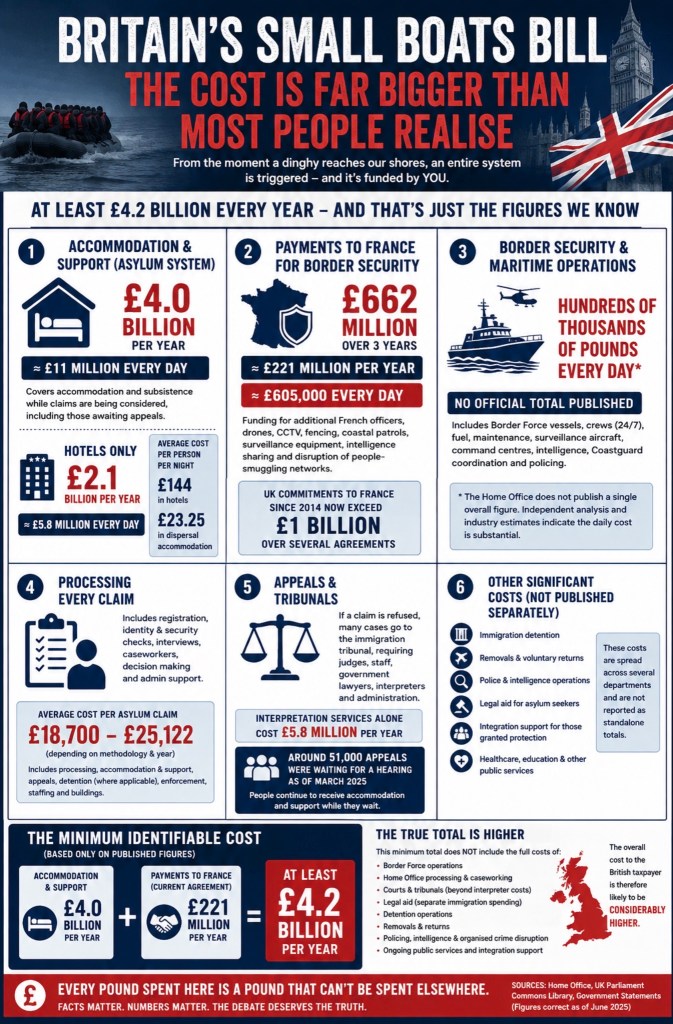
Official figures indicate this now costs around £4 billion every year.
That equates to approximately:
● £11 million every single day
● Around £458,000 every hour
● More than £7,600 every minute
Hotel accommodation alone accounts for approximately £2.1 billion annually, or around £5.8 million each day.
Payments to France
Successive British Governments have paid France increasing sums to strengthen border security.
The latest agreement commits approximately £662 million over three years.
That averages roughly:
● £221 million each year
● More than £600,000 every day
The funding is intended to pay for additional police officers, surveillance equipment, drones, fencing, intelligence sharing and coastal patrols.
Border Security
Protecting one of the world’s busiest shipping lanes is not cheap.
Border Force vessels, surveillance aircraft, command centres, intelligence teams, Coastguard coordination and policing all form part of Britain’s response.
The Government does not publish a single overall operating figure for these activities, but they clearly amount to hundreds of thousands of pounds each day, in addition to the accommodation costs already being incurred.
Processing Every Claim
Every asylum application requires:
● Registration.
● Identity checks.
● Security screening.
● Interviews.
● Caseworkers.
● Administrative support.
● Decision making.
Government estimates suggest the average asylum claim costs between approximately £18,700 and £25,100 once processing and related support are taken into account.
Appeals
If an application is refused, many cases proceed through the immigration tribunal system.
That requires:
● Judges.
● Court staff.
● Government lawyers.
● Interpreters.
● Administration.
● Continued accommodation and support while cases remain outstanding.
The Government does not publish one overall annual figure for appeals, although interpretation services alone cost several million pounds each year.
The Costs That Rarely Make Headlines
Beyond these headline figures are additional public costs that are harder to separate, including:
● Immigration detention.
● Removal operations.
● Voluntary return schemes.
● Police investigations into organised criminal gangs.
● Intelligence operations.
● Integration support for those granted refugee status.
● Ongoing healthcare and education where applicable.
Many of these costs are spread across several government departments and therefore rarely appear in one easily understood total.
At Least £4.2 Billion
Using only the figures that are publicly identifiable, Britain is already spending at least:
● £4 billion per year on asylum accommodation and support.
● £221 million per year on the current French border security agreement.
That produces a minimum identifiable cost of approximately £4.2 billion every year.
Importantly, this does not include the full costs of Border Force operations, Home Office processing, detention, removals, policing, courts or intelligence because those figures are either incorporated into wider departmental budgets or are not published separately.
The true overall cost is therefore likely to be considerably higher than the minimum identifiable total.
The Real Debate
This is not simply an argument about immigration.
It is also a debate about public finances.
Every pound spent responding to illegal Channel crossings is a pound that cannot be spent elsewhere without increasing taxation or borrowing.
Reasonable people can disagree on how Britain should respond.
Some will argue these costs are the unavoidable consequence of meeting humanitarian obligations.
Others will argue that preventing illegal crossings would reduce long-term expenditure and allow more resources to be directed towards legal migration, public services or border security itself.
Whichever view you take, the numbers deserve to be part of the conversation.
A country cannot make informed decisions if it does not first understand the price of the choices it is making.


Leave a comment