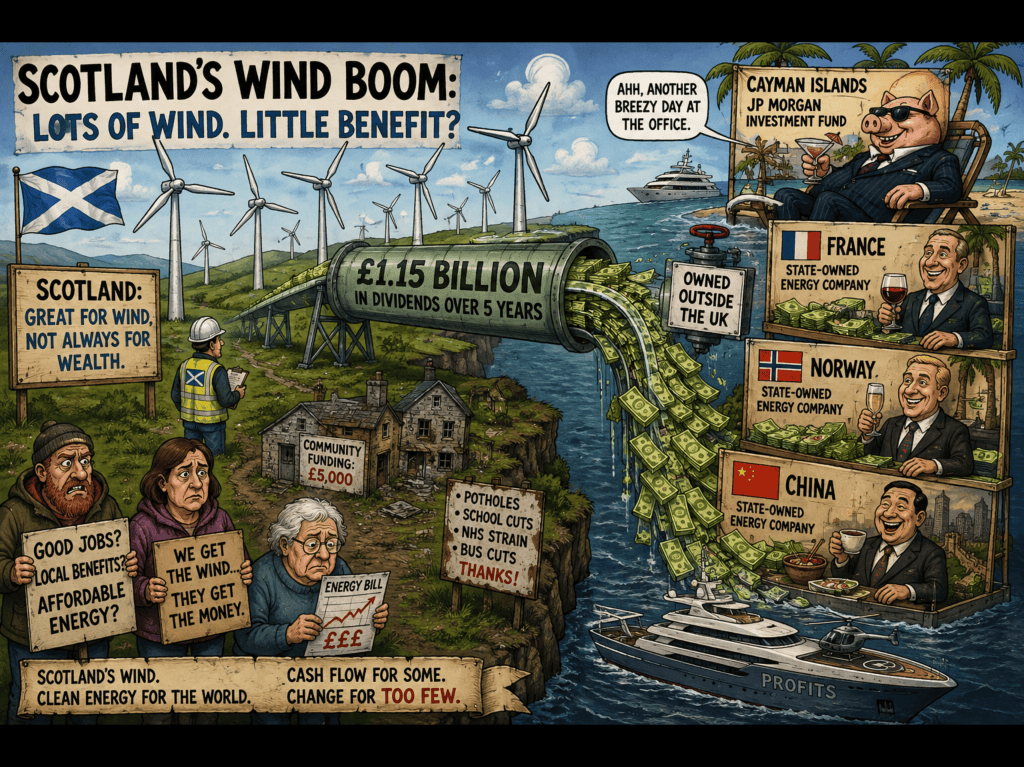
Scotland’s winds are among the most valuable natural resources in Europe, yet a growing debate asks a simple question: who is actually profiting from them?
An analysis by The Ferret of five years of company accounts from 37 major onshore wind farms found that projects ultimately owned outside the UK paid around £1.15 billion in dividends during that period. Those beneficiaries included a Cayman Islands investment fund managed by JP Morgan, as well as state-owned energy companies from France, Norway and China. 🌍💸
🌪️ Scotland Supplies the Wind, Others Collect the Breeze 💰
There’s something almost poetic about Scotland generating clean electricity while the profits catch a flight overseas.
For decades we’ve been told renewables would power not only homes but prosperity. Instead, many of the largest wind farms resemble a financial relay race: Scottish hills generate the electricity, multinational investors collect the dividends, and local communities are often left debating whether discounted village halls and community grants really amount to a fair share of billions.
Of course, the renewable industry has a point too. Building wind farms requires enormous upfront investment, and overseas investors were willing to take risks when domestic capital often wasn’t. Without that money, many projects might never have been built. They also argue the industry supports thousands of jobs, improves energy security and helps Scotland meet climate targets. ⚡🌱
Critics, however, ask why countries like Norway have built sovereign wealth from their natural resources while Scotland continues watching valuable assets pass into foreign ownership. If Scottish wind is such a golden opportunity, why do so many of the biggest financial rewards end up enriching pension funds and state-backed companies overseas rather than building long-term wealth at home?
The real question isn’t whether foreign investment is bad—it’s whether Scotland negotiated the best possible deal. After all, inviting someone to dinner is one thing; handing them the house keys before dessert is another. 🏡🔑
🔥Challenges🔥
If Scotland’s wind generates billions, should more of that wealth stay in Scotland? Should governments insist on greater public ownership, stronger community stakes, or higher returns for taxpayers? Or is overseas investment simply the price of getting renewable infrastructure built?
Tell us where you stand in the blog comments. Is this smart economics, missed opportunity, or simply the reality of global investment? 💬⚖️
👇 Comment, like and share if you think Scotland deserves a bigger slice of its renewable riches—or if you believe foreign investment is exactly what made the wind boom possible.
🏆 The best comments will be featured in the next issue of the magazine!


Leave a comment