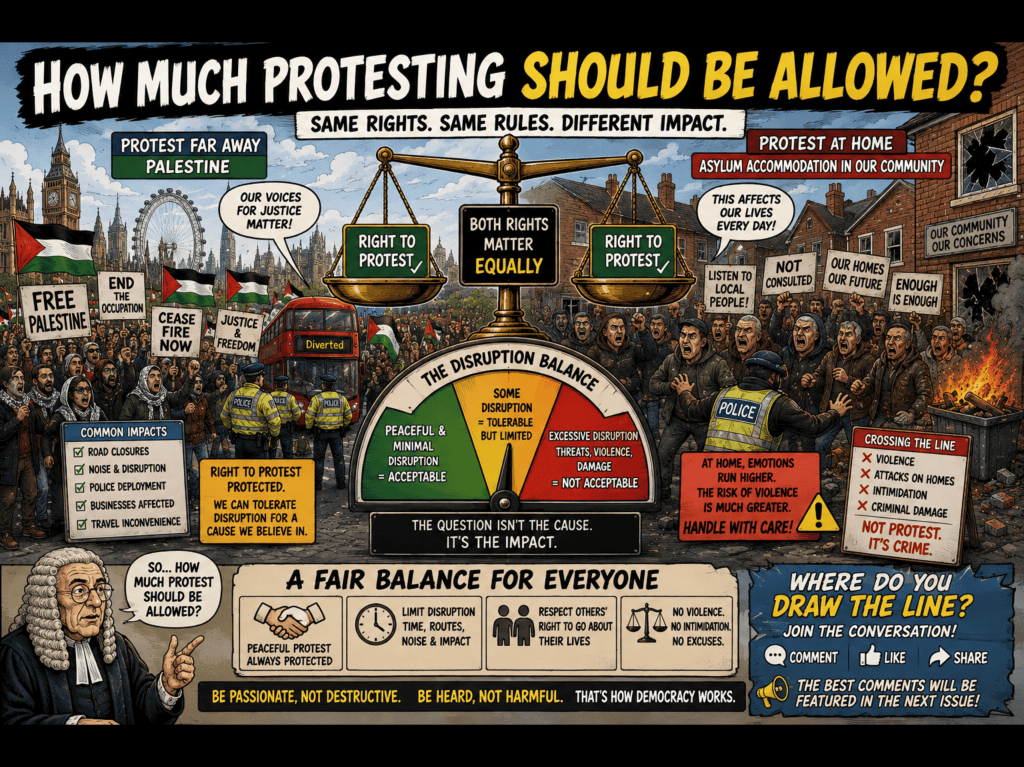
For years, London has become almost synonymous with large-scale demonstrations over Palestine. Weekend after weekend, thousands have filled the streets. Roads close. Buses are diverted. Police resources are stretched. Businesses lose trade. Commuters grit their teeth and accept the delays.
The justification is always the same:
In a democracy, people have the right to protest.
Fair enough. Most people would agree.
But what happens when the protest isn’t about events thousands of miles away—it’s about something happening on your own doorstep?
🤔 Same Right… Different Reaction?
In Thetford, residents have been protesting against asylum seekers being housed in their community.
Let’s be absolutely clear before anyone reaches for the outrage button. Peaceful protest is one thing. Violence is another entirely.
Homes reportedly attacked. Windows smashed. Police officers assaulted.
That’s not protest—that’s criminality. 🚔
No cause, no slogan, no political flag excuses violence or intimidation. Ever.
But beneath those criminal acts sits a far more uncomfortable question.
Why does disruption seem acceptable in some circumstances—but intolerable in others?
When tens of thousands march through London over an overseas conflict, we’re told inconvenience is simply the price of living in a democracy.
Road closures?
Accepted.
Heavy policing?
Necessary.
Businesses disrupted?
Part of democratic life.
Yet when communities protest over immigration or asylum accommodation affecting their own towns, the conversation often shifts remarkably quickly toward extremism, public order and demands for tougher policing.
⚖️ Democracy Doesn’t Work on a Favourites List
To be fair, this isn’t a simple case of one side getting away with everything.
Pro-Palestinian marches have faced restrictions, designated routes and arrests where laws have allegedly been broken. Public order legislation already exists to balance protest with public life.
And that’s exactly the point.
The law shouldn’t care what is written on the placard.
If peaceful protest is a democratic right, it remains a democratic right whether the cause is popular or unpopular.
If blocking roads eventually becomes unreasonable, then it shouldn’t matter whether the banner says PALESTINE, IMMIGRATION, CLIMATE, or anything else.
And if violence, intimidation and criminal damage are the red line—as they absolutely should be—then that line must apply equally to everyone.
Justice shouldn’t change colour depending on the flag being waved. ⚖️
🔥 Challenges 🔥
Here’s the uncomfortable question.
How much disruption should society be expected to tolerate before the right to protest begins to infringe on everyone else’s right to simply live their lives?
Should every cause be treated equally?
Should every protest face the same rules?
Or have we quietly drifted into a system where some disruption is celebrated while other disruption is condemned?
💬 We’d love to hear your view—but keep it respectful. Head over to the blog comments and tell us where you think the line should be drawn.
👍 Like it. 🔄 Share it. 💭 Start the debate.
The sharpest, most thoughtful comments will be featured in the next issue of the magazine!


Leave a comment