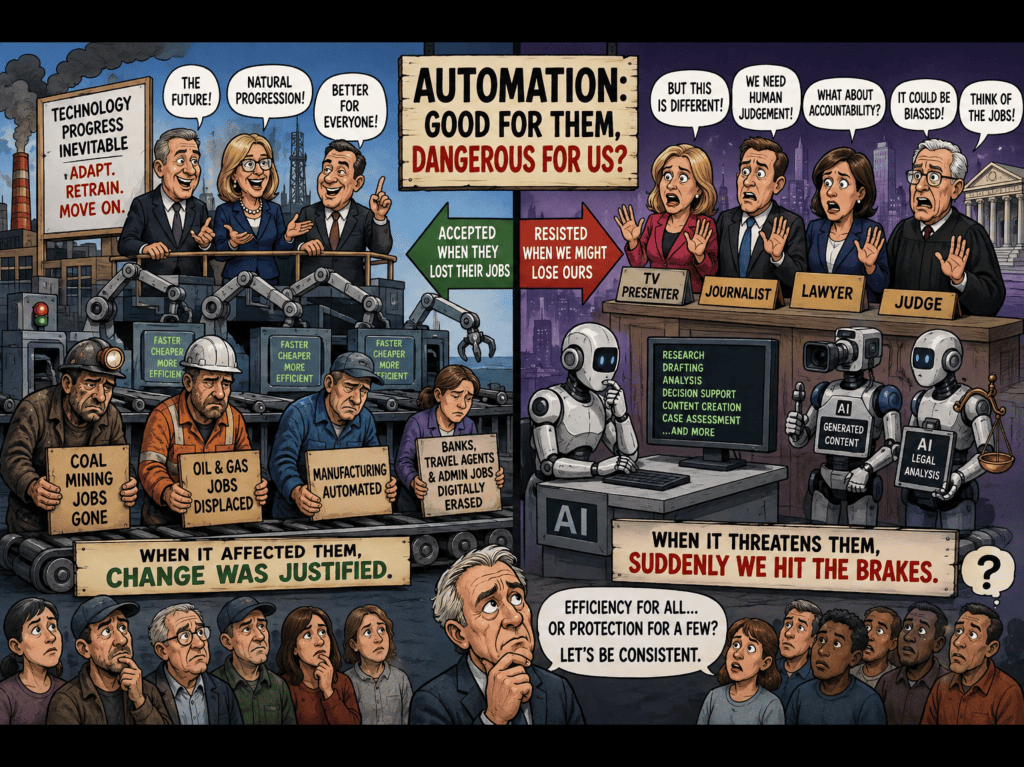
For decades, workers were told that technological progress was simply the price of progress. Coal miners watched pits close. Manufacturing workers saw robots roll onto factory floors. Bank staff disappeared as branches shut. Travel agents, call centres, and countless administrative roles were quietly hollowed out by digital technology.
The message was remarkably consistent: adapt, retrain, move on. Progress waits for no one.
Now, however, artificial intelligence is knocking on the doors of television studios, law firms, newsrooms and even courtrooms. Suddenly, the conversation has changed. The same technology that was once hailed as inevitable is now treated with far more caution when it threatens prestigious professions. 🤔
🎭 The Automation Rulebook Has Been Rewritten
When a factory worker lost their job to a robot, it was described as economic reality.
When an offshore worker faced redundancy because of automation or the energy transition, they were urged to embrace change.
When newspapers cut reporters because the internet transformed advertising, it was simply “the future.”
Yet mention AI replacing television presenters, journalists, lawyers or other influential professionals, and the language shifts overnight. Suddenly we’re warned about protecting careers, preserving expertise and slowing down technological change. Funny how “creative destruction” feels a lot less creative when it reaches the executive car park. 🚗💼
That doesn’t mean every concern is hypocritical. Some absolutely deserve serious attention.
Judges, for example, aren’t merely defending their profession. Courts deal with liberty, family disputes, criminal convictions and enormous financial consequences. Accountability, transparency and due process matter. Even if AI one day proves statistically less biased than humans, someone still needs to be legally responsible for life-changing decisions.
Likewise, a television presenter worried about losing their livelihood isn’t fundamentally different from a miner or factory worker who feared redundancy decades ago. Losing your income hurts regardless of whether you wear a hard hat or designer shoes.
The principle should remain the same for everyone.
🔥 Challenges 🔥
Here’s the uncomfortable question:
If society accepted automation when it mainly affected manual, industrial and administrative workers, should it also accept automation when it starts replacing highly paid professionals, media personalities and other influential occupations?
If the answer is yes, then the principle is consistent. Technology improves efficiency wherever it can.
If the answer is no, then we owe everyone an honest explanation of why some professions deserve protection while others were expected to quietly disappear.
💬 What do you think? Has society suddenly discovered compassion now that AI is climbing the career ladder—or are some professions genuinely different?
👍 Like, share, and most importantly, leave your thoughts in the blog comments. We want the arguments, the disagreements, and the hot takes.
🏆 The best comments will be featured in the next issue of the magazine.


Leave a comment