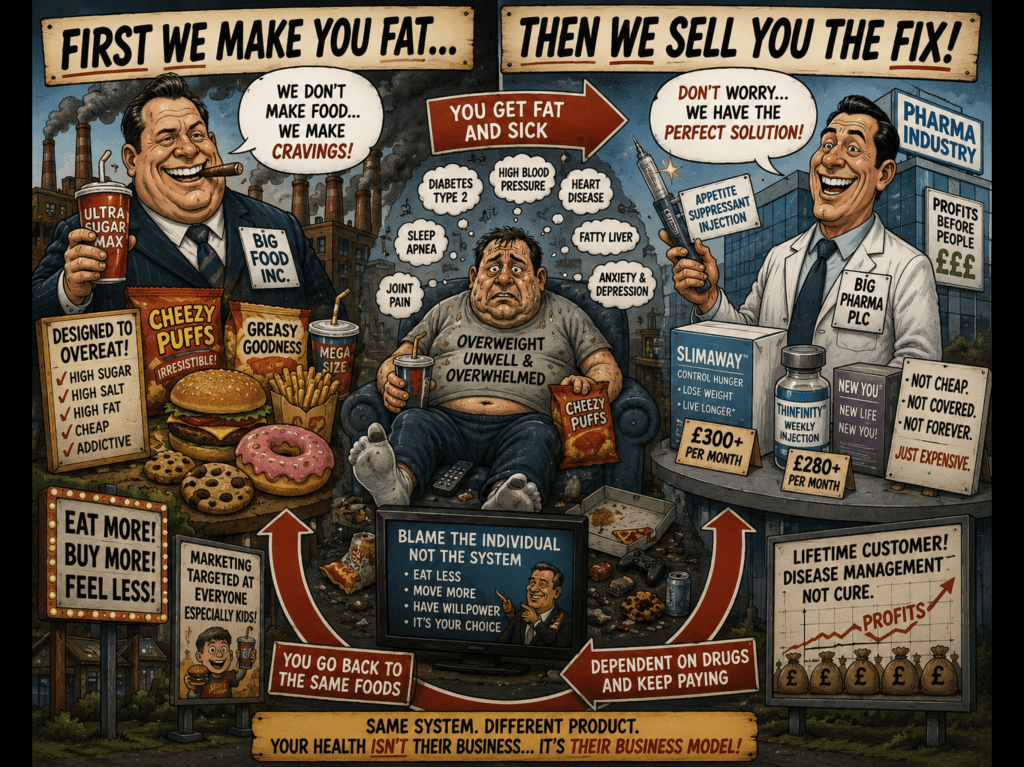
Think about how utterly bizarre modern life has become.
We have built a food environment overflowing with cheap, convenient, aggressively marketed products engineered to be extremely easy to eat—and extraordinarily difficult for some people to stop eating.
Then, when expanding waistlines and obesity become enormous public-health problems, along comes another industry with an extraordinary solution:
A pharmaceutical injection that can cost hundreds of pounds. 💉💷
Welcome to modern capitalism’s most impressive magic trick:
Monetise the appetite. Then monetise suppressing it.
🍩 Big Food Meets Big Pharma: Everybody Gets Fed Except Your Bank Account
To be clear, obesity isn’t simply caused by food companies, and modern weight-loss medicines weren’t invented as an antidote to “toxic food.” Genetics, biology, activity, sleep, environment, income and numerous other factors matter.
But stand back and look at the wider picture and it’s difficult not to appreciate the absurdity.
Walk into a supermarket and you’re surrounded by brightly packaged, heavily promoted foods designed around convenience and irresistible combinations of fat, refined carbohydrates, salt and sweetness.
BUY ONE GET ONE FREE! 🍕
FAMILY SIZE! 🍫
EXTRA CHEESY! 🧀
NOW WITH 30% MORE THING YOU DIDN’T NEED! 🎉
We made overeating remarkably convenient.
Then society spent decades telling people struggling with their weight:
“Have you considered simply having more willpower?”
Brilliant.
Now pharmaceutical science has produced powerful medicines that can substantially reduce appetite and help some people lose significant amounts of weight.
That’s a genuine medical development that can be enormously valuable for appropriate patients.
But culturally, the situation is almost too ridiculous for satire.
One enormous commercial machine spends billions persuading us:
EAT! EAT! EAT!
Another increasingly valuable commercial market says:
HERE’S SOMETHING THAT HELPS YOU NOT WANT TO EAT SO MUCH!
And the consumer stands between them holding a doughnut in one hand and an injection pen in the other, wondering how civilisation reached this particular checkpoint. 🍩🤷💉
Imagine explaining it to somebody 100 years ago.
“In the future we’ll have more food than previous generations could dream of.”
Wonderful!
“Some of it will be marketed relentlessly and available virtually everywhere.”
Right…
“Millions of people will struggle with obesity.”
Oh.
“Then we’ll develop sophisticated drugs that suppress appetite and charge substantial sums for them.”
Hang on.
“Anyway, welcome to progress.” 🚀
Perhaps the question shouldn’t only be whether these drugs work.
Perhaps we should also ask why demand for them has become so enormous.
Why do we spend fortunes treating obesity while simultaneously maintaining an environment in which calorie-dense, heavily marketed food is everywhere?
Why is the individual constantly lectured about personal responsibility while some of the world’s most sophisticated marketing machines are competing for that individual’s appetite?
And if medication becomes an increasingly important answer to obesity, are we fixing the underlying environment—or simply becoming considerably better at treating its consequences?
There’s something uniquely modern about constructing an environment that encourages consumption and then developing another enormously profitable industry to help people resist it.
Breakfast sponsored by the food industry.
Weight loss sponsored by the pharmaceutical industry.
Your wallet sponsored by absolutely nobody. 💷🔥
🔥 Challenges: Are We Treating the Disease—or Monetising the Cycle? 🔥
Weight-loss medicines may transform lives, and for some patients they can be serious medical treatments rather than cosmetic shortcuts.
But here’s the uncomfortable question:
How did we reach a point where expensive appetite-suppressing medication can seem like a rational response to a food environment constantly encouraging us to consume more?
Should governments concentrate harder on prevention, food formulation, marketing and nutrition—or are these medicines simply the next logical tool for tackling obesity?
💬 Tell us what you think in the blog comments: are weight-loss injections a medical revolution, evidence of a broken food system, or somehow both at once?
👇 Comment, like and share. And ask the awkward question neither industry particularly enjoys: who profits from the cycle? 🍔➡️💉➡️💷
The best comments, arguments and gloriously uncomfortable observations will be included in the magazine. 🎯📰


Leave a comment