This story is no longer merely about whether Professor Jason Arday committed plagiarism.
It is about something potentially much more embarrassing for one of the world’s most prestigious universities:
What exactly did Cambridge check before appointing him?
Arday arrived with an extraordinary story: severe childhood difficulties, a remarkable academic rise and, in 2023, appointment as Cambridge’s professor of sociology of education. His appointment was widely celebrated, including his status as the youngest Black professor appointed at Cambridge. (The Guardian)
Then came the questions.
Questions about published work.
Questions about academic affiliations.
Questions about elements of his public biography.
Questions serious enough that Cambridge eventually opened an investigation after saying it had received new information. Arday subsequently resigned while denying that he was a fraud or liar. (The Guardian)
And suddenly the uncomfortable question isn’t just:
“What did Jason Arday do?”
It is:
“What did Cambridge do?” 🔍
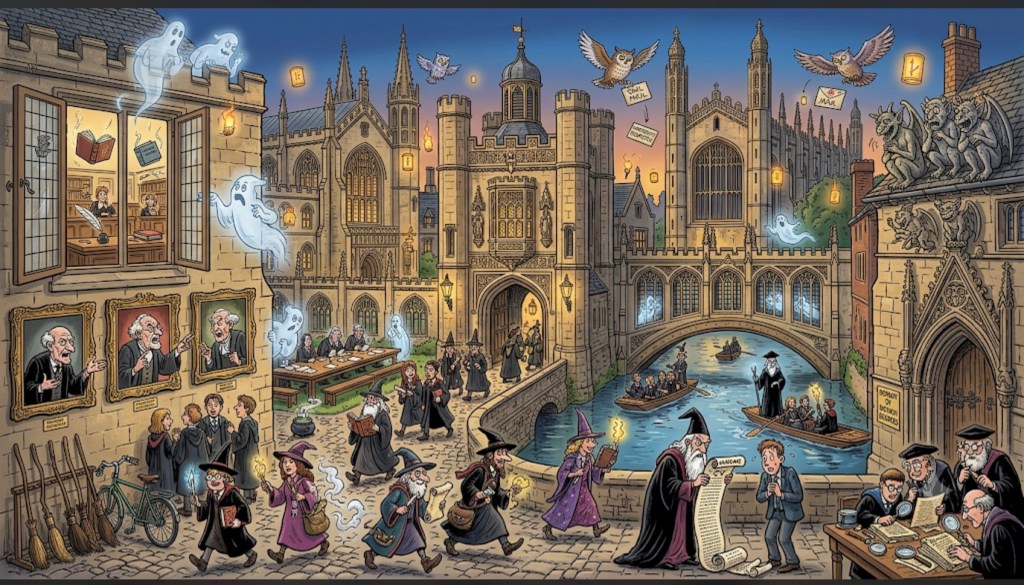
🧐 Nine Academics Walk Into an Appointment Panel… Apparently Nobody Brings a Magnifying Glass
According to reporting by The Times, Arday’s appointment was approved unanimously by a nine-member Board of Electors.
Nine.
Not one enthusiastic manager.
Not a distracted HR assistant approving a CV between Teams meetings.
Nine senior selectors. (The Times)
Presumably Cambridge does not appoint professors by placing CVs in a sorting hat and shouting, “Sociology!”
These are prestigious academic appointments.
The entire point of such a process is scrutiny.
Candidates are supposed to be examined, compared, questioned and assessed.
So when subsequent reporting produces a growing catalogue of disputes and discrepancies, ordinary people are entitled to ask an almost comically basic question:
What was actually verified?
Did anybody systematically examine the publication record?
Did anybody independently verify claimed appointments and affiliations?
Did anybody investigate unusual claims?
Did anybody compare what was written on paper with independently obtainable evidence?
Or did everybody become so dazzled by the extraordinary narrative that the normal academic microscope got left in a cupboard somewhere behind the port? 🍷🔬
Because Cambridge wasn’t merely hiring somebody.
It was hiring somebody into Cambridge.
You know — the place internationally famous for examining things.
🔥 Challenges
Here is where the story becomes awkward.
Within months of Arday’s appointment, academics David Harris and Martyn Hammersley were raising concerns about a 2018 publication. The article was subsequently removed from its online platform while concerns were addressed, and Hammersley reportedly urged Cambridge to examine Arday’s wider publication record. (The Times)
That is not proof that every allegation subsequently made against Arday is true.
It is, however, exactly the sort of flashing dashboard light that normally encourages sensible people to open the bonnet.
Instead, reporting says Professor Hilary Cremin, then head of Cambridge’s Faculty of Education, expressed strong support for Arday. (The Times)
Supporting an employee when allegations emerge is perfectly reasonable.
Supporting somebody and investigating properly are not mutually exclusive.
That distinction matters enormously.
Because universities routinely tell students:
Check your references.
Verify your evidence.
Interrogate assumptions.
Challenge authority.
Follow the data.
Do not accept claims simply because somebody impressive makes them.
Wonderful principles.
Perhaps somebody should laminate them and stick them above the recruitment desk. 📚
The irony here could generate enough electricity to power half of Cambridgeshire.
Arday’s response to some questioning also became part of the controversy. The Times reported that Harris was eventually told not to contact him again, and that subsequent contact was reported to police, who took no further action. (The Times)
Again, none of that proves the underlying academic allegations.
But academic scrutiny cannot function if legitimate questions about published research are automatically treated as personal hostility.
The traditional academic response to:
“Can you explain this evidence?”
is generally supposed to involve…
explaining the evidence.
Not producing an ideological smoke grenade and sprinting towards the nearest grievance procedure. 💨🏃
And this is where Cambridge’s problem grows considerably larger than one professor.
Nearly 100 academics have reportedly called for a fuller independent examination of the affair, criticising aspects of how the appointment and subsequent controversy were handled. Cambridge has announced a review of senior hiring, while Glasgow University has also begun reviewing how Arday was appointed there. (The Guardian)
That matters.
Institutions rarely start reviewing recruitment procedures because absolutely everything went magnificently.
Perhaps Cambridge’s biggest mistake was not appointing Arday.
Perhaps it was becoming too emotionally invested in what his appointment represented.
His race mattered publicly.
His age mattered publicly.
His childhood story mattered publicly.
His extraordinary rise mattered publicly.
The appointment became more than an appointment.
It became a narrative.
And narratives are dangerous things when institutions begin believing them more enthusiastically than they verify them.
Because eventually somebody walks into the room carrying the least fashionable object in modern public life:
a list of questions. 📝
This controversy should not become an excuse for racism against Arday or Black academics generally. Indeed, some Black academics have warned that the affair is already being weaponised to attack diversity efforts more broadly. (The Guardian)
Nor does criticism of Cambridge’s appointment process establish that Arday committed deliberate academic fraud. He has disputed serious allegations against him, and an earlier Liverpool John Moores University investigation did not uphold plagiarism allegations relating to his PhD. (The Guardian)
Those qualifications matter.
But they do not make the institutional questions disappear.
Nine selectors reportedly approved the appointment unanimously.
Cambridge celebrated it enthusiastically.
Concerns about published work appeared soon afterwards.
Further questions followed.
Arday resigned.
Cambridge is now examining aspects of what happened.
So perhaps the most important examination Cambridge conducts this year will not involve students at all.
It will involve Cambridge examining Cambridge. 🎓🔍
What did the selectors verify?
What warning signs appeared?
Who examined them?
What safeguards existed?
And were normal standards of scepticism weakened because everybody desperately wanted an extraordinary story to be true?
Those questions deserve answers regardless of anybody’s politics, race or position on diversity.
Because if Cambridge ultimately discovers that its procedures were rigorous, it should publish enough detail to demonstrate that.
And if they weren’t?
Then the uncomfortable lesson will be spectacularly simple:
one of the world’s greatest centres of critical thinking may have forgotten to think critically when it mattered most. 🎯
👇 What do you think Cambridge should disclose about the appointment process? Were the checks good enough, or did institutional enthusiasm overpower institutional scepticism?
Drop your verdict in the blog comments — not just on Facebook. 💬🔥 Like it, share it, argue with it, challenge it.
The best comments, counterarguments and glorious academic flamethrowers will be featured in the magazine. 📝🎯


Leave a comment