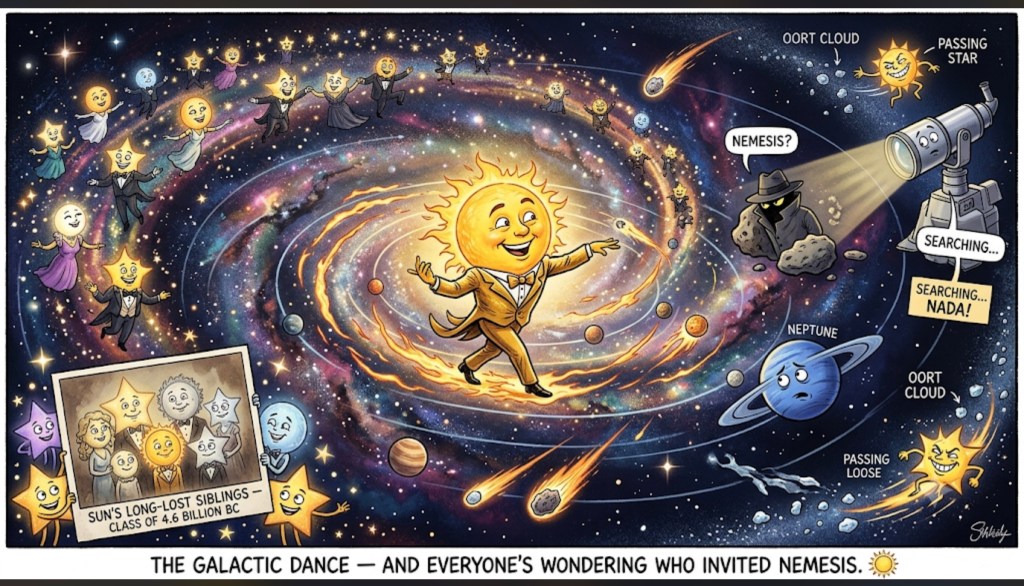
☀️💃🌌For decades, astronomers have entertained the deliciously ominous possibility that our Sun might have a dark, faint companion lurking somewhere beyond the planetary suburbs. They even gave this hypothetical cosmic stalker a suitably cheerful name: Nemesis. Unfortunately for fans of celestial conspiracy, infrared surveys have repeatedly failed to uncover the proposed hidden heavyweight. So, no sinister second Sun currently appears to be skulking behind Neptune waiting for its dramatic entrance.
🌠 Forget Nemesis — The Whole Galaxy Is Already Dancing
The Sun isn’t parked in space like a patio heater nailed to the universe. It is hurtling around the Milky Way at roughly 230 km/s, dragged through a gravitational ballroom filled with stars, spiral arms, molecular clouds and enough invisible forces to make Strictly Come Dancing look mechanically straightforward. 💫
Nearby stars are doing the same thing: sweeping past, drifting away and occasionally wandering comparatively close before vanishing back into the Galactic crowd. Thanks to missions such as Gaia, astronomers can reconstruct those movements with astonishing precision.
And then comes the genuinely romantic bit.
The Sun was probably born alongside many other stars inside a stellar nursery around 4.6 billion years ago. Those siblings were gradually scattered across the Milky Way, meaning our Sun may have thousands of long-lost brothers and sisters cruising around the Galaxy with absolutely no intention of attending the family reunion. 🌟🥲
So the cosmic scorecard looks something like this: a secret second Sun permanently orbiting ours is extremely unlikely; gravitational encounters with other stars are absolutely real; and the vast intertwined motions of stars around the Milky Way really can be described as an immense gravitational dance.
The truly interesting question is what happens when one of those dancers gets a little too close.
Stars occasionally pass near the Solar System, and sufficiently close encounters can disturb distant objects in regions such as the Oort Cloud. Astronomers can even calculate some future stellar flybys. Which means space isn’t merely dancing—it occasionally throws an elbow. 🕺💥☄️
🔥
Challenges
🔥
What if the biggest mysteries of the Solar System aren’t hiding in some undiscovered twin Sun at all, but in the billions of years of stellar encounters we’ve already forgotten?
Could ancient flybys have shaken comets toward the inner Solar System? Could one of the Sun’s lost siblings someday be identified? And how many cosmic near-misses have happened without Earth ever noticing?
💬 Drop your theory in the blog comments. Nemesis believer, Galactic-dance enthusiast or unapologetic cosmic sceptic—we want the argument.
👇 Comment, like and share the post. Bring your best astronomical hot take. 🌌🔥
The best comments will be included in the magazine. 🎯📝


Leave a comment