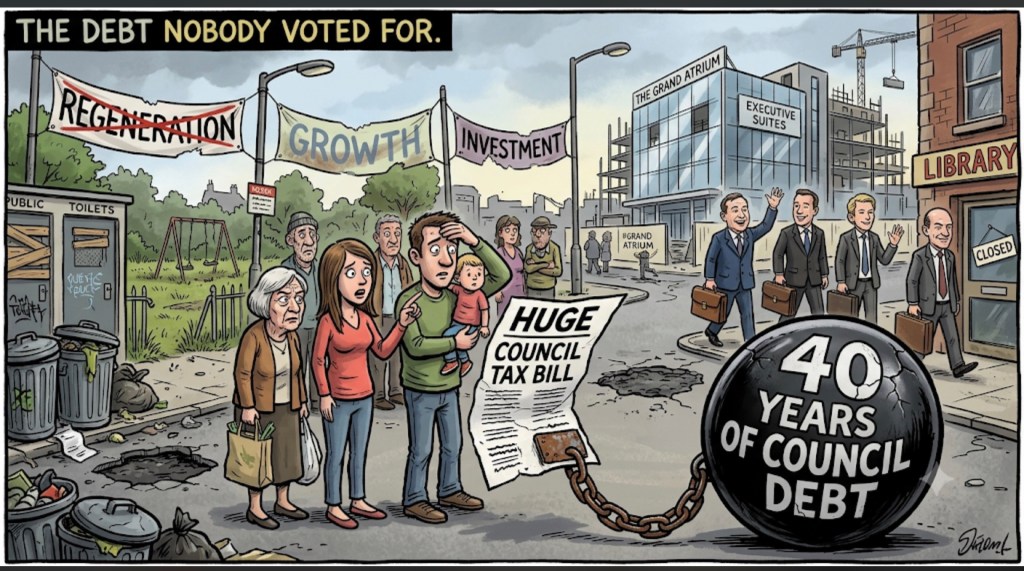
💷🏗️Imagine moving into a town ten years from now.
You buy a house, start paying council tax and reasonably expect that money to help fund the things around you: roads, bins, schools, parks, social care, libraries, public spaces and the services people rely on every day.
But before you have even paid your first bill, part of that money may already be spoken for.
Not because of anything you voted for.
Not because of a decision made by the councillors currently sitting in office.
But because years earlier, somebody approved a major borrowing scheme tied to a regeneration project, commercial development, new headquarters, shopping complex or some other grand vision that was supposed to transform the area.
At the time, the presentation probably looked magnificent. There would have been glossy artist impressions, optimistic forecasts, confident statements about jobs, growth, visitors, business rates and increased income. Councillors may have stood beside giant boards showing what the future was supposed to look like.
Then reality arrived.
Construction costs rose. Interest rates changed. Tenants failed to appear in the numbers predicted. Consumer habits moved on. The economy shifted. The promised boom quietly turned into a shrug.
The people who approved the scheme may have moved on by then.
The politicians may have lost their seats or retired. Senior officers may have taken jobs elsewhere. Consultants may have finished their contracts. Developers may have collected their money and disappeared onto the next project.
But the debt does not retire.
The debt does not lose an election.
The debt does not move to another council.
It sits there patiently, year after year, waiting to be paid. 💷
The Grand Vision Leaves, the Invoice Stays
🧾This is the strange thing about public borrowing.
A project can be politically fashionable for five years and financially relevant for forty.
That creates a dangerous mismatch between the lifespan of responsibility and the lifespan of debt.
A councillor might be in office for four years. A chief executive might stay for ten. A consultant might be involved for eighteen months. Yet the borrowing attached to the project could still be draining money from council budgets decades later.
And when those repayments begin to bite, they rarely arrive labelled honestly.
You do not normally receive a council leaflet saying, “Your library is closing because a commercial gamble approved fifteen years ago failed to deliver.”
Instead, the language changes.
Suddenly there are “budget pressures”.
There are “financial challenges”.
There are “efficiency savings”.
There are “difficult decisions”.
There is always a tremendous supply of professional vocabulary when the money has disappeared. 📉
The road full of potholes is not described as an interest payment.
The public toilet that closes is not called a debt consequence.
The community centre losing funding is not introduced as the price of yesterday’s optimism.
The care service being squeezed is not presented as the hidden cost of a failed development.
Yet financially, these things can all become connected.
Every pound committed to servicing old borrowing is a pound that cannot be freely spent somewhere else.
That is the part of public debt that deserves far more attention.
Debt is not simply money owed.
Debt is future choice already spent.
When Investment Starts Dressing Up as Speculation
🎭None of this means councils should never borrow.
That would make no sense.
Borrowing to build a school that serves generations of children can be perfectly reasonable. Borrowing for flood defences, bridges, social housing, essential infrastructure or major repairs can also make strong financial and social sense.
If people will benefit from an asset for decades, spreading the cost across those decades can be entirely justified.
The real problem begins when public investment starts behaving more like commercial speculation.
There is a huge difference between borrowing to replace a dangerous school building and borrowing because somebody believes the council should become a property developer.
Private developers risk investor money.
Businesses risk shareholder money.
Councils risk public money.
And taxpayers are not voluntary investors.
They did not sit down with a prospectus, study the risks and decide to buy shares in the local authority’s latest property adventure.
They cannot sell their stake if the strategy looks disastrous.
They cannot ring a broker and say, “I think the shopping centre plan is going badly, get me out.”
They live there.
And if the project fails, they remain there when the repayments arrive.
That is why commercial borrowing by councils should face a much higher burden of justification than borrowing for essential public infrastructure.
Because the rewards and risks are not distributed equally.
If a project succeeds, the politicians responsible can talk about vision, regeneration and legacy.
If it fails years later, the people who approved it may be nowhere to be seen.
The debt simply becomes somebody else’s problem.
Congratulations, Future Resident — You’ve Inherited a Mortgage
🏠💸This is where the issue becomes genuinely uncomfortable.
One generation of decision-makers can commit the income of another generation of taxpayers.
Those future taxpayers may never have seen the original business case.
Some may have been children when the decision was approved.
Some may have lived hundreds of miles away.
Some may not even have been born.
Yet one day they move into the area, receive a council tax bill and begin contributing towards financial decisions made decades before they arrived.
It is almost like buying a house and discovering halfway through the paperwork that you have also inherited the previous owner’s failed restaurant investment.
“Welcome to the neighbourhood. The bins are collected every three weeks now, but on the bright side, you also own 0.00003% of an empty retail development nobody wanted.” 🏬
This is why major council borrowing should never be buried beneath hundreds of pages of committee language, forecasting tables and financial jargon.
Residents should be able to understand the real commitment being made.
They should know the total amount being borrowed, how long the debt is expected to last, what interest could cost, how much annual repayment is expected and what happens if the income assumptions fail.
They should also be told how much of the council’s future income will already be committed after the project proceeds.
Because that is the number that really matters.
Not just what the project costs today.
But how much freedom tomorrow loses.
The Question Every Council Should Have to Answer
🔥When politicians announce that there is “no money” for something the public considers important, perhaps residents should start asking a different question.
Not simply, “Why is there no money?”
But:
How much of tomorrow’s money has already been spent?
That question should sit at the centre of every major council borrowing decision.
Because a £40 million development is not merely a £40 million development if interest, refinancing, maintenance, vacancies, declining income and decades of repayments follow behind it.
The full cost can stretch far beyond the photograph of politicians cutting the ribbon.
And that ribbon-cutting photograph is rarely taken beside the future council tax bills.
The greatest danger is not borrowing itself.
The danger is borrowing without visible responsibility.
It is making long-term commitments when the people approving them may face only short-term political consequences.
Councils should absolutely invest in the future.
But the bigger the gamble, the clearer the explanation should be.
If taxpayers are expected to carry the downside, they deserve far more than optimistic forecasts and attractive CGI buildings.
They deserve to know exactly what is being placed on tomorrow’s shoulders.
🔥Challenges🔥
So here is the uncomfortable question.
Should councillors be allowed to approve borrowing that future generations will still be paying long after the original decision-makers have disappeared?
And should every major council project be required to show residents, in plain English, exactly how much future income is being committed before a single vote is cast?
Because when a grand project fails, taxpayers do not get to walk away.
They are still there.
The council tax still arrives.
And eventually, so does the bill. 💷📬
Have your say in the blog comments. Tell us whether councils need stronger controls, clearer debt disclosures and far more public scrutiny before borrowing millions in the name of regeneration. Like it, share it and send it to someone who has ever wondered where their council tax really goes. 💬🔥
The best comments and strongest arguments will be featured in the magazine. 🎯📝


Leave a comment