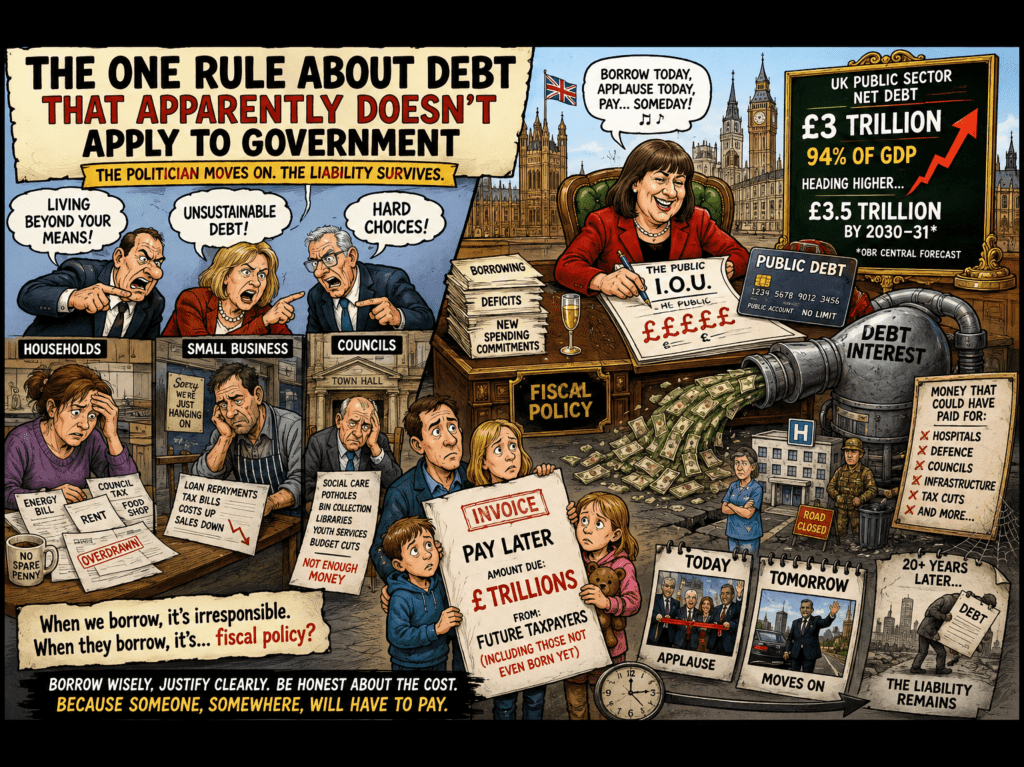
💳🏛️When ordinary people borrow too much, they’re “living beyond their means.” When businesses pile up liabilities, they’re warned about “unsustainable debt.” When councils run into trouble, suddenly everyone discovers the sacred scriptures of fiscal responsibility.
But when central government borrows hundreds of billions?
Apparently that’s not debt. That’s fiscal policy wearing a lanyard. 🎩📊
There are perfectly sensible reasons why a sovereign government’s finances are different from a household budget. Governments can tax, issue long-term debt, invest in infrastructure and manage borrowing across economic cycles. But somewhere along the way, “government debt is different” has occasionally mutated into the far more convenient idea that government debt barely matters at all.
It does.
Because the bill doesn’t vanish when the press conference ends.
💷 Welcome to the Great Westminster Credit Card — Minimum Payment Optional
Britain’s public debt now sits around the £3 trillion mark, with debt interest competing directly with hospitals, defence, local services, infrastructure and tax cuts.
That’s the bit political speeches tend to glide past.
Borrow today.
Announce something shiny tomorrow.
Cut a ribbon next Thursday. 🎀📸
Then allow some future Chancellor, council leader and generation of taxpayers to discover that the financial equivalent of the hotel minibar has been emptied.
Of course, not all borrowing is foolish. Borrowing billions for infrastructure that genuinely boosts productivity for decades can make economic sense. Borrowing repeatedly to cover ordinary spending because expenditure continually exceeds revenue is a rather different creature.
And that should be the test.
What was borrowed? What was it spent on? What return will it produce? Who carries the risk? And who eventually pays?
Instead, political debate often deteriorates into something resembling a family argument where everybody agrees the credit card bill is outrageous but nobody can remember who ordered the inflatable hot tub. 🛁💸
It is also too simplistic to pin every increase in national debt on whichever Chancellor currently occupies No. 11. Governments inherit deficits, debt-servicing costs, existing commitments, inflation-linked liabilities and economic conditions established years earlier.
But that doesn’t make scrutiny less important.
It makes it more important.
Because government debt has one remarkable superpower:
The politician disappears.
The debt doesn’t.
The minister moves on.
The Chancellor changes.
The council leader retires.
The ribbon-cutting photographs yellow with age.
And somewhere, twenty years later, somebody is still paying for the ribbon. 🎀🧾
🔥Challenges🔥
Here’s the question politicians rarely seem thrilled to answer:
If borrowing is irresponsible when you do it, why does it become sophisticated economics when they do it?
Government borrowing can absolutely be justified—but shouldn’t every major borrowing decision come with a brutally clear explanation of the cost, expected benefit and eventual taxpayer liability?
Because “future generations will sort it out” is not an economic strategy. It’s leaving the restaurant before the waiter brings the card machine. 🍽️🏃
👇 Comment on the blog and tell us where YOU draw the line between sensible investment and political spending on tomorrow’s tab. Like it, share it, argue with it—and send it to somebody who thinks government money grows naturally behind the Treasury. 💬🔥
The best comments, burns and arguments will be included in the magazine. 🎯📰


Leave a comment