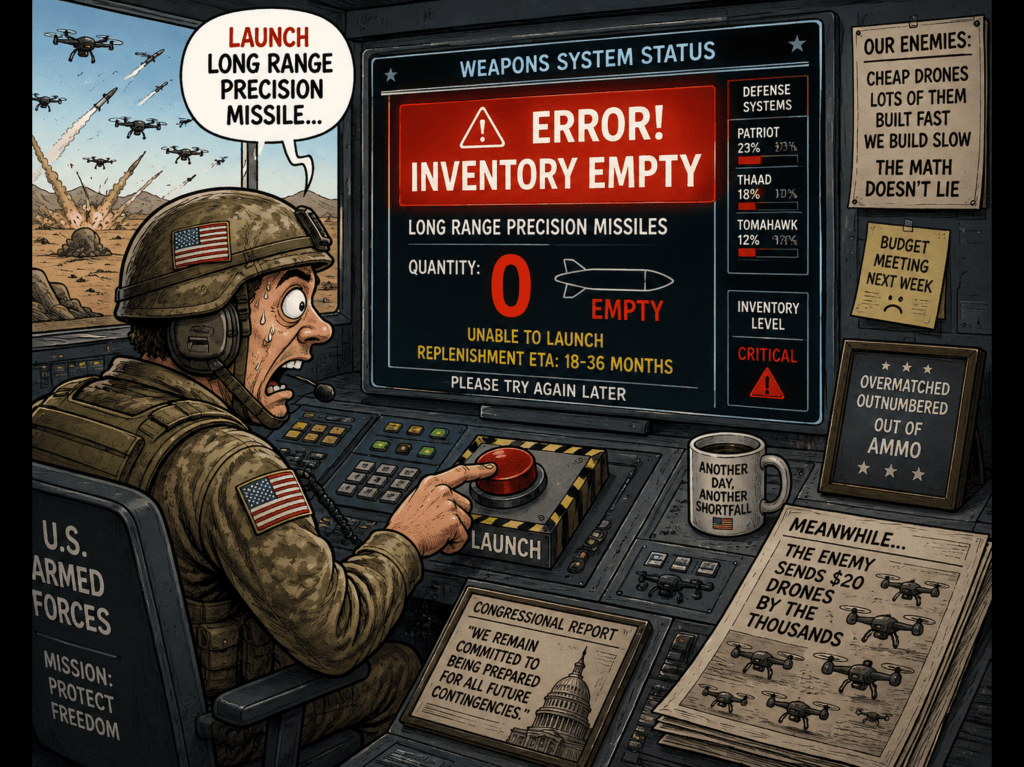
America has spent decades developing some of the most sophisticated weapons ever created. Its missiles can travel enormous distances, intercept extraordinarily difficult targets and strike with a level of precision that previous generations of military planners could barely have imagined.
There is, however, an increasingly uncomfortable question hanging over all that technological brilliance:
What happens when you start using these extraordinarily expensive weapons faster than you can replace them?
That is one of the lessons emerging from America’s confrontation with Iran. It isn’t simply a question of whether American weapons work. Many work extraordinarily well. The problem is that technological superiority and economic sustainability are not necessarily the same thing.
💸 Welcome to the Most Expensive Game of Whack-a-Mole Ever Invented
Modern warfare has produced a wonderfully absurd economic equation. Your opponent launches something relatively inexpensive. You respond with an exquisitely engineered interceptor costing vastly more.
The target disappears.
Everyone cheers.
Then somebody from procurement quietly enters the room carrying a calculator. 🧮
Iran has invested heavily in comparatively inexpensive drones and missiles. America, meanwhile, possesses some of the world’s most sophisticated defensive systems. Different interceptors are designed for different threats, so simplistic dollar-for-dollar comparisons can be misleading, but the underlying problem remains brutally straightforward.
If your enemy can manufacture threats much faster and more cheaply than you can manufacture the weapons required to destroy them, every successful interception can still contribute to a strategic problem.
That doesn’t mean America should simply allow dangerous drones or missiles through because shooting them down isn’t financially attractive. Obviously not. If a relatively cheap weapon is heading towards a billion-dollar warship, an airbase or a populated area, destroying it with an expensive interceptor may be an extremely sensible transaction.
The real question comes afterwards.
How many expensive interceptors do you have, and how quickly can you manufacture replacements?
That is where the swagger of modern military technology collides with the considerably less glamorous world of factories, supply chains, skilled workers, specialist components and production schedules.
America isn’t simply discovering the cost of warfare.
It is rediscovering the importance of industrial warfare.
For decades, Western military thinking has increasingly prized extraordinary capability. Better sensors. Greater accuracy. Longer range. More sophisticated electronics. Weapons capable of accomplishing things that would once have required entire formations of aircraft.
And there is an obvious logic behind that approach.
Why fire twenty weapons when one extremely accurate weapon can accomplish the mission?
But that philosophy becomes vulnerable when the enemy changes the question.
Instead of asking, “Can we build something technologically superior to America’s missile?” an adversary can ask:
“Can we build enough cheap threats to make America keep firing its expensive missiles?”
Suddenly the world’s most technologically advanced military is participating in the world’s most violent economics lesson.
Iran doesn’t necessarily need every drone to penetrate American defences.
Some merely need to force a response.
Every interceptor fired is one fewer interceptor sitting in a magazine waiting for the next attack. And when the replacement cannot roll off the production line tomorrow morning, ammunition becomes something more important than a weapon.
It becomes time.
That is why reports about pressure on American weapons inventories matter so much. America is certainly not simply “out of weapons,” and enormous care is required when discussing classified stockpile levels. But reports that important categories of precision weapons and interceptors have been heavily consumed raise an obvious strategic concern.
Because America’s military responsibilities don’t conveniently stop while the factories restock the shelves.
There is Europe.
There is the Middle East.
There is the Indo-Pacific.
There are treaty allies expecting American protection.
And looming behind virtually every discussion of American military stockpiles is the enormous strategic question called China.
Imagine discovering after one major conflict that the ammunition cupboard looks considerably emptier just as another potential adversary decides to inspect the neighbourhood.
That isn’t merely a procurement problem.
That’s deterrence.
And this is where America’s predicament may actually produce something useful.
Perhaps Western militaries have become too fascinated by exquisite weapons.
There will always be missions requiring extraordinarily sophisticated missiles. Nobody sensible is suggesting replacing advanced interceptors with bargain-bin fireworks because they’re cheaper.
But perhaps a modern arsenal needs something resembling a supermarket rather than a jewellery shop.
You need the expensive stuff.
You also need enormous quantities of the affordable stuff.
You need systems capable of defeating cheap drones without automatically answering every £30,000 problem with a multimillion-dollar solution.
You need electronic warfare, cheaper interceptors, directed-energy systems where practical, autonomous defensive systems and vast quantities of inexpensive drones capable of fighting other inexpensive drones.
Most importantly, you need factories capable of producing ammunition at wartime speed rather than peacetime committee speed.
Because possessing the world’s greatest missile means considerably less if you have twelve of them and your opponent can manufacture twelve thousand things requiring interception.
America’s enormous defence budget can disguise this problem.
People naturally assume that a country spending hundreds of billions of dollars on defence must possess an almost bottomless warehouse of missiles.
But sophisticated weapons aren’t cans of beans.
Production lines have limits.
Components have lead times.
Specialist workers need training.
Factories cannot magically triple output because somebody in Washington suddenly discovers that wars consume ammunition.
You can authorise another billion dollars in an afternoon.
You cannot authorise another billion dollars’ worth of missiles into physical existence by teatime.
And that may be the most important lesson of all.
America has spent decades perfecting the science of destroying targets.
Its next challenge may be considerably more mundane:
learning how to manufacture enough things to keep destroying them.
Iran’s strategy highlights an uncomfortable truth about asymmetric warfare. You don’t always defeat technological superiority by developing superior technology yourself.
Sometimes you defeat its economics.
Force the other side to expend something rare against something plentiful.
Force something expensive to destroy something cheap.
Force something slow to manufacture to respond to something quick to manufacture.
Repeat until the accountants become strategic participants in the war.
That is not glamorous warfare.
There are no dramatic recruitment advertisements featuring supply-chain managers staring heroically towards the horizon while orchestral music plays.
But perhaps there should be. 🏭🇺🇸
Because history repeatedly demonstrates that wars aren’t only won by the country possessing the best weapons when the shooting starts.
They’re also won by the country capable of producing enormous quantities of weapons after the shooting starts.
🔥 Challenges: Is America Running Out of Weapons — or Running Into Reality? 🔥
So perhaps the uncomfortable answer is that America’s predicament could be both bad and good.
It is obviously bad if important stockpiles become sufficiently depleted to undermine readiness or deterrence.
But it could ultimately be valuable if it forces Washington — and America’s allies — to confront a procurement culture in which extraordinarily sophisticated weapons have sometimes become extraordinarily difficult, slow and expensive to replace.
The future battlefield may belong neither entirely to cheap drones nor entirely to exquisite missiles.
It may belong to whoever understands how to combine both.
Keep the Ferrari.
But perhaps build a few thousand mopeds as well.
Because there is little comfort in possessing the most accurate missile humanity has ever created when somebody eventually walks into the ammunition bunker and says:
“Excellent weapon, sir. Unfortunately, that was the last one.” 🚀📦
💬 What do you think? Has America become too dependent on extremely expensive weapons, or is technological superiority worth the enormous cost? And should Western militaries now prioritise mass production of cheaper drones and interceptors alongside their premium weapons?
👇 Comment on the blog, like it and share it. This debate isn’t simply about America or Iran — it is about what warfare is becoming and whether Western militaries are economically prepared for it.
🏆 The best comments, arguments and weapons-grade sarcasm will be included in the magazine.


Leave a comment