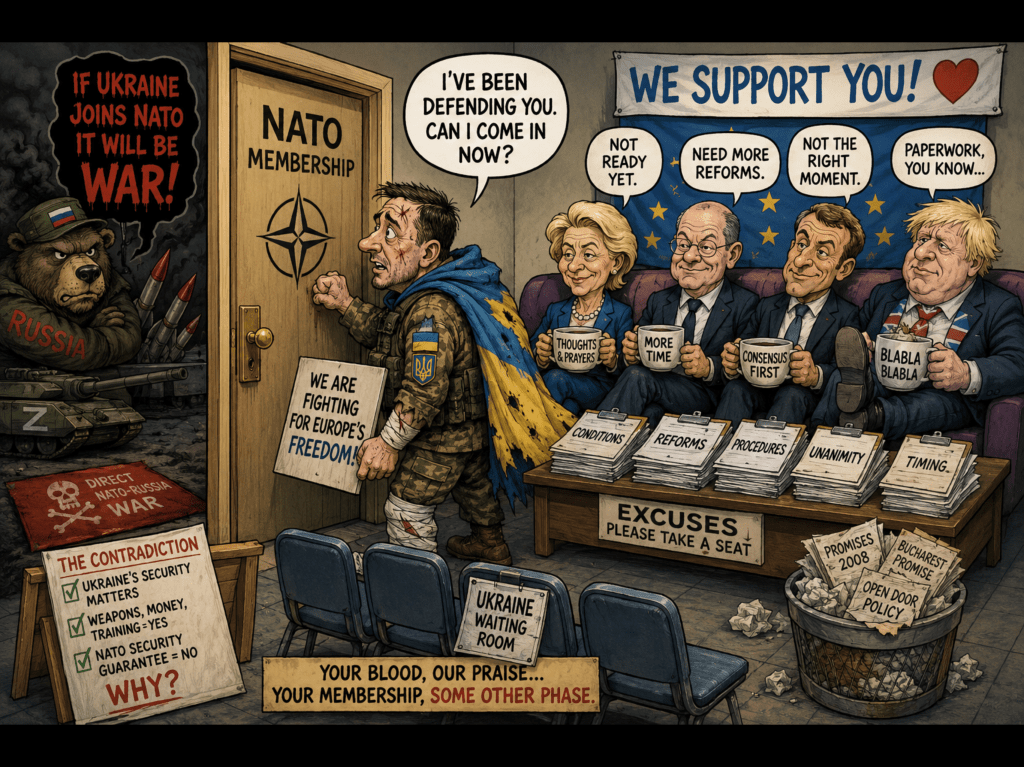
We keep hearing the respectable explanations for why Ukraine still isn’t safely inside NATO: procedures, conditions, reforms, consensus, timing and enough diplomatic vocabulary to wallpaper Brussels.
But there is one uncomfortable fact that deserves far more prominence: Russia has repeatedly warned that Ukrainian NATO membership crosses a red line, and Western governments plainly have to calculate the risk of a direct NATO-Russia war. 🚨
📋 Apparently the Tanks Are Waiting for the Forms to Be Processed
Nobody needs to pretend the formal obstacles are imaginary. NATO membership requires unanimous agreement, and admitting Ukraine while it is fighting Russia would raise an extraordinary question: what happens to NATO’s collective-defence commitment the moment Ukraine joins?
That’s not administrative trivia. That’s potentially nuclear-armed NATO and nuclear-armed Russia staring directly at one another.
And that is the contradiction critics should hammer. 🔨
Western leaders can say Ukraine’s security matters enormously. They can supply weapons, money and training. They can impose sanctions on Russia and insist Ukraine must be free to determine its own future.
But when the conversation reaches the security guarantee that could require NATO countries themselves to fight Russia, suddenly the temperature changes.
So spare us the illusion that this debate exists in some peaceful bureaucratic vacuum where everybody is merely waiting for the correct boxes to receive their little blue ticks. ☑️
Russia’s threats matter. The possibility of escalation matters. And European governments’ reluctance to trigger a direct NATO-Russia confrontation matters.
That doesn’t prove every other explanation is a lie. Ukraine’s EU membership is a separate process involving genuine accession requirements, while the UK isn’t even an EU member anymore. But when we’re talking about NATO membership during this war, pretending fear of a direct confrontation with Russia isn’t central to the calculation would be absurd.
Call it caution. Call it deterrence. Call it strategic ambiguity.
Just don’t hide the elephant behind a filing cabinet. 🐘🗄️
🔥 Challenges 🔥
If Ukraine is supposedly defending the security of Europe, how far should Europe actually be prepared to go to guarantee Ukraine’s security? That’s the uncomfortable question behind all the diplomatic language.
💬 Put your answer in the blog comments. Like it, share it, challenge it — but don’t settle for slogans from either side.
The best comments will be included in the magazine. 🎯📝


Leave a comment