💴🇬🇧🍾
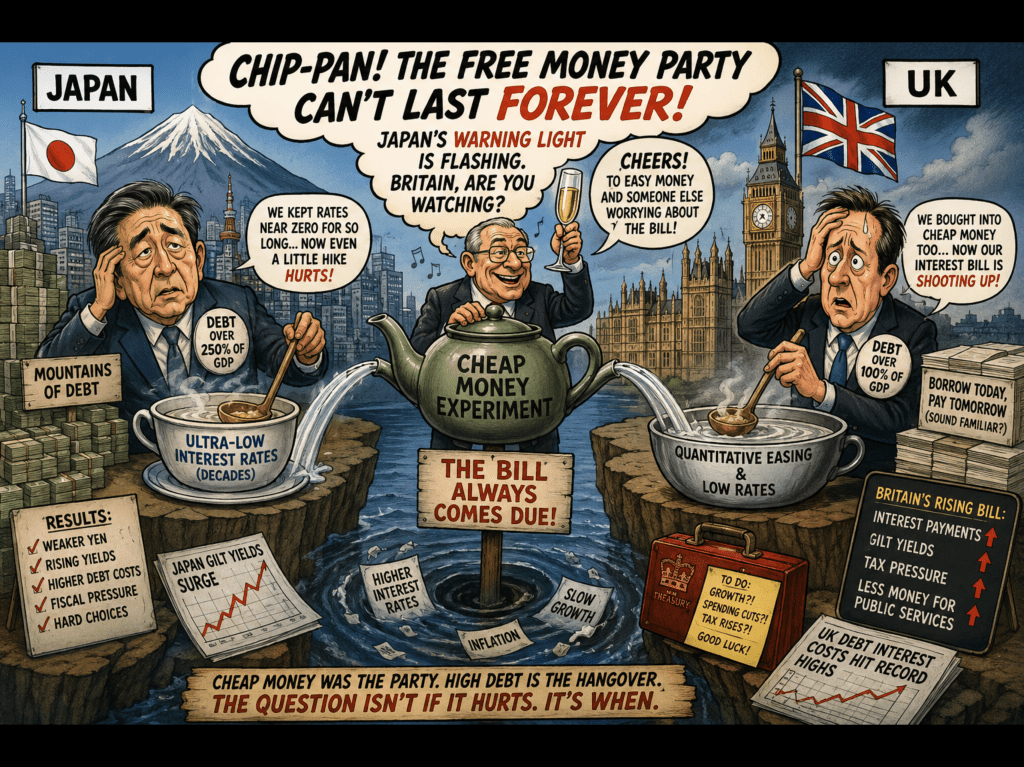
Japan may be discovering an awkward truth about economics: money can stay ridiculously cheap for years, but eventually somebody brings the bill.
After decades of ultra-low interest rates, enormous government borrowing and central-bank intervention, Japan is confronting the uncomfortable consequences of trying to move away from cheap money.
Britain should be watching very carefully.
Because while the UK hasn’t followed exactly the same economic path as Japan, it has enjoyed its own lengthy holiday from expensive borrowing. Governments became accustomed to low rates, debt accumulated, quantitative easing became part of the economic furniture—and borrowing billions started sounding considerably less frightening when financing it cost next to nothing. 💷🖨️
Then inflation arrived.
Interest rates rose.
Bond yields mattered again.
And suddenly the national credit card wasn’t offering the introductory rate anymore. 📈💳
💸 Tokyo Today, Westminster Tomorrow? Welcome to the Great Debt Reality Check
Japan is the extreme example of what happens when cheap money becomes embedded in an economy.
Britain’s version is different, but the underlying warning is remarkably familiar.
When interest rates are tiny, governments can carry enormous debts without the annual interest bill immediately eating the furniture.
Politicians can announce another few billion here, another emergency package there and another spending commitment somewhere else while assuring everybody that borrowing remains “affordable.”
Of course it was affordable.
The money was practically being rented out for the price of a library card. 📚💷
But borrowing £1 when interest rates are near zero is a very different proposition from continually refinancing enormous debts when market rates are substantially higher.
That’s where the Japanese experience becomes particularly interesting for Britain.
Japan spent decades demonstrating that a wealthy country with its own currency, a powerful central bank and deep domestic financial markets could sustain extraordinarily high government debt without immediately detonating.
The temptation was obvious:
If Japan can do it, perhaps debt isn’t really that frightening after all.
Except Japan may now be demonstrating the second half of the experiment—the bit nobody puts on the PowerPoint presentation.
Getting into the cheap-money world can be much easier than getting out. 🚪🔥
Britain doesn’t need Japanese levels of debt for the problem to hurt.
Higher borrowing costs mean more government revenue potentially disappears into servicing existing debt instead of hospitals, schools, defence, infrastructure or tax reductions.
That’s money taxpayers hand over without receiving a shiny new hospital, railway or aircraft carrier in return.
It’s essentially Britain’s increasingly expensive subscription to Things We Already Bought. 📦
And Westminster faces another awkward complication.
Britain’s governments have repeatedly promised voters combinations of better public services, economic growth, controlled taxation and responsible borrowing.
Lovely.
We’d also like a beachfront house in Birmingham. 🏖️🏠
Eventually arithmetic enters the room.
If economic growth remains weak while debt servicing stays expensive, politicians have fewer painless choices. Taxes can rise. Spending can fall. Borrowing can increase. Inflation can erode things quietly. Or governments can pray for growth to arrive wearing a cape.
None tends to look particularly attractive on an election leaflet.
Japan’s experience therefore shouldn’t be dismissed as some peculiar Tokyo economic laboratory.
It may instead be a postcard from further down the road:
“Dear Britain, cheap money was fantastic. Getting back to normal is proving slightly more complicated. Wish you were here. Actually, don’t come.” 🇯🇵📮🇬🇧
The real lesson isn’t that Britain is about to become Japan.
It is that low interest rates can disguise the political consequences of high debt for an extraordinarily long time.
Once money becomes expensive again, those consequences stop whispering.
They start sending invoices. 🧾💥
🔥 Challenges: Has Britain Built Its Own Cheap-Money Trap? 🔥
Here’s the question Westminster would probably prefer buried underneath seventeen consultations and a Treasury spreadsheet:
Did Britain mistake historically cheap borrowing for permanently cheap borrowing?
Japan pushed the experiment much further, but could Britain now be encountering its own version of the same problem—high debt, expensive refinancing, sluggish growth and politicians discovering there aren’t enough painless options left?
Or is comparing Britain with Japan economic doom-mongering, with growth and falling borrowing costs eventually making today’s worries look overblown?
💬 Drop your verdict in the blog comments: is Japan Britain’s warning from the future, or are these two economies simply too different for the comparison to hold?
👇 Comment, like and share this post. And send it to somebody who still thinks government borrowing is free money because “we owe it to ourselves.” 💷🔥
The best comments, arguments and economic truth bombs will be included in the magazine. 🎯📰


Leave a comment