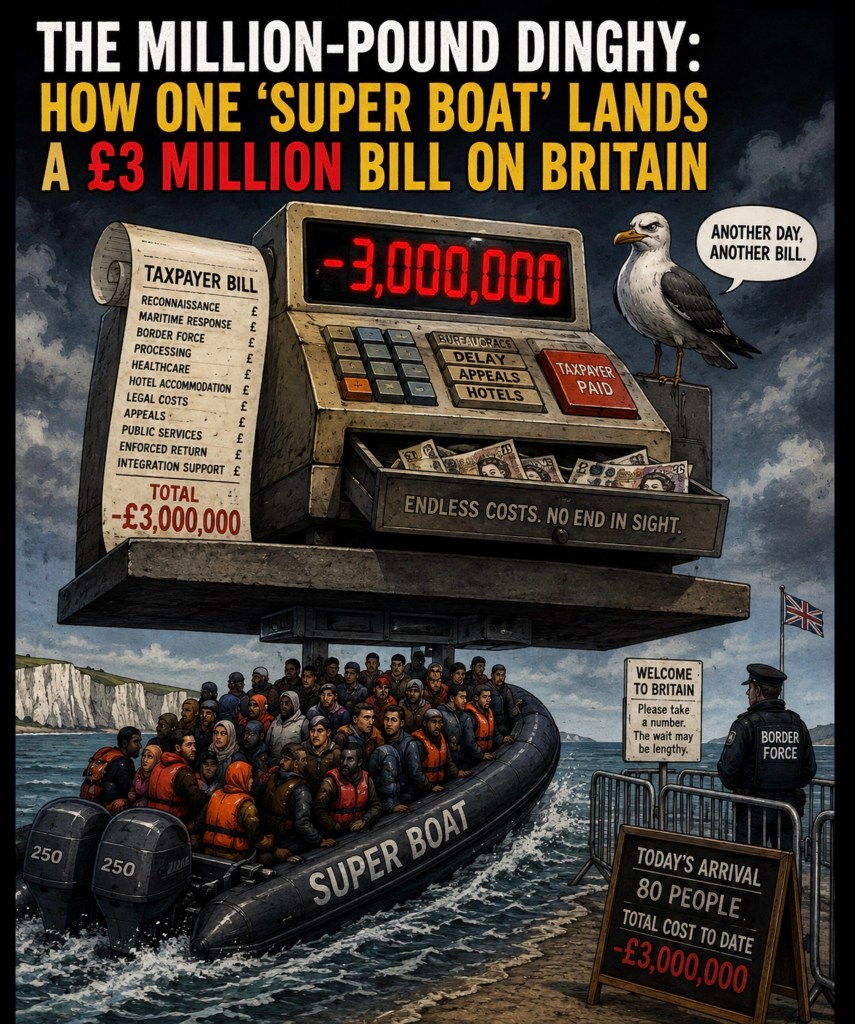
🚤💷DENTON BEACH, KENT — The dawn light has barely broken over the Dover Strait when a 40-foot semi-rigid inflatable boat scrapes onto the shingle carrying 80 men, women and children. Within minutes, the immediate danger of the Channel crossing is over. For the taxpayer, however, the journey has only just begun.
Long before the passengers have boarded the coaches waiting nearby, an enormous administrative machine is already in motion. Aircraft have tracked the vessel, maritime crews have been deployed, Border Force teams are waiting, contractors are standing by, processing facilities are preparing for arrivals and accommodation providers are ready to start invoicing.
The dinghy might be deflated and removed from the beach within hours. The bill attached to it can continue inflating for months or years.
💷 Welcome to Britain’s Most Expensive Rubber Boat
The first invoices arrive before anyone reaches a hotel. Surveillance aircraft and drones have tracked the crossing, maritime vessels have been deployed, Border Force staff have mobilised, shoreline reception teams are waiting and coaches are ready to move passengers into the processing system.
For a single large arrival, those first hours alone can burn through tens of thousands of pounds. Air and sea reconnaissance, maritime support, shoreline contractors and transport quickly turn what looks like a simple beach landing into a £45,000 opening act.
And that is before anyone has been medically assessed, processed, accommodated, legally represented or potentially removed from the country.
The extraordinary thing about the small-boats system is that the boat itself is probably one of the cheapest pieces of equipment involved.
🏨 The £144-a-Night Waiting Room
Once arrivals reach a processing facility, the administrative conveyor belt begins properly. Identity checks, biometric logging and health screening all require staff and infrastructure, while anyone requiring urgent treatment is transferred into an NHS system already under pressure.
Then comes one of the largest recurring expenses: temporary accommodation.
At approximately £144 per person per night, housing 80 people in hotels costs around £11,500 every twenty-four hours. Keep that group accommodated for a month and the hotel bill alone moves towards £350,000. Keep them there for several months while claims are processed and the arithmetic becomes considerably more dramatic.
The passengers are not receiving £144 each to spend on room service and champagne. The figure represents the cost of maintaining the accommodation system around them, much of it delivered through private contracts arranged under pressure.
This is where the state performs one of its favourite magic tricks: turning temporary emergency accommodation into a long-running industry.
⚖️ When a File Is Refused, It Doesn’t Necessarily Close
Processing an asylum claim is not simply a matter of stamping a form and sending somebody on their way. A refusal can trigger appeals, legal representation, tribunal hearings and additional months of accommodation while the case works its way through the system.
Instead of the file closing, it can expand.
That means more administration, more legal costs, more housing support and more public spending while a final decision remains unresolved. The longer the process takes, the greater the cost of maintaining the person inside it.
Britain has effectively developed a system where delay itself has a price tag.
Every unresolved claim becomes a running meter, and taxpayers continue paying while the bureaucracy decides whether somebody will ultimately stay or leave.
✈️ Even the Exit Door Comes With a £48,000 Invoice
If an asylum claim eventually fails, the spending does not necessarily end there. An enforced return can cost around £48,000 per person once flights, escorts, detention, administration and the wider removal process are included.
In other words, taxpayers may spend months funding accommodation and processing, only to receive another substantial bill at the moment the case finally reaches an unsuccessful conclusion.
If the person is granted asylum, the expense does not simply vanish either. Responsibility shifts towards housing, local authority support, benefits and community integration.
Either way, the dinghy has long since disappeared while the ledger keeps moving.
🧮 The £3 Million Question
Add together the opening maritime and aviation response, transport, processing, healthcare, hotel accommodation, legal costs, appeals, administration and the possibility of eventual removal or long-term integration, and the financial exposure generated by a single 80-person vessel can comfortably move beyond £3 million.
That is the part of the small-boats debate rarely captured by pictures of people stepping ashore.
The public sees a rubber boat.
The Treasury sees eighty individual administrative journeys, each capable of producing months or years of expenditure.
Perhaps the most astonishing feature is how quickly the system transitions from emergency response into permanent cost. Within minutes of the boat landing, a chain of government departments, contractors, legal services, hotels, health providers and local authorities becomes financially involved.
The boat is temporary. The bureaucracy is built for endurance.
🎪 Britain’s Immigration Industrial Conveyor Belt
There is something almost beautifully absurd about the scale of the machine.
A relatively inexpensive inflatable boat crosses the Channel and activates aircraft, cutters, lifeboats, coaches, processing centres, medical teams, hotel contracts, lawyers, tribunals, council services and potentially charter flights.
Somewhere in Whitehall, a spreadsheet opens and begins quietly screaming.
The obvious question is not whether vulnerable people should receive emergency assistance when they arrive. Of course they should.
The real question is why the system that follows has become so expensive, slow and dependent on temporary solutions.
Why are hotels required for so long? Why do claims become trapped in administrative backlogs? Why does removal cost tens of thousands of pounds? Why can a single boat arrival generate a bill that would comfortably fund substantial local services elsewhere?
The taxpayer is not simply paying for border control.
The taxpayer is paying for the consequences of a system that appears incapable of resolving cases quickly enough to stop temporary expenses becoming permanent ones.
📈 The Ledger Never Sleeps
Back on the Kent coast, workers eventually haul the empty inflatable from the beach. The engines are silent, the passengers are gone and the coaches have disappeared towards processing centres.
The physical evidence of the crossing is cleared away.
The financial evidence remains.
Hotel nights begin accumulating. Caseworkers begin processing. Legal clocks start ticking. NHS costs appear. Contractors invoice. Councils prepare for what happens next.
Then radar operators in Dover notice another group of signals moving slowly across the Channel.
The machinery resets.
The coaches start their engines.
And Britain’s taxpayer ledger begins another page. 💷🚤
🔥 Challenges: How Much Should One Boat Really Cost?
The argument isn’t whether people pulled from dangerous crossings should receive food, medical help and shelter. The question is whether Britain has built such a slow and expensive administrative system around asylum that every arrival becomes vastly more costly than it needs to be.
If one crowded dinghy can ultimately generate millions of pounds in public expenditure, where should the real focus be: stopping the boats, accelerating asylum decisions, reducing hotel dependency, cutting legal delays, reforming removals — or rebuilding the entire system from the ground up?
👇 Don’t just argue about the boat. Follow the money. Come to the blog and tell us where you think the real waste begins. 💬🔥
COMMENT, LIKE AND SHARE. Tell us whether Britain has an immigration problem, a bureaucracy problem, a spending problem — or all three welded together.
The best comments, sharpest calculations and most brutal observations will be included in the magazine. 🎯📰


Leave a comment