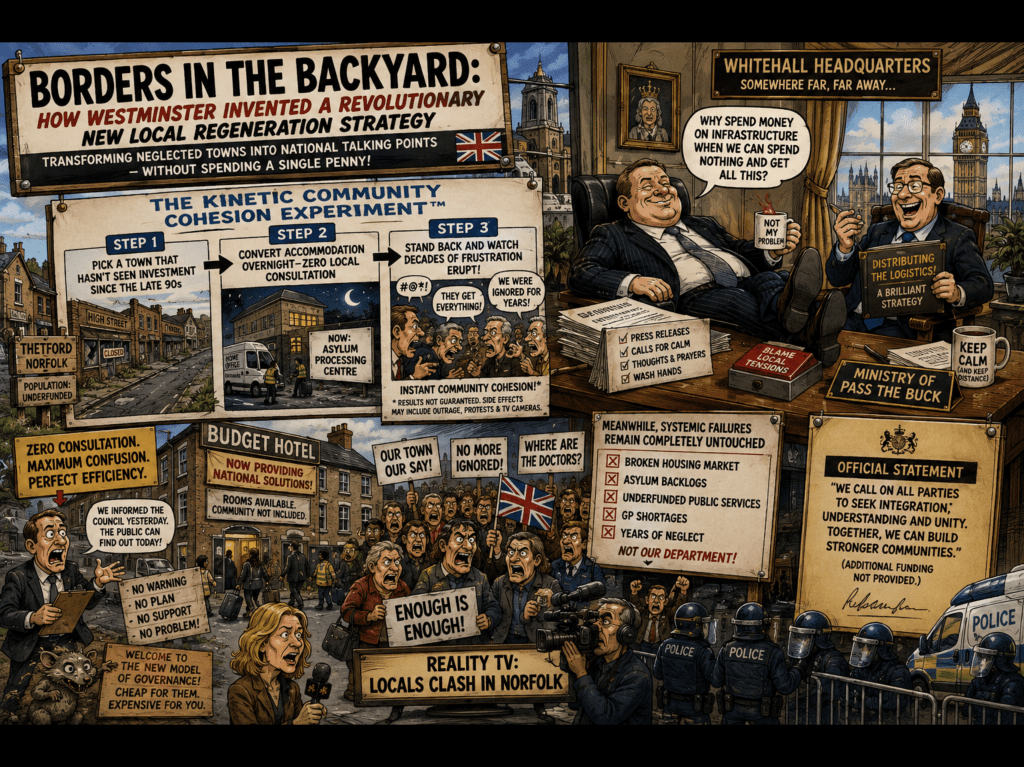
🏘️🏛️🔥THETFORD, NORFOLK — For decades, politicians have wrestled with one great question: how do you revive a neglected town without actually spending much money on it?
You could build affordable housing, improve transport, expand GP services and support local councils. Unfortunately, all of that involves investment.
Westminster appears to have discovered a cheaper alternative: take a complicated national problem, drop its consequences into a local community, then express concern when everyone starts arguing.
Welcome to The Kinetic Community Cohesion Experiment™.
🏛️ Westminster’s Problem-Delivery Service
Asylum seekers need safe accommodation while their claims are considered, but housing people also affects healthcare, policing, transport and local services. That requires planning, funding and communication.
The problem is that consultation creates questions. Residents ask how many people are arriving, how long they will stay, what extra support is coming and whether services can cope. Councils may even ask Westminster to pay for something.
Far easier to deliver the policy first and explain later.
Imagine the label: “Recipient: Thetford. Contents: One complicated national political problem. Please resolve locally.” 📦
🏚️ The Town Was Already Under Pressure
Communities do not suddenly develop housing shortages, weak public services and economic frustration because asylum seekers arrive. Those problems often existed already.
But when extra demand is introduced without enough explanation or visible support, people focus on what they can see. The people they can see are not the officials who made the policy. They are the newcomers.
That is how a national administrative failure becomes a local social conflict. The asylum seeker becomes the face of problems they did not create, while Westminster quietly disappears from the picture.
📱 Never Leave an Information Vacuum Near Facebook
When official communication is slow, social media fills the gap.
One rumour becomes ten. Numbers grow. Facts blur. Before long, somebody’s cousin’s neighbour allegedly knows everything about secret plans, free cars and luxury accommodation.
That is why consultation matters. Clear information does not solve every disagreement, but it makes misinformation harder to weaponise.
🚨 Protest the Policy, Not the People
Residents have every right to oppose asylum policy, protest peacefully, demand answers and challenge politicians.
But asylum seekers did not create Britain’s housing shortage, design the immigration system, award accommodation contracts or decide where they would be placed.
If your complaint is with Westminster, targeting people in temporary accommodation is like protesting against an online retailer by punching the parcel.
Wrong address. 📦
💷 Why Solve a Problem When You Can Manage It Forever?
When asylum decisions take too long, people stay in temporary accommodation longer. That creates more contracts, administration, security, transport and local pressure.
Eventually, Britain risks building an entire industry around managing the consequences of a system that is not resolving cases fast enough.
It is like responding to a leaking roof by hiring fifty people with buckets instead of repairing the roof. 🪣🏠
A functioning system should make fair decisions within reasonable timescales, move successful applicants into ordinary life and deal lawfully with failed claims. Endless limbo helps nobody.
🎪 Locals Versus Migrants: The Perfect Television Format
Once tensions rise, television cameras arrive. Residents become “furious locals,” asylum seekers become “controversial arrivals,” police become “the thin blue line,” and Westminster suddenly becomes the sensible adult calling for calm.
That is quite a transformation.
The institution responsible for national immigration policy gets to referee the dispute created partly by the consequences of that same policy.
Meanwhile, the harder questions disappear. Why were services already stretched? Why was housing already scarce? Why are councils struggling? What extra support should communities receive when national responsibilities are placed on them?
Those questions require money and long-term planning. Angry crowds make much better television.
🎭 The Real Political Trick
Neglected communities and asylum seekers are not natural enemies. Both need safe housing, functioning services and competent government.
But when resources feel scarce, people start fighting over what remains. The argument shifts from why there is not enough to who deserves the little that is left.
That is where policy failure becomes politically useful. Westminster can call for tolerance while avoiding the more expensive debate about housing, infrastructure, council funding and asylum processing.
🏆 The Kinetic Community Cohesion Experiment™
So perhaps this is Britain’s cheapest regeneration strategy yet.
Do not repair the high street. Do not expand healthcare. Do not build enough housing. Simply introduce a politically explosive national issue into an already pressured town, provide too little explanation and wait for the cameras.
Suddenly everybody knows where Thetford is.
A structural national problem becomes a local behavioural problem, and Westminster gets to present itself as the referee rather than the architect.
It is not regeneration. It is the outsourcing of consequences.
🔥 Challenges: Are We Fighting the Wrong People?
The real question is not whether residents are allowed concerns or whether asylum seekers deserve safety. Both are true.
The question is what Westminster owes a town when it expects that town to carry part of a national responsibility.
Should asylum accommodation come with proper consultation, clear information and extra funding for local services? And have years of frustration over housing and public services been redirected towards people who did not create the underlying problems?
👇 Bring the argument to the blog and tell us whether Westminster is solving Britain’s problems — or simply changing their postcode. 💬🔥
COMMENT, LIKE AND SHARE. Challenge the policy, challenge the article or challenge each other — but aim the argument at the decisions, not the people caught in the middle.
The best comments and sharpest responses will be included in the magazine. 🎯📰


Leave a comment