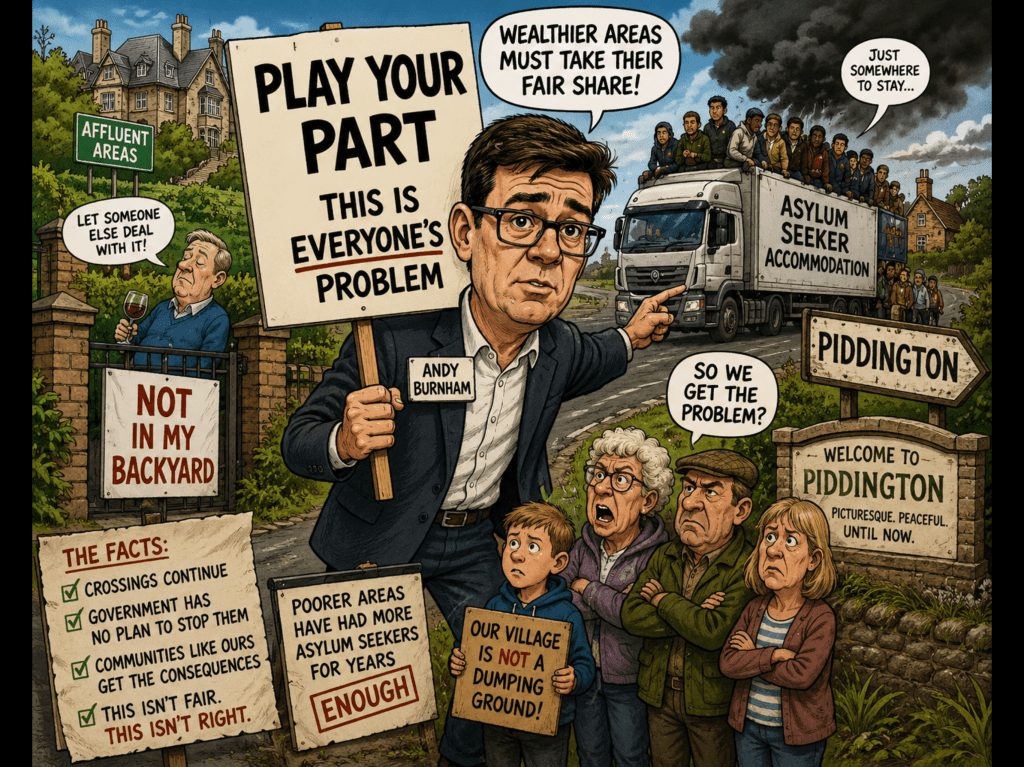
🚤🏡Andy Burnham’s message to Britain’s better-off communities is becoming clearer: asylum accommodation cannot keep being concentrated in poorer areas, so wealthier and middle-class communities will have to “play their part.” His comments came amid the row over plans to accommodate asylum seekers at a former military site near tiny Piddington in Oxfordshire. (The Times)
And that produces one almighty political question: whose neighbourhood gets volunteered? 🤔
Burnham’s argument is not actually new. Back in 2018, he complained that Greater Manchester was carrying an unfair share of asylum dispersal, saying some towns had more asylum seekers concentrated in a handful of wards than entire regions elsewhere. (The Guardian)
So accusing him simply of suddenly discovering “fair shares” would miss an important bit of history.
🏡 Welcome to the Great British Game of Pass the Asylum Accommodation
Piddington is the sort of tiny rural community where plans for large-scale asylum accommodation are hardly going to slip unnoticed between the parish newsletter and the village fête.
Reports say proposals concern accommodation for up to 1,250 single male asylum seekers at a nearby former Ministry of Defence site, prompting fierce opposition from residents who argue that the area lacks the infrastructure for something on that scale. (The Times)
Burnham’s answer is effectively that poorer communities cannot remain the default destination and that more prosperous areas must shoulder some of the responsibility too. (GB News)
Fair enough as a principle.
But here’s where the political microscope comes out. 🔬
Burnham has long been publicly associated with the Leigh/Warrington area; recent reporting has described his home as being in Warrington, while biographical material has historically described him as living in Leigh. There is no public-interest reason to publish a private street address. (Reuters Connect)
The much more legitimate question is this:
Are communities comparable to those in which senior politicians themselves live being asked to “play their part” on anything resembling the same scale?
Because “fair distribution” only really means something if it survives contact with the distribution map. 🗺️
If Piddington must accept that national pressures can arrive on its doorstep, then voters are entitled to ask whether prosperous suburbs, desirable commuter settlements and politicians’ own broader communities are receiving proportionate accommodation too.
And there is another uncomfortable question sitting underneath the argument.
The Government is under intense pressure over continuing small-boat crossings, and Burnham has promised a change in strategy rather than offering a timetable for ending them. (The Sun)
So for residents, “play your part” may sound less like an immigration strategy and more like a distribution strategy for the consequences of an immigration system the Government has yet to bring under control. 🚤➡️🏘️
That distinction matters.
You can believe poorer towns have carried too much of the burden and believe that dumping disproportionately large accommodation schemes into tiny communities isn’t a sensible solution.
Those positions aren’t contradictory.
Perhaps the real test of Burnham’s policy should therefore be wonderfully simple:
Publish the numbers.
Show asylum accommodation by local authority and deprivation level. Show how poorer, middle-income and affluent communities compare. Show whether politically powerful areas are taking their share. And show voters what “fair” actually means rather than asking them to applaud the slogan. 📊
🔥Challenges🔥
If Piddington has to “play its part”, who decides what that part should be—and should the same rule apply equally to the communities where Britain’s political class lives?
That’s the debate worth having.
Not abuse of asylum seekers. Not publishing politicians’ private addresses. Not another shouting match where everybody goes home convinced they won.
Show us the numbers and let the public judge whether the burden really is being shared fairly.
👇 Comment on the blog, like the post and share it. Tell us whether Piddington is being asked for a fair share—or being handed somebody else’s unsolved problem. 💬🔥
The best comments will be included in the magazine. 🎯📝


Leave a comment