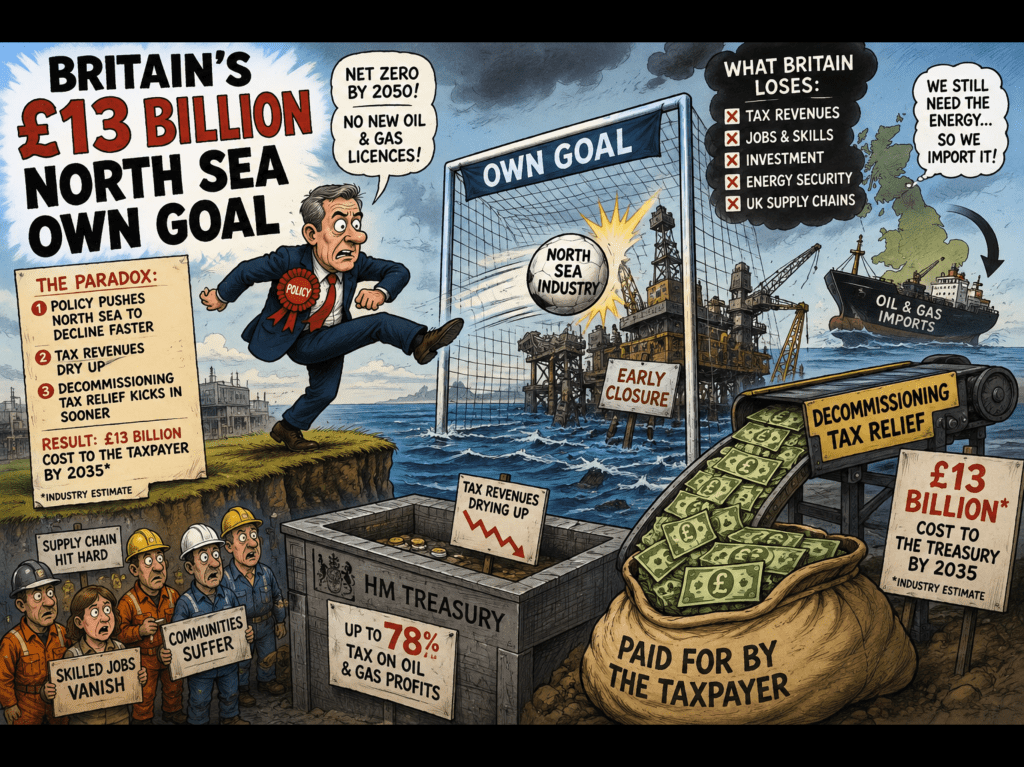
The North Sea still matters to Britain.
It supports thousands of skilled jobs, generates billions in economic activity, and — when profitable — is taxed at up to 78%, including the Energy Profits Levy.
But it is also a declining basin, and how Britain manages that decline has major fiscal consequences.
Because when production ends, the costs do not.
Wells must be plugged, platforms dismantled, and pipelines removed. Decommissioning is unavoidable, and the UK tax system provides significant relief on those costs, including through Decommissioning Relief Deeds that guarantee minimum levels of support. (GOV.UK)
The concern is what happens if policy accelerates the North Sea’s decline.
Earlier closure means:
- Less tax revenue from remaining production
- Lost investment and supply-chain activity
- Fewer high-skilled jobs
- Earlier and larger decommissioning liabilities
- Greater reliance on imported oil and gas
And imports do not eliminate demand — they simply shift production abroad, along with the associated jobs, investment, and emissions.
According to industry estimates, the combined effect of lost tax receipts and decommissioning relief could cost the Treasury around £13 billion between now and 2035. (The Telegraph)
This is not an argument against energy transition. The North Sea will decline regardless, and the UK will ultimately move to other sources of energy.
The question is timing.
Shutting domestic production before replacement capacity is ready does not reduce demand — it displaces it. The tanker still arrives, the gas is still burned, but the economic value is captured elsewhere.
There is also a structural risk: North Sea infrastructure is interconnected. Once major assets are removed, smaller fields can become uneconomic, meaning opportunities are permanently lost. Decommissioning is not easily reversible.
That is why the key issue is not whether the North Sea ends, but how it ends.
A managed transition would:
- Maximise remaining tax revenues
- Maintain viable production for longer
- Preserve infrastructure and skills
- Scale alternatives like wind, nuclear, and storage in parallel
- Reduce output only as replacements become capable of meeting demand
That is a transition.
Closing domestic production while continuing to consume the same energy is not.
It is simply shifting the “postcode” of production.
And if Britain ends up having paid billions in lost tax revenue, billions in decommissioning support, and billions more for imported energy — all while dismantling a functioning domestic industry — future taxpayers may ask a simple question:
What exactly did we achieve?


Leave a comment