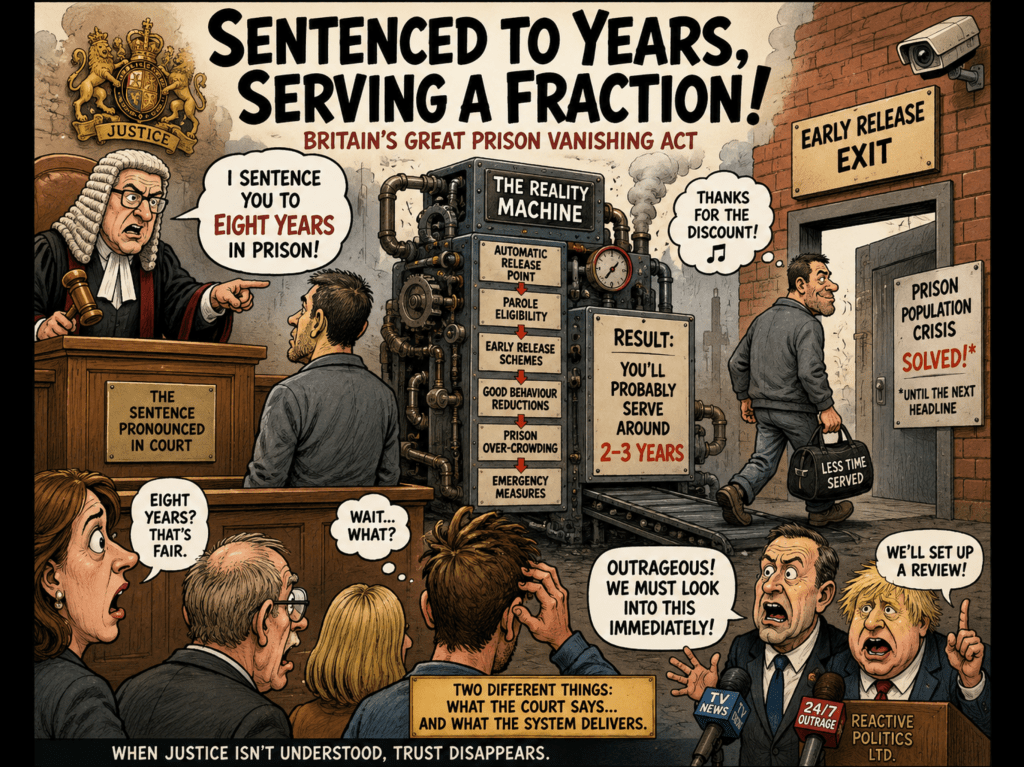
⚖️🚪Britain has managed a remarkable linguistic trick: a judge can pronounce one sentence in court while the prison system delivers something considerably shorter. The public hears “six years” and, quite reasonably, imagines something resembling six years. But sentencing rules, automatic release provisions, parole eligibility and early-release schemes can make the reality far more complicated.
Then a notorious offender approaches release, everyone notices, politicians discover television studios, and Westminster reacts as though this mysterious system arrived overnight in an unmarked van. 🚨📺
🎩 Welcome to Britain’s Department of Elastic Sentences
There is a legitimate reason for supervised release: rehabilitation and managing an offender’s return to society can be safer than simply opening the prison gate at the very end of a sentence with no supervision whatsoever.
But that sensible principle doesn’t excuse incomprehensible sentencing.
If a court says “eight years”, ordinary people assume eight years means eight years. They don’t naturally translate it as: “eight years, subject to statutory release arrangements, licence conditions, possible recall and whatever emergency prison-capacity policy happens to be operating by Thursday.” 🤹♂️⚖️
That gap between the headline sentence and the time actually spent behind bars is where public confidence goes to die.
And politicians have an extraordinary habit of noticing the problem only when an especially infamous prisoner becomes tomorrow’s headline.
Suddenly: outrage! 😱
Suddenly: reviews! 📋
Suddenly: ministers promising that THIS TIME sentences will mean something!
Meanwhile, the less famous cases continue without a camera crew outside the prison gates.
The serious question isn’t whether every offender should serve every second behind bars. It’s whether the punishment being imposed is explained honestly enough that victims, offenders and the public understand what the sentence actually means.
Because if “ten years” doesn’t ordinarily mean ten years in prison, perhaps courts should stop allowing the public to believe that it does.
Call it ten years including licence. State the expected custodial period. Explain what can alter it. Put the reality in language that doesn’t require a criminal-law textbook and three government websites to decipher. 📚🔍
A justice system shouldn’t need a notorious prisoner to expose how its own arithmetic works.
🔥 Challenges: What Should a Sentence Actually Mean?
Here’s the uncomfortable question: when a judge announces a prison sentence, should the public be told there and then exactly how much of it will normally be served behind bars?
And if early release is necessary because prisons are overcrowded, should governments say that plainly rather than waiting for the next notorious case to trigger another outbreak of ministerial outrage? 🏛️🔥
👇 Tell us in the blog comments: should prisoners normally serve the full sentence announced in court, or should courts simply become much clearer about what that sentence really means?
Comment. Like. Share. And bring your strongest argument — agreement isn’t compulsory. 💬⚖️🔥
The best comments will be included in the magazine. 🎯📰


Leave a Reply